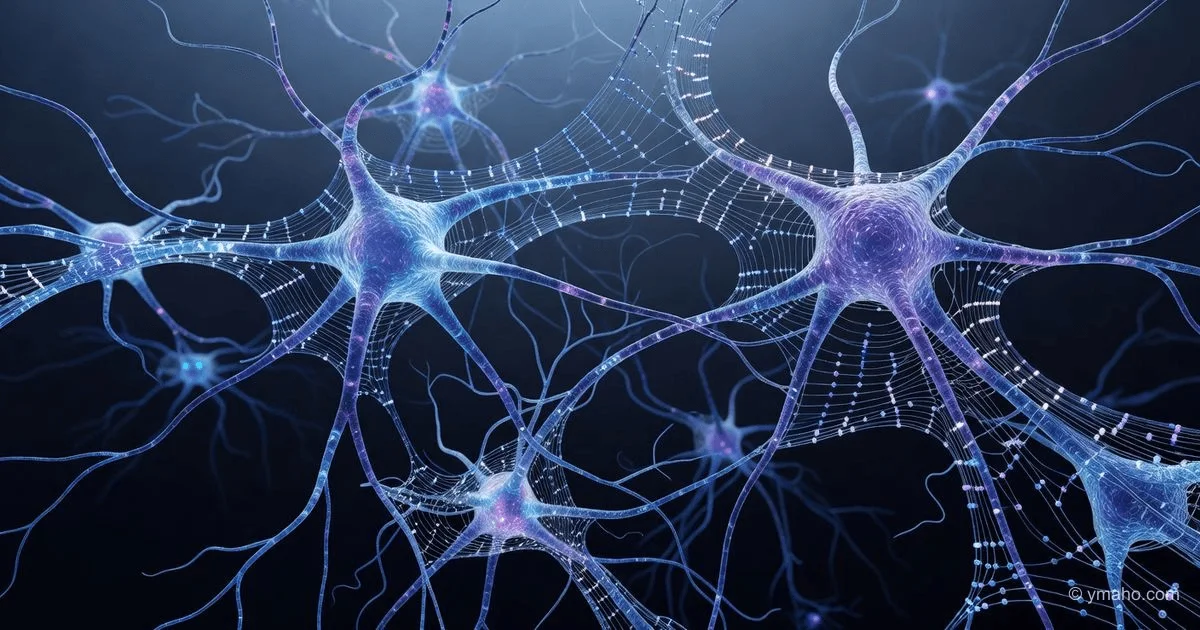
Nature Electronics: 3D Interface Created for Direct Connection of Electronics with Brain Cells
Scientists at Princeton University have created the 3D-MIND device, which integrates living neurons with flexible electronics, paving the way for energy-efficient biocomputers and treatments for neurological diseases.
[The Gist]: What's Really Happening
In reality, the publication in Nature Electronics is not just "another neural interface." It demonstrates that the architectural problem that has separated living tissue and silicon for decades has finally been solved. The team of Tian-Ming Fu and James Sturm at Princeton has shown the 3D-MIND device, which does not pierce neurons with rigid needles or place a flat electrode array underneath them, but instead grows into a three-dimensional neural network from within.
The key technological move is the "inside-out architecture." Instead of growing an organoid and trying to insert sensors from the outside, the researchers first create a flexible three-dimensional scaffold of microelectrodes coated with epoxy resin that has the mechanical properties of brain tissue, and then seed it with neurons. The cells weave around this scaffold, grow through it, and form a full volumetric network where each electrode ends up not on the outside, but inside a living computing environment.
Why is this happening now? Because the AI industry has hit an energy ceiling. According to the International Energy Agency, data centers in 2026 will exceed 1,000 TWh of consumption—comparable to the annual energy use of the entire country of Japan. The human brain performs computations of comparable complexity while consuming about 20 watts. 3D-MIND is a direct response to this crisis: not to simulate the brain on silicon, but to use the biological substrate itself as a computing environment.
Timeline and Context
The story didn't start today. Back in 2022, the Australian company Cortical Labs demonstrated DishBrain—800,000 neurons in a flat Petri dish that learned to play Pong in five minutes. However, DishBrain was fundamentally limited by its two-dimensional geometry: neurons lay on a flat array, and 90% of the signals within the network remained invisible to the electronics.
Key milestones on the path to 3D-MIND are as follows: in November 2025, the Princeton team presented preliminary results at the MRS Fall Meeting, where they first reported a 17% superiority of the 3D architecture over 2D in classification tasks. The publication in Nature Electronics came out on April 23-27, 2026. And today, May 8, 2026, the 3D neuroscience market is valued by analysts at $1.71 billion, with a projected growth to $2.95 billion by 2030 at a CAGR of 14.5%.
In parallel, and importantly, MIT in November 2025 presented the miBrains platform—a customizable 3D model of brain tissue with six cell types. Together with 3D-MIND, these two developments create a closed loop: miBrains provides physiologically relevant tissue, and 3D-MIND provides an interface for long-term reading and stimulation. The industry has been waiting for this loop for at least five years.
Who Wins and Who Loses
Winners:
- The Princeton group and personally Tian-Ming Fu: the patent on the "flexible 3D mesh inside a living network" architecture is a potential industry standard for the next decade. If Princeton files a US patent application before September 2026, licensing royalties from any biocomputer built on this scheme could be 3–5% of the device price.
- Pharma companies with neuroscience focus (Biogen, Roche, Lundbeck): 3D-MIND allows observing the effect of a drug on a neural network not for hours, but for six months. This reduces the preclinical testing phase for neuro-drugs by 30–40%. With an average cost of bringing one neuroscience drug to market at $2.5 billion, this means savings in the hundreds of millions.
- Neurodegeneration researchers: the platform allows modeling the development of neural circuits in a controlled environment and tracking their degradation in Alzheimer's or Parkinson's disease. Given that the NIH projects the number of dementia patients in the US will double to 13.8 million by 2060, any accelerated screening of therapies is a billion-dollar market.
Losers:
- Manufacturers of flat MEA systems (Multi-Electrode Array): companies like Axion Biosystems and MaxWell Biosystems have sold planar electrode arrays for $50,000–$150,000 per unit for decades. 3D-MIND makes their technology obsolete, as flat arrays are physically incapable of reading activity inside a three-dimensional network.
- NVIDIA and AI accelerator manufacturers in the long term: if biocomputers reach the level of "wetware" capable of pattern classification with energy consumption 1/1,000,000 of a silicon chip, today's GPU data center boom will be called into question. This is not an immediate threat, but a signal for strategic planning.
- Startups that invested in the old DishBrain paradigm: companies that, after Cortical Labs' success, began building platforms on 2D neurocomputing will now face the need for a complete architectural overhaul. Investors who have poured over $50 million collectively into such startups may demand a pivot or merger.
What the Media Isn't Saying
Press releases tout "six months of stable operation" as a triumph. But six months is precisely the threshold beyond which degradation begins even under ideal conditions. Cells in 3D-MIND require a constant supply of oxygen and nutrients through microfluidics, as well as removal of metabolic waste. The paper mentions that the team is working on integrating microfluidic channels, but the current version of the device still requires an external life support system. Without built-in microfluidics, scaling to practically useful biocomputers is impossible—larger organoids will simply die from hypoxia in the center of the network.
The second point: signal-to-noise ratio. 3D-MIND reads action potentials with high resolution, but the bioelectrical signal of neurons is microcurrents in a medium saturated with ionic noise. The more electrodes embedded in the network, the harder it is to filter the useful signal from spontaneous background activity of the culture. The paper doesn't say this explicitly, but from the engineering context it's clear: the denoising algorithms that Fu's team used to achieve the claimed classification accuracy could become a bottleneck when scaling.
And finally, an insider observation: 3D-MIND uses hippocampal neurons from rat embryos. This is the gold standard for prototyping. But for commercial biocomputing, either human neurons (iPSC-derived) or stable cell lines that do not require sacrificing laboratory animals will be needed. The transition to iPSCs is a separate engineering challenge: induced neurons are less electrically active and form long-term potentiation less effectively. If this transition is not made, the FDA will never approve such a platform for clinical use in drug testing.
Forecast: Next 30 Days and 90 Days
Next 30 days (until June 7, 2026):
Princeton will announce the creation of a spin-off company to commercialize 3D-MIND. Likely names: NeuroMesh Technologies or MindWire. The first round of funding (seed) will be $15–20 million from venture capital firms specializing in deep tech—likely candidates: Lux Capital, The Engine (MIT), and DCVC. In parallel, Nature Electronics will receive a wave of citations, and the editorial board will likely commission a review article on bio-hybrid computing by August.
Next 90 days (until August 7, 2026):
Closed-door negotiations with the FDA will begin regarding the regulatory pathway for using 3D-MIND as a preclinical drug testing platform. Since the device is not implanted in humans but used in vitro, the pathway will go through the Research Use Only (RUO) category, followed by certification as Class II laboratory equipment. In parallel, Fu's team will present the first results of integrating microfluidics with 3D-MIND—if this happens before August, the platform's scalability will be confirmed, and the spin-off's valuation will jump to $80–100 million.
Long-term—by the end of 2026—the 3D neuroscience market will approach $1.9 billion, and every significant academic achievement in this field will be perceived not as fundamental science, but as a potential product. The Princeton group has just opened a door behind which laboratory neurobiology and the computing industry cease to be separate worlds.
— Editorial Team









