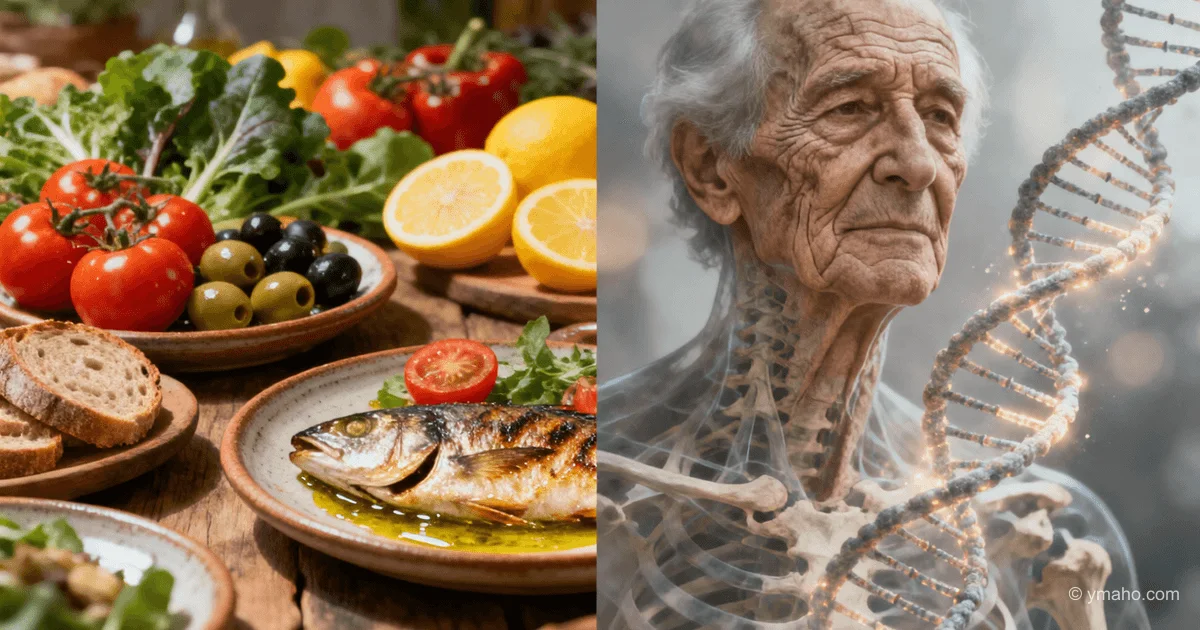
Large-Scale Study: 5 Popular Diets That Extend Life by Up to 4 Years
Scientists analyzed data from over 100,000 people over 10 years and found that eating patterns such as DASH, the Mediterranean diet, and other plant-based diets can increase life expectancy by up to 4.3 years due to high fiber content and limited sugar. The key is the overall principle, not a strict choice of a specific diet.
The Gist: What's Really Happening
At first glance, it's just another study on the "benefits of a healthy lifestyle." But look deeper. The work was published not just anywhere, but in Science Advances. The sample: 103,000 people, observation period 10 years, linking diet to 19 longevity genes. The numbers for AHEI-2010: +4.3 years for men, +3.2 for women. This is not a correlation like "eat salad — live longer." This is data that could reshape the wellness industry map.
In reality, two powerful trends are colliding: "clean food" as medicine versus "pill from the shelf." And while everyone discusses diets, the real battle is for the consumer's wallet, who wants to buy themselves extra years of life.
Timeline and Context
February 2026. Publication of the UK Biobank study in Science Advances. A news event that sends ripples.
March 2026. Women's and mass media pick it up: Women's Health releases an adapted version for the 35+ audience. The narrative forms: "Changing your diet after 45 is not too late."
April 2026. FMI publishes a forecast: the plant-based food market will grow from $15.9 billion in 2026 to $49.5 billion by 2036. Longevity studies are instantly converted into market analytics.
May 2026. Beyond Meat publishes its Q1 CY2026 report: revenue $58.21 million — a drop of 15.3% year-over-year, shares plummet. The "plant-based meat" producer sinks while scientific journals prove that plant-based food extends life. A paradox.
Who Wins and Who Loses
Winners:
- Whole Foods and "clean" retailers. When science says "eat whole grains, fruits, and vegetables," that means traffic to fresh produce aisles, not frozen food sections.
- Longevity supplement manufacturers. The longevity supplements market: $9.67 billion in 2026, forecast $14.29 billion by 2030. NAD+, polyphenols, omega-3 — consumers will buy the "concentrate" of a diet in a capsule.
- Personalized nutrition services. Nutrigenomics and genetic tests gain scientific backing: the study accounted for 19 longevity genes.
Losers:
- Beyond Meat and its peers. The plant-based meat market is declining; the company lost 19.5% of sales volume in Q1 2026. Reason: the study praises whole foods, not ultra-processed bacon imitations.
- Dairy industry (in the long run). A Dutch study shows that to achieve 50% plant-based protein, meat and dairy consumption must be reduced. They maintain the status quo for now, but the trend is against them.
- Pharmaceutical diets. Wegovy, Ozempic, Mounjaro — weight loss drugs that divert attention from "food as the cause." The new study brings the focus back to diet.
What the Media Isn't Saying
1. The study was funded by entities interested in selling food, not drugs.
The formal sponsor is UK Biobank. But look at who is republishing and citing: Women's Health (owned by Hearst), Prevention, Research and Markets. This is a media-analytics complex serving the food and wellness industries. The result "food extends life" perfectly fits retailers' advertising contracts.
2. "Whole foods" is an anti-Beyond Meat manifesto.
The study praises fruits, vegetables, whole grains. Not a word about pea protein or soy heme iron. But ultra-processing is the core of Beyond Meat's and Impossible Foods' portfolios. Headlines like "plant-based is healthy" are misleading: science defends not everything, but specifically whole foods. Beyond Meat with its 15.3% revenue drop is living proof of the gap between the scientific trend and consumer demand for "fast plant-based."
3. The genetic factor is practically irrelevant. This is a bomb for insurance companies.
The researchers stated outright: adherence to a healthy diet reduces mortality regardless of longevity genes. This means lifestyle outweighs heredity. For insurance companies, it's a signal: actuarial models based on family history are becoming obsolete. Soon a new class of policies will emerge, offering discounts not for a DNA test, but for a subscription to a Mediterranean diet and grocery receipts.
4. The supplement market growth to $14.29 billion by 2030 capitalizes on the fear that "I can't eat right."
People learned that AHEI-2010 gives +4.3 years. But sticking to the diet is hard. The market responds: "Buy our NMN, NAD+, and polyphenols. Get the same 4 years without the hassle of cooking." This is a hedging strategy: science proves the power of food, but profits go to those selling "food in a pill."
Forecast: Next 30 Days and 90 Days
30 days (until June 8, 2026)
Healthy food retailers will launch "Diet Score" marketing campaigns — calculators to measure how well a diet aligns with AHEI-2010 principles. Whole Foods, Erewhon, Dutch Albert Heijn — expect branded shelves saying "Approved by the UK Biobank study." Supplement manufacturers will update packaging: the word "longevity" will be replaced by "science-backed diet support." Beyond Meat shares will continue to fall below $0.90 each, analysts will talk about delisting from NASDAQ.
90 days (until August 7, 2026)
The first app calculating "biological age" based on photos of supermarket receipts will appear. A major insurer (likely European — Allianz or AXA) will announce a pilot discount program for customers adhering to AHEI-2010 principles. The Dutch government will use the UK Biobank study as an argument to accelerate the "50% plant-based protein by 2030" plan. And most importantly, at industry conferences like the Food & Nutrition Conference & Expo, the term "longevity diet prescription" will be heard for the first time, and the FDA will begin informal consultations on the possibility of labeling products "approved for longevity."
— Editorial Team









