Mechanism of Overcoming Drug Resistance in Head and Neck Cancer Revealed
Researchers have shown that the compound b-AP15 sensitizes head and neck squamous cell carcinoma cells to TRAIL-induced cell death through the generation of reactive oxygen species and activation of JNK signaling, opening new avenues for combination therapy.
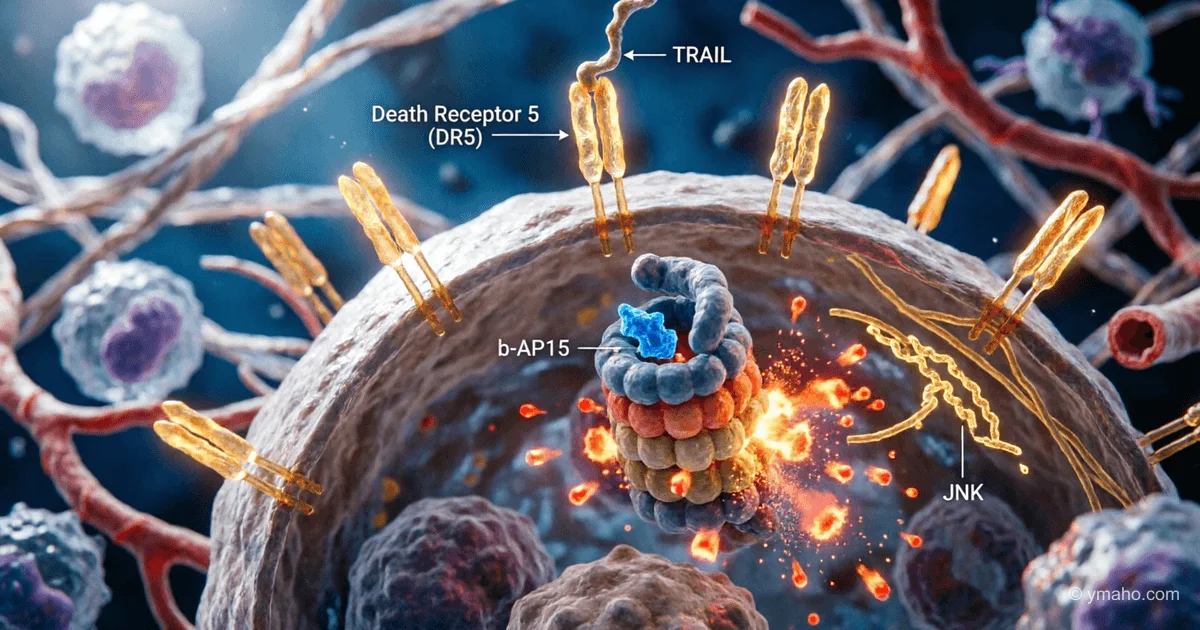
Countdown for resistant cells: how the combination of b-AP15 and TRAIL restarts the cancer self-destruction mechanism
Introduction
Head and neck squamous cell carcinoma (HNSCC) ranks seventh in prevalence among all cancers worldwide, causing over 900,000 new cases and about 450,000 deaths annually. Despite aggressive treatment protocols including surgery, chemotherapy, and radiotherapy, the five-year survival rate for HPV-negative subtypes ranges from 28.8% to 58.7% depending on tumor location. One of the main obstacles to cure remains the activation of the NFκB signaling pathway, which endows cancer cells with the ability to resist cytotoxic therapy. Direct inhibition of NFκB is associated with high systemic toxicity, forcing researchers to seek more refined tools. A breakthrough study by an international team of scientists, published in the journal Cancer Gene Therapy in May 2026, offers an elegant solution: using the compound b-AP15, the researchers were able not only to weaken the tumor's defenses but also to reprogram its internal signaling pathways, making it vulnerable to a selective and safe agent—the TRAIL protein.
Event Details and Timeline
The study, whose results were published on May 2, 2026, is an in-depth preclinical investigation of the mechanisms of action of the deubiquitinase inhibitor b-AP15. Previously, the same research group showed that b-AP15 targets the enzymes USP14 and UCHL5, disrupting proteasome function and preventing the degradation of the NFκB inhibitor protein IκBα. This blocks the translocation of the RelA subunit into the cell nucleus, effectively turning off the pro-inflammatory and anti-apoptotic program driven by NFκB.
In the new study, the scientists went further, testing whether b-AP15 could make HNSCC cells sensitive to TRAIL—a member of the tumor necrosis factor family that selectively triggers apoptosis in cancer cells with minimal impact on healthy tissues. Experiments on a panel of HNSCC cell lines, including both HPV-negative and HPV-positive samples, showed that b-AP15 treatment dose-dependently increased the expression of the TRAIL receptor DR5 at both mRNA and protein levels, increasing its density on the cell surface.
Methodologically, the work relied on a comprehensive approach: from flow cytometry to measure cell death levels to gene silencing using siRNA to confirm the functional role of each element of the signaling cascade. The combination of b-AP15 and TRAIL showed a Combination Index of less than 0.6 in all tested lines, statistically confirming synergy—the mutual enhancement of the two agents.
In chronological perspective, this work is a logical continuation of the group's previous study, which demonstrated b-AP15's ability to suppress NFκB in HNSCC and enhance the effect of TNFα and radiation. Thus, in less than a year, the research team built a complete evidence base revealing the potential of b-AP15 as a sensitizer to immune-mediated tumor destruction mechanisms.
Impact and Significance (for the world / industry / society)
Paradigm shift in targeted therapy. Traditionally, combating drug resistance involved either increasing doses of cytostatics or directly inhibiting "survival genes," often leading to unacceptable toxicity to healthy tissues. This work demonstrates a fundamentally different approach: instead of crudely blocking NFκB from the outside, b-AP15 triggers a cascade of events leading to the generation of reactive oxygen species (ROS) and activation of the stress kinase JNK (c-Jun N-terminal kinase).
The JNK signaling pathway, in turn, induces the expression of the DR5 receptor on the surface of tumor cells—and this is what makes them targets for TRAIL. A key finding: the reduction of the NFκB-dependent protein XIAP is a necessary condition for DR5 induction. Thus, the researchers for the first time described in detail the molecular axis b-AP15 → ROS → JNK → XIAP suppression → DR5 expression, opening new horizons for creating "cocktails" of small molecules and endogenous or recombinant death ligands.
Clinical and economic potential. HNSCC remains an extremely costly disease for healthcare systems. The cost of treating a single patient with recurrent or metastatic disease using modern checkpoint inhibitors (pembrolizumab or nivolumab) can reach $150,000 per year in the United States. Side effects of standard chemotherapy and radiation often require prolonged hospitalization and rehabilitation, further increasing the economic burden. Although b-AP15 has not yet undergone clinical trials and its commercial price is unknown, small molecule inhibitors are generally significantly cheaper to produce than biological agents, potentially making future combination therapy more economically accessible.
Significance for patients. The synergy of b-AP15 with IAP protein agonists, also shown in the study, points to the possibility of creating new treatment regimens for patients who have exhausted all standard options. Since TRAIL selectively kills cancer cells, this approach promises fewer systemic side effects compared to classical chemotherapy.
Reactions of Key Players
The study, published in the reputable journal Cancer Gene Therapy and indexed in PubMed on May 3, 2026, was made open access, ensuring its immediate availability to the global scientific community. The authors include representatives from several institutions, including Fin T A Brown and Ethan L Morgan, indicating the collaborative nature of the work.
The academic community received the publication with marked interest, as it fills a critical gap in understanding how manipulations of the ubiquitin-proteasome system can affect the extrinsic apoptosis pathway. The fact that the study was accepted for publication in a peer-reviewed Springer Nature journal speaks to the high assessment of its methodological quality and scientific novelty.
Although major pharmaceutical companies have not yet officially commented on the results, an indirect sign of their attention is the industry's long-standing interest in TRAIL agonists and IAP inhibitors. Early clinical trials of recombinant TRAIL and DR5-agonist antibodies faced the problem of rapid resistance development, and the results of this group offer a clear mechanism for overcoming it through prior cell priming.
Forecast and Conclusions
The work published in May 2026 lays the foundation for a new therapeutic strategy, but the path from laboratory discovery to clinical application remains long. The immediate next step, as the authors themselves rightly note, is preclinical studies in animal models in vivo, which will allow assessment of the safety and efficacy of the b-AP15 and TRAIL combination in a whole organism.
If the data are confirmed in animals, Phase I clinical trials can be expected to start within 3–5 years. Given the high unmet need in treating recurrent HNSCC, especially the HPV-negative subtype, regulatory agencies are likely to grant such therapy orphan drug status or accelerated review.
In a broader sense, the principle of "sensitization through oxidative stress and stress kinase activation" demonstrated in this work could be extrapolated to other solid tumors with hyperactivated NFκB. The b-AP15 → ROS/JNK → DR5 mechanism could potentially turn TRAIL from a "failed" experimental drug into a powerful weapon against cancer—provided that doctors know when and in what combination to use it. The study of May 2, 2026 gives them this map of molecular targets.
— Editorial Team









