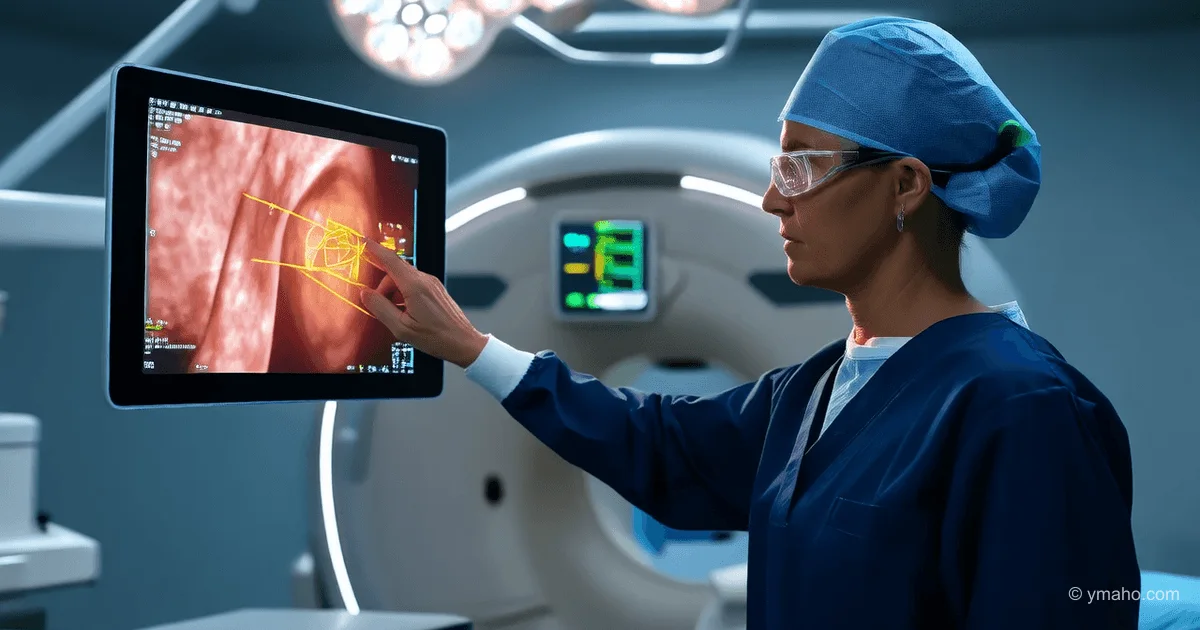
FDA Approves Abbott Ultreon 3.0 AI Platform for Cardiac Imaging in Coronary Stenting
The Ultreon 3.0 platform, with new AI algorithms, automatically analyzes optical coherence tomography images in real time, helping cardiologists accurately assess the degree of blockage and select the optimal stent size.
When the algorithm chooses a stent faster than the surgeon: why Abbott Ultreon 3.0 is not just "another FDA approval"
The Bottom Line: What's Really Happening
On April 29, 2026, Abbott announced simultaneous FDA clearance and European CE marking for the Ultreon 3.0 platform. The news spread instantly across medical publications, but nearly all reported it the same way: "Abbott improved imaging for stenting." This is a deliberate oversimplification — not only by journalists but also by Abbott itself, which has reasons not to emphasize the true scale of what's happening.
In reality, Ultreon 3.0 is the first platform in history where AI not only helps the physician interpret the image but makes micro-decisions in real time, with which the surgeon agrees or disagrees post hoc. The FDA recognized the legitimacy of this shift by publishing unprecedentedly detailed algorithm performance statistics: lipid plaque detection sensitivity — 98%, specificity — 91%, stented area detection — 100%. The regulator has never published such figures for any AI platform in cardiology before.
A key detail being missed: this is not a software update of Ultreon 2.0. It is a completely redesigned architecture where an OCT scan is performed in one second with low or zero contrast agent use. For 25% of patients with ischemic heart disease who have comorbid kidney disease, this is not an "image quality improvement." It is the difference between being able to perform the procedure and having to forgo it due to the risk of contrast-induced nephropathy.
Timeline and Context
2021 — Abbott receives CE marking for Ultreon 1.0, the first version of the platform with AI assistance elements. This is a European story; the FDA stays on the sidelines.
2022–2024 — Ultreon 2.0 expands functionality, but the key limitation remains: image acquisition speed and the need for contrast.
2024 — Abbott-sponsored clinical trial: OCT-guided PCI shows significantly larger minimum stent diameter compared to angiography, but without statistically significant reduction in target vessel failure at two years. Critics use this as an argument: "OCT looks nice but doesn't change outcomes."
April 24, 2026 — The FDA publishes its decision on application K253459. Status: "SESE" (Substantially Equivalent). But the document contains 7 separate AI performance metrics — a level of detail unprecedented for cardiology software.
April 28–29, 2026 — Abbott officially announces FDA clearance and CE Mark. The market reacts cautiously: Abbott shares remain under pressure due to EPS dropping from $0.76 to $0.61 in Q1 2026.
Early May 2026 — King's College Hospital NHS Foundation Trust in London becomes one of the first centers in the world to implement Ultreon 3.0 in routine practice. Expected volume: 500 patients per year.
Who Wins and Who Loses
Winners.
Abbott — and this is not limited to direct platform sales. Abbott is building an ecosystem: Ultreon 3.0 completes the vascular technology portfolio, which grew 9.5% on a comparable basis in Q1 2026. More importantly, the platform creates switching costs for hospitals. If a hospital has invested in training staff on Ultreon 3.0 and integrated it into the workflow, switching to a competitor (say, an IVUS solution from Boston Scientific or Philips) becomes not just a hardware replacement but a restructuring of the entire decision-making process in the catheterization lab.
Interventional cardiologists in high-volume centers. Evan Shlofmitz from St. Francis Hospital puts it succinctly: "the platform leapfrogs, not improves, existing technology." One second for a full OCT scan means the PCI procedure does not lengthen. Previously, the cardiologist faced a choice: speed (angiography) or accuracy (OCT). Now the choice disappears.
Patients with CKD (chronic kidney disease) — 25% of the CAD population. Zero-contrast PCI with AI guidance ceases to be an experimental technique and becomes a standard option.
Losers.
Boston Scientific — manufacturer of intravascular ultrasound (IVUS) systems. Ultreon 3.0 strikes directly at this niche: OCT provides higher resolution than IVUS, and AI automation removes the main objection — "OCT is too difficult to interpret."
Second- and third-tier hospitals that cannot afford a system costing several hundred thousand USD. The gap between cardiology in academic centers and community hospitals will widen. Abbott understands this and offers the Ultreon 3.0 Software Upgrade Kit — an upgrade for existing systems, lowering the entry barrier.
Old-school cardiologists relying on "eyeball" angiography. A system that identifies lipid core plaque with 98% accuracy and detects stented areas with 100% accuracy makes the surgeon's visual assessment increasingly irrelevant from a medico-legal standpoint.
What the Media Isn't Saying
Insight #1: Abbott is turning Ultreon from a tool into a platform with closed-loop data.
The FDA specifications mention "cloud connectivity for updates." This is not for firmware update convenience. Every case, every OCT recording, every algorithm decision is potentially data for retraining models. Abbott is collecting the world's largest dataset of OCT images with gold standard annotations from thousands of cardiologists. In three years, the entry barrier for competitors will not be the algorithms — those can be replicated. The barrier will be the data, which no one else will have.
Insight #2: The approval is based on bench testing, not clinical outcomes.
The FDA made its decision based on "Software verification and validation" and "Human factors summative evaluation" — without a new randomized clinical trial. This is normal for 510(k), but Abbott deliberately bypassed the need to prove impact on two-year target vessel failure. Why? Because the previous trial already showed no significant effect of OCT on this endpoint. The bet is that AI superiority in imaging metrics will translate into outcomes — but this has yet to be proven.
Insight #3: King's College Hospital is not a random choice for first implementation.
King's is one of the largest NHS Trusts in the UK, and the NHS is under tremendous pressure due to waiting lists for cardiology procedures. Ultreon 3.0 with its accelerated workflow is not only a medical but also an operational argument: more procedures per shift. Abbott is deliberately using the NHS as a demonstration platform for the European market.
Forecast: Next 30 Days and 90 Days
Days 1–30 (mid-May to mid-June 2026):
Abbott will begin publishing data from initial commercial cases at King's College Hospital and St. Francis Hospital. Expect presentations at conferences like EuroPCR (late May), with emphasis on zero-contrast procedures in CKD patients.
Competitors — primarily Boston Scientific with IVUS and Philips with laser atherectomy — will ramp up counter-marketing, highlighting the lack of clinical outcome data for AI guidance.
Investors will continue to ignore the news. The Abbott market is focused on the formula business, tariffs, and margin pressure, not cardiology AI. The stock price will remain in the $115–125 range.
Days 31–90 (June to August 2026):
Abbott will announce a partnership with a major US hospital network (HCA Healthcare or Ascension) for full-scale Ultreon 3.0 deployment. The contract will be structured on a value-based model: payment partially tied to reduction in repeat revascularizations.
The first preprint articles comparing cardiologist decisions "with Ultreon" and "without Ultreon" in identical clinical scenarios will appear. If the data show reduced decision variability (and they will — AI by definition standardizes assessment), this will become an argument for including the technology in ESC/AHA clinical guidelines.
The FDA will publish new guidance on AI/ML in interventional cardiology, tightening algorithm validation requirements. Ultreon 3.0, with its unprecedentedly detailed dossier, will become the de facto benchmark against which competitors are evaluated.
The story of Ultreon 3.0 is not a story about "faster OCT." It is a story about how real-time clinical decision-making ceases to be exclusively the prerogative of humans. While Abbott frames it as "confidence for clinicians," the reality is harsher: an algorithm with 98% sensitivity and 91% specificity is already shaping the decision, and the physician verifies it. The difference is subtle in rhetoric but fundamental in legal and professional terms. Who makes the decision when the procedure's outcome depends on stent placement accuracy — the surgeon or the model? The answer to this question will determine not only Abbott's fate but also the contours of cardiology for the next decade.
— Editorial Team









