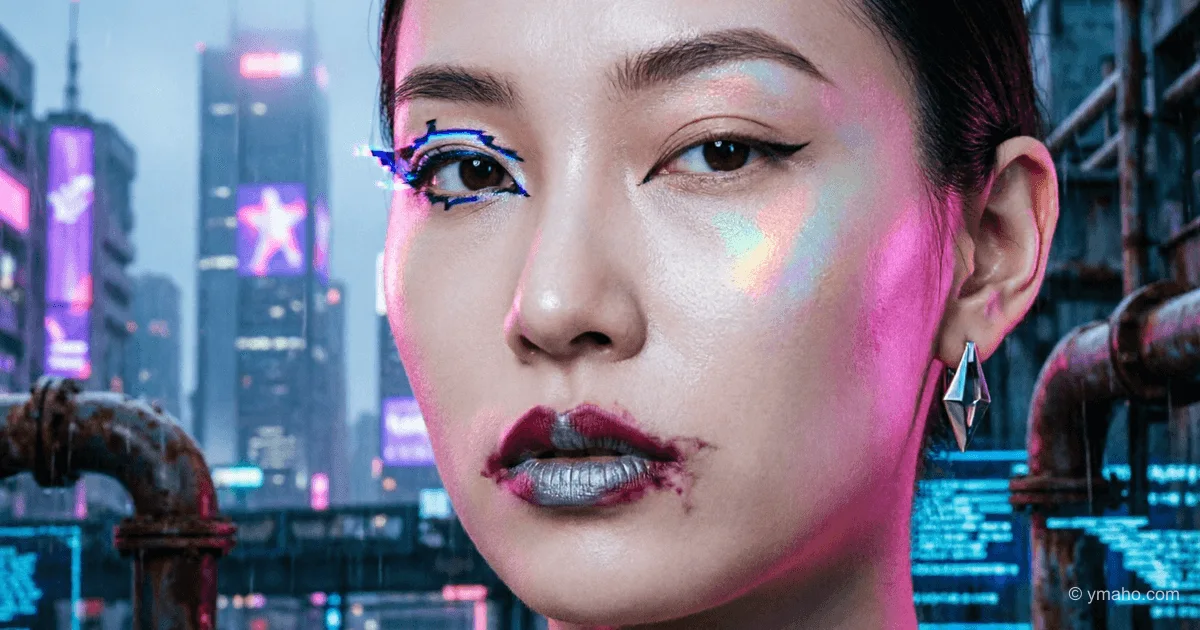
The Aesthetics of Self-Expression: Glitchy Glam and Escapism in Makeup
Makeup trends in 2026 reflect escapism and identity formation. In vogue are deliberate asymmetry (Glitchy Glam), gothic looks (Vamp Romantic), cosmic aesthetics (Extra Celestial), and animal aesthetics (Wilderkind) as a means of self-expression through style.
From Clean to Chaos: How Escapism and the Aesthetics of Self-Expression Exploded the Beauty Industry in 2026
Introduction
For years, the beauty industry lived under the dictatorship of "clean": flawless blending, symmetrical eyeliner, "baby skin," and minimalism raised to an absolute. The clean girl aesthetic, no-makeup makeup—these trends defined the face of the decade, demanding that women be natural yet perfect.
In 2026, this ideal collapsed. And it happened for a reason. The world experienced collective trauma, fatigue from perfectionism accumulated, and the beauty industry responded in the most radical way. Restraint gave way to escapism—a flight into alternate realities through one's look. Instead of hiding, beauty became a tool of self-expression, an instrument of identity formation, and even a political statement.
The main trends of 2026—Glitchy Glam, Vamp Romantic, Extra Celestial, and Wilderkind—share one thing: they all reject a single standard. Each offers its own universe, its own narrative, and its own degree of "normalcy," giving people the right to choose who they want to be today—a broken doll, an ancient vampire, an alien entity, or a forest nymph.
In this article, we will break down the dramaturgy of this cultural shift, its chronology, its impact on the industry and society, and why 2026 became the year of "beautiful chaos."
Event Details and Chronology
The formation of a new aesthetic paradigm occurred through the gradual rejection of minimalism and an intensification of the social context.
Stage 1: Dominance of Minimalism and "Quiet Luxury" (2022–2024).
In the post-COVID years, the industry was obsessed with "healing" and order. Trends like skinimalism, "glass skin," and barely-there makeup symbolized a return to basic values but simultaneously created a new standard of perfectionism unattainable for many.
Stage 2: Emergence of "Broken" Aesthetics in Niches (2024–2025).
The Pinterest Predicts 2026 report, based on a global analysis of search queries from September 2023 to August 2025, first captured emerging trends. Searches for "avant-garde makeup" grew by 270%, "eccentric makeup" by 100%, and "weird makeup looks" by 115%. These were the first signals: the audience was tired of "correct" formulas and was looking for an escape.
Stage 3: Institutionalization of Trends and Reaction to Trauma (2025 – February 2026).
By the end of 2025, Pinterest officially announced the main trends for 2026. Among them were Glitchy Glam (asymmetry, "broken" makeup) and Vamp Romantic (gothic romance). However, the key moment was New York Fashion Week (NYFW) in February 2026. As BeautyMatter notes, the shows of this season were permeated with a sense of collective trauma and open rebellion.
Stage 4: Mass Popularization and Escalation (2026).
In spring 2026, the aesthetics of self-expression moved from the runways to the masses. Extra Celestial and Wilderkind flooded social media feeds, offering alternative worlds—through holographic highlighters, "galaxy" magnetic nail polishes, or freckles mimicking deer hide.
Impact and Significance (for the World, Industry, Society)
Impact on the Industry:
The main economic effect is the decentralization of trends. Whereas before there were one or two dominant beauty looks, in 2026 there are dozens. Brands can no longer rely on a single "formula for success." This dictates the need to expand palettes (e.g., neon and chrome shades instead of nudes), produce unconventional textures (duochromes, magnetic top coats), and invest in creative marketing.
The industry also realized that makeup is no longer just "decoration." As shown at NYFW, makeup became a political statement. Show directors deliberately challenged conservative aesthetics, creating looks of "beautiful chaos" in opposition to "artificial, painted doll-like faces" (the so-called "Mar-a-Lago Face").
Impact on Society and Psychology:
The trends of 2026 are a reaction to three major stressors. First, technological and information overload. The Wilderkind aesthetic was born as a direct response to "digital exhaustion" and the desire of Gen Z and Gen Alpha to "reset" through a connection with nature and animals. Second, fear of the future and AI, reflected in Glitchy Glam—a deliberately "glitchy," "broken" look, as if copied from an artificial intelligence that malfunctioned. Third, fatigue from escapism itself, which transformed into a need for dissociation through the creation of an alternative fantasy persona.
Impact on the Perception of Beauty:
The most important shift is the change in the criterion of "beauty." Now, value lies not in perfection but in authenticity and courage. As ELLE Kazakhstan writes, Glitchy Glam gives the right to "play by your own rules," not to copy someone else. This returns the industry to its original function—being a space for play and creativity.
Reaction of Key Players
Leading industry players are not just observing—they are actively shaping and leveraging these trends.
Cosmetic Giants and Makeup Artists:
At NYFW, leading makeup artists became the main interpreters of these sentiments. Dick Page for Collina Strada created an "ancient vampire" look with deathly pale lips and coal-black eyes. Thomas de Kluyver for Proenza Schouler proposed "puzzle lips" and completely asymmetrical eyeliner (liner only on the upper lid of one eye and on the waterline of the other), embodying the quintessence of Glitchy Glam.
Brands and Products:
Trends are quickly picked up by manufacturers. For example, the cosmetic brand Charlotte Tilbury released entire product lines adapted for Vamp Romantic: the "The Vintage Vamp" eyeshadow palette, berry-toned lip and cheek tints. Nail brands are actively promoting magnetic gels for "galactic" effects and deep wine, burgundy, and black shades for stiletto nails.
Platforms and Analytics:
Pinterest became the main "predictor" and mouthpiece for these trends. Platform analytics showed explosive growth in searches for "hallucinogenic makeup," "nails with different colors on each hand" (up 125%), and "asymmetrical bob" (up 85%). The platform itself actively uses this data to attract advertisers and shape the narrative about the future of beauty.
Niche and Independent Brands:
On the wave of Extra Celestial and Wilderkind, small brands specializing in duochrome pigments, "wet glass" highlighters, holographic top coats, and unconventional nail shapes are flourishing.
Forecast and Conclusions
What awaits us next, after chaos and escapism have become mainstream?
- Hyper-individualization. Trends will no longer be uniform. The future lies in a "builder": people assemble their own look from different aesthetics (today—a space alien, tomorrow—a forest elf). Brands offering tools for such assembly (modular palettes, interchangeable textures, neural networks for look generation) will be winners.
- Synthesis of Technology and Organics. The strongest trends of the next stage will lie at the intersection. Already, we see how digital "glitches" of Glitchy Glam combine with organic "freckles" of Wilderkind. The future is augmented reality in makeup and "bio-futurism."
- Politicization of Beauty. As NYFW showed, makeup is increasingly becoming a form of protest and self-identification in a turbulent world. Brands will have to decide: stay on the sidelines or take a stand. "Neutrality" may become synonymous with "outdated."
- Growth of the Market for Creative Removers. The more complex and vibrant the makeup, the higher the demand for professional removers that do not damage the skin after layered textures and glitter.
Conclusion:
2026 became a point of no return for the beauty industry, which forever abandoned the monolithic ideal of the "clean girl" in favor of the diversity of "beautiful chaos." The aesthetics of self-expression are not just a change in color palette; they are a reflection of deep social shifts: the desire to control at least one's own image in a world that has spiraled out of control. Makeup no longer masks—it reveals, proclaims, and protects. And that is its new, far more important role.
— Editorial Team









