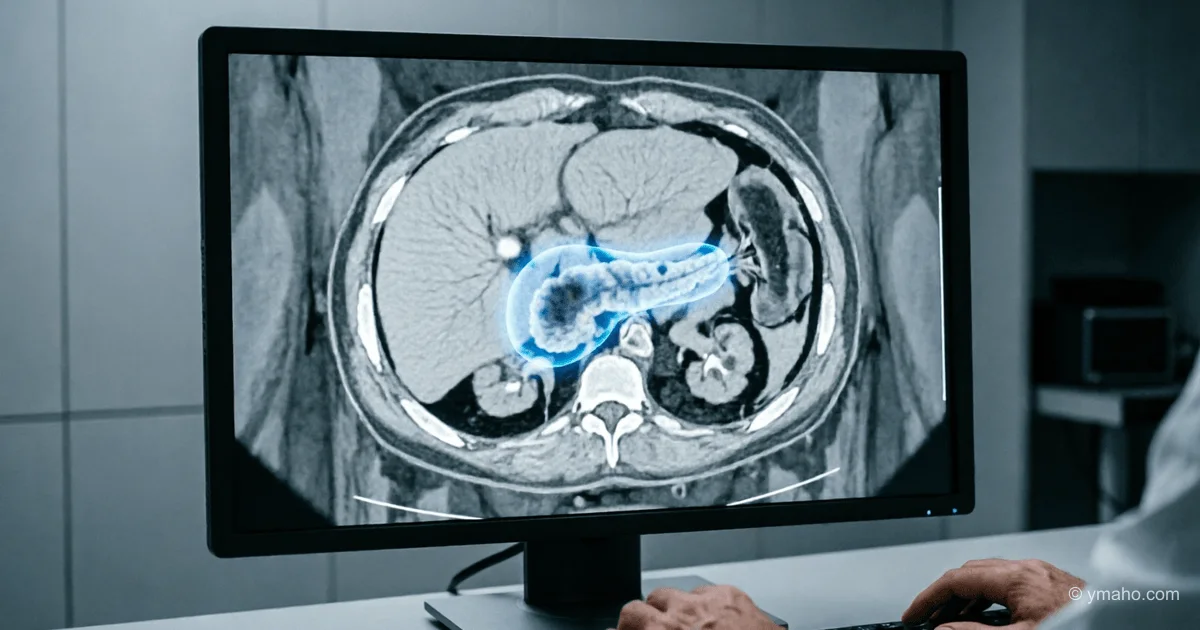
AI Detects Pancreatic Cancer 3 Years Before Diagnosis on CT Scans
A deep learning model trained on 32,000 CT images identifies sub-centimeter tumors with 86% accuracy, critical for cure given low survival rates.
Introduction
In April 2026, the world of oncology achieved a breakthrough that could change the fate of one of the deadliest cancers. Researchers at Mayo Clinic unveiled REDMOD, an artificial intelligence model capable of detecting pancreatic ductal adenocarcinoma on standard abdominal CT scans up to three years before clinical diagnosis.
Pancreatic cancer remains the oncological disease with the worst prognosis. Over 85% of patients are diagnosed at a stage when the tumor has already spread beyond the organ, and the five-year survival rate does not exceed 12%. By 2030, this type of cancer will become the second leading cause of cancer death in the USA. The main obstacle to saving lives is not the lack of treatment methods, but the inability to see the disease at an early, still curable stage.
REDMOD addresses precisely this problem. Instead of searching for a visible tumor, the AI analyzes subvisual radiomic patterns—barely perceptible disruptions in tissue texture and structure that appear years before the formation of a neoplasm.
Event Details and Timeline
Model Development. REDMOD was trained on a multi-institutional cohort of 969 patients, including 156 individuals with preclinical cancer and 813 control cases. The model uses fully automated pancreas segmentation and an ensemble architecture (logistic regression, random forest, XGBoost) trained on 40 radiomic features.
Key Results. When tested on an independent cohort of 493 patients, REDMOD achieved an AUC of 0.82 and sensitivity of 73.0%, detecting cancer on average 475 days before clinical diagnosis. The model's sensitivity was nearly double that of experienced radiologists (73.0% vs. 38.9%). For cases detected more than 24 months before diagnosis, the AI's advantage increased to nearly threefold (68.0% vs. 23.0%).
Stability and Generalizability. On repeated scans of the same patients, REDMOD demonstrated 90–92% result consistency. The model's specificity was 81.3% on an independent multi-institutional cohort of 539 patients and 87.5% on the public NIH dataset of 80 patients.
Parallel Developments. In addition to REDMOD, other systems emerged in 2025–2026. Scientists from Saint Petersburg State Electrotechnical University LETI, in collaboration with the Vishnevsky National Medical Research Center of Surgery, developed a neural network with 92.55% accuracy in detecting pathological changes. A study published in PLOS ONE presented a CAD system with detection accuracy of 99.64% and classification accuracy of 98.72%.
Impact and Significance
For the Oncology World. REDMOD confirmed the theory of a preclinical "window" lasting years, during which pancreatic cancer is already present in the body but remains invisible to the human eye and standard imaging methods. Mayo Clinic researchers demonstrated for the first time that subvisual tissue texture disruptions captured by AI serve as reliable predictors of future disease.
"The biggest barrier to saving lives in pancreatic cancer has been our inability to see the disease when it is still curable," said Ajit Goenka, senior author of the study. "This AI can now identify the cancer signature on a normally appearing pancreas, and it does so reliably over time and across different clinical settings."
For the Pharmaceutical Industry. The REDMOD breakthrough changes the economics of drug development for pancreatic cancer. Early diagnosis opens the possibility of testing new drugs in patients with minimal tumor burden, where therapy efficacy is potentially higher. Simultaneously, Mayo Clinic researchers launched the AI-PACED clinical trial, evaluating the integration of AI screening to assist patients with newly diagnosed diabetes—a high-risk group.
For Society. Modeling shows that increasing the proportion of localized pancreatic cancer cases from 10% to 50% would more than double survival rates. The time window created by REDMOD allows shifting diagnosis from symptomatic late stage (where only palliative care is possible) to stage 0, when cancer cells are present but have not spread, and treatment can be radical and potentially curative.
Reactions of Key Players
Mayo Clinic. Researchers emphasize that REDMOD is not a replacement for radiologists but a decision-support tool. The model is intended for analyzing CT scans already performed for other reasons, especially in high-risk patients (older adults with newly diagnosed diabetes and weight loss). The next step is prospective validation in real-world screening programs.
Scientific Community. REDMOD results were published in Gut, one of the leading journals in gastroenterology. The study received high praise for methodological rigor: it demonstrated for the first time the longitudinal stability of predictors and specificity on independent cohorts. Particular attention was drawn to the analysis of the model's working mechanisms: over 90% of REDMOD's predictive power comes from texture features extracted at multiple scales of wavelet transformation.
Russian Scientists. The neural network development at LETI is being conducted as part of the Decade of Science and Technology in Russia. In the future, the model will be integrated into a clinical decision support system that will not only detect tumors but also assess the degree of their invasion into adjacent organs.
Forecast and Conclusions
What We Have as of May 2026. REDMOD became the first fully automated, longitudinally stable, and externally validated AI system for detecting preclinical pancreatic cancer. The model's sensitivity is nearly double that of radiologists, and the advantage increases with the time horizon to diagnosis.
Main Challenges. High specificity (81–87%) means that a few percent of patients may receive false-positive results—a problem requiring clear follow-up protocols. Additionally, the study was conducted on a limited ethnic sample. Prospective studies on high-risk cohorts are needed for final clinical implementation.
Outlook. The next stage of development is integrating REDMOD with electronic health record analyzers that can identify patients with new-onset diabetes and weight loss and automatically initiate screening. Large-scale prospective trials are already planned in Boston, Berlin, and Singapore.
Conclusion. Pancreatic cancer is no longer an "invisible" disease. REDMOD and similar AI systems can look years ahead, to where the disease is just beginning. This is not a panacea, but a powerful tool that—combined with precise targeting of risk groups and effective therapy—could turn the tide in the fight against one of the most insidious oncological diseases. As the study authors summarize: "The paradigm shift from late symptomatic diagnosis to proactive preclinical interception is a real hope for improving outcomes in this challenging disease."
— Editorial Team









