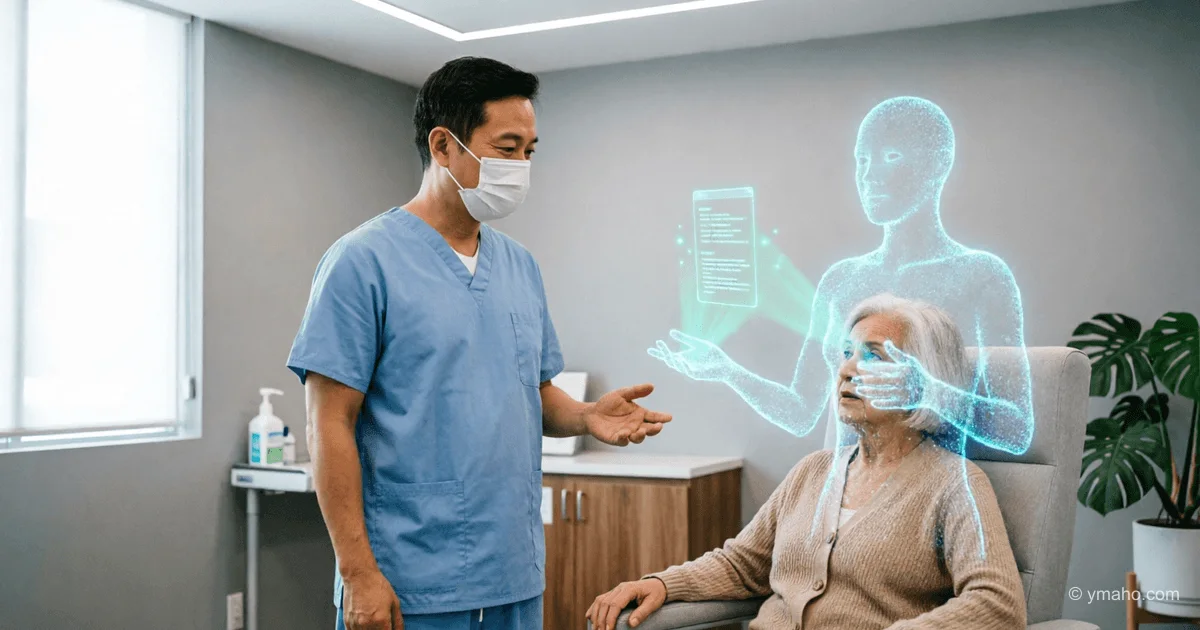
In 2026, AI in Healthcare Will Move from Pilot Projects to Full-Scale Implementation
According to forecasts from 26 industry leaders surveyed by Chief Healthcare Executive, this year artificial intelligence technologies, including agentic AI and ambient listening, will begin to integrate actively into everyday clinical practice, reducing the burden on physicians and improving diagnostics.
2026: Artificial Intelligence in Healthcare Enters the Era of Maturity
Introduction
"The hybrid clinical workflow of 2026 is not a choice between remote and in-office work. It's about the harmonious coexistence of physicians, nursing staff, and AI agents, where each contributes uniquely to patient care."
This thesis, put forward by industry leaders at HIMSS 2026, is not a prophecy about a distant future. It is a statement of fact unfolding right now. According to forecasts from 26 industry leaders surveyed by Chief Healthcare Executive, 2026 will be a turning point when AI technologies move from pilot projects and limited deployments to full-scale integration into everyday clinical practice.
The main focus of this transition is two directions. The first is ambient listening, which frees physicians from the drudgery of documentation and returns them to the patient. The second, even more ambitious, is agentic AI, capable not just of analyzing or recommending, but of performing multi-step actions in clinical workflows, becoming a digital member of the team.
This article is an analytical review of how exactly this transformation is happening, what results it is already yielding, and what challenges the industry faces.
Event Details: How the Transition Is Happening
The shift from pilots to practice is confirmed by several major cases. If in 2024 AI learned to listen, in 2026 it learns to act.
Scaling Ambient Listening Systems:
The ambient scribe technology, which creates an invisible transcript of the physician-patient conversation, has become mainstream and evolved into a key workflow element:
- Kaiser Permanente deployed the system in Northern California. Result: savings equivalent to 1,794 workdays per year for physicians, and an increase in patient satisfaction by 8.6%. Physicians can now maintain eye contact instead of looking at a screen.
- Houston Methodist reported a 40% reduction in documentation time and a 27% increase in time spent directly with the patient.
- AIDA system by Viamed Salud in Spain has already processed over 50,000 consultations, solving the fundamental problem of "the screen as a barrier" between physician and patient.
The Rise of Agentic AI:
At HIMSS 2026, the main discussion was about agentic AI—systems capable not just of generating text but of performing tasks. "You set a goal for the agent, and it performs the steps necessary to achieve it," explained Doug McKeever from Orlando Health.
An example of this approach is the Andor Health solution (ThinkAndor®), which actively orchestrates the patient journey from initial triage and scheduling to post-discharge care. Tampa General Hospital (TGH) database already includes 61 AI applications, including the agent "Aimee" for the contact center. The deployment of agents led to a 56% reduction in abandoned calls and a decrease in average wait time from 6.2 to 2.4 minutes.
Reaction of Key Players (Regulators and Vendors):
A key catalyst for mass adoption was regulatory changes. In December 2025, CMS (Centers for Medicare & Medicaid Services) finalized national reimbursement for the AI platform SENSORA® (Eko Health) for heart screening. This created a financial foundation for deploying such technologies even in small hospitals, like Wayne General Hospital in rural Mississippi.
EHR vendors like Epic are integrating AI tools natively, while Microsoft Dragon Copilot and Abridge are becoming standards for health systems.
Debate on Autonomy Boundaries (HIMSS 2026):
At HIMSS 2026, a heated discussion erupted about the degree of AI autonomy. The main question: is the "human-in-the-loop" turning into a "human-in-the-way"? Research shows that in some scenarios, AI systems can make decisions faster and more accurately than human-machine teams, mainly because physicians are not trained to interact effectively with AI. However, the consensus remains conservative: AI is taking over operational tasks (scheduling, call handling, initial triage), while clinical decisions remain with humans.
Impact and Significance
For the Healthcare System: Digital Workers and Efficiency
The most obvious effect is combating physician burnout. AI tools have begun to "return time" to physicians' schedules, which is critical for staff retention. As noted by Viamed's transformation director, AI removes the unpleasant moments when "a physician tries to look at the patient while typing on a keyboard."
Additionally, AI addresses the Value-Based Care issue. AI automates routine documentation and closing care gaps, which directly translates into financial efficiency for clinics.
For Patients: A New Standard of Accessibility and Experience
Patients have already adapted to AI: OpenAI reports that over 40 million people daily turn to ChatGPT with medical questions. Hospitals are deploying AI-powered contact centers (like TGH) to meet this demand.
Ambient listening technology creates a different level of empathy. When the physician is not distracted by a screen, the patient feels heard. The technology becomes transparent, invisible, working for the benefit of human interaction.
For the Industry: The End of "Wild West" AI Use
A significant trend is the recognition that 66.7% of physicians already use AI (mostly public tools like ChatGPT), often outside hospital IT control. 2026 is the time when industry leaders stopped ignoring this fact and began deploying corporate, secure, and validated alternatives to replace the "Wild West" of uncontrolled tools with a managed infrastructure.
Reaction of Key Players
- Large health systems (Tampa General, Kaiser, Sutter Health): Demonstrate a pragmatic approach, abandoning lengthy pilots in favor of rapid scaling. Scott Arnold (TGH) speaks of a "bullish" sentiment toward agentic AI.
- Vendors and developers (Andor Health, Nabla, Google Cloud): Focus on creating multimodal infrastructure where AI not only listens but also sees and interacts. "Agent factories" (Agentic AI Factory by Greenway Health) are emerging, enabling rapid deployment of AI workers.
- Professional organizations (AAO-HNS, Academies): Urge physicians to redefine the "hybrid workplace." It is no longer about remote work, but about synergy between human and machine, where routine tasks are handed off to AI agents, leaving complex clinical decisions to humans.
Forecast and Conclusions
Analysts at Signify Research predict that ambient listening will evolve into "workflow-native" systems. Documentation will cease to be an end goal; it will become a trigger for actions: AI will automatically order lab tests, send referrals, or initiate monitoring.
The Path to Full Autonomy. Although human control remains critical (especially in diagnostics), AI will gain increasing autonomy in operational tasks. We are moving toward a "human-on-the-loop" model, not just "in the loop."
Growth of Specialized AI. General-purpose AI assistants are giving way to specialized ones (e.g., AI for ophthalmology from Nextech or AI for cardiology from Eko), which better understand the specifics of a given field.
Main Takeaway: 2026 is the moment when AI in healthcare has "grown up." It has ceased to be an expensive toy or a lab experiment. It has become as much a working tool as a stethoscope, only now this tool is virtual, listens to conversations, unloads the physician's neural networks, and helps them return to what matters most—caring for people, not paperwork.
— Editorial Team









