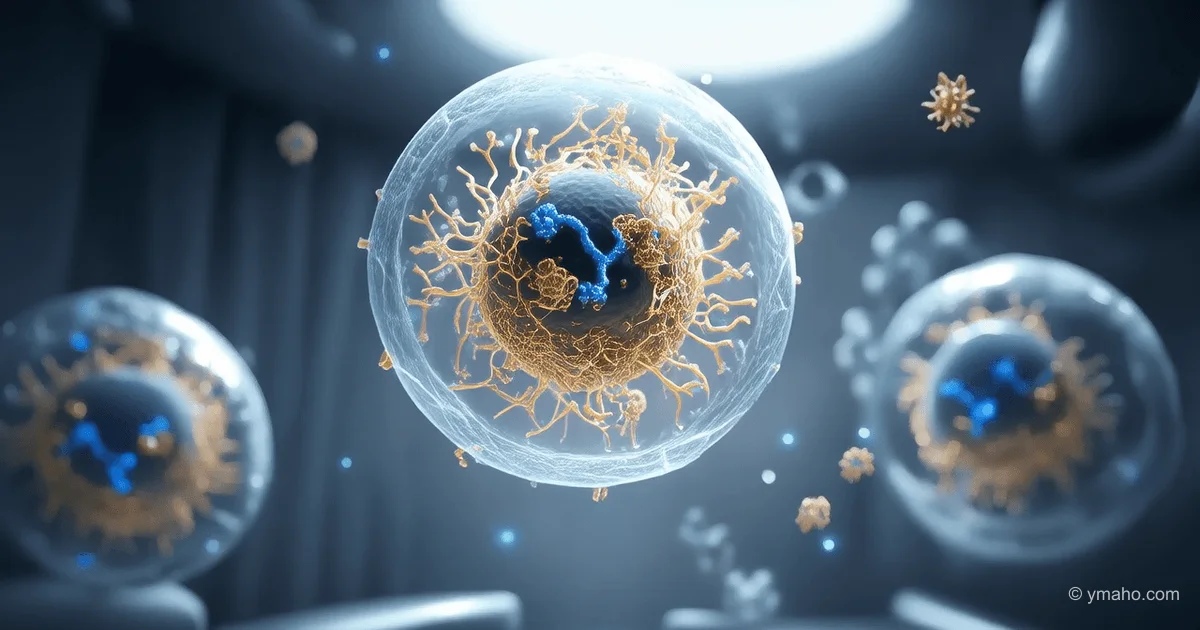
Houston Methodist AI Platform Decodes Intercellular Communication in Cancer and Alzheimer's
Scientists have created the iS2C2 platform, which uses AI to analyze spatial signals between individual cells. This helps understand how distorted signaling in cell "conversations" leads to cancer and neurodegenerative diseases.
A conversation we finally eavesdropped on: why iS2C2 is not just AI, but a shift in scientific method
The gist: what's really happening
On May 14, 2026, Houston Methodist announced the creation of the iS2C2 platform — Co-Intelligent Single-cell Spatial Cell-cell Communication. Journalists framed it as "AI decodes cell conversations." Formally true. But behind this lies something more fundamental: for the first time, an algorithm not only analyzes data but formulates testable biological hypotheses at a level that experts have assessed as accurate and reproducible.
Steven Wong, lead researcher and holder of the John S. Dunn Presidential Distinguished Chair in Biomedical Engineering, put it this way: "Understanding disease means determining how these cell conversations went wrong and how to fix them." The key word is "fix." This is not about observation, but about finding therapeutic targets.
The platform operates at the intersection of two worlds that previously did not overlap. On one side is the mathematically rigorous S2C2 algorithm, which models intercellular signaling pathways, including downstream intracellular cascades down to transcription factors. On the other side is a large language model that takes the structured results of this modeling as input and, using chain-of-thought reasoning and few-shot learning, generates meaningful hypotheses. Fifteen independent experts validated the results — I have not seen this level of rigor in evaluating AI-generated hypotheses in any other 2026 publication.
Timeline and context
The problem of intercellular communication is as old as molecular biology itself. Cells communicate through ligand-receptor interactions that trigger cascades inside the cell. When signaling is distorted, disease arises: cancer, neurodegeneration, autoimmune processes. But until now, we had either powerful algorithms that calculated correlations and explained nothing, or experts who explained but could not handle the volume of data.
2023–2024 — explosive growth of single-cell RNA-seq and spatial transcriptomics. More data than anyone could meaningfully interpret.
2024 — attempts to attach LLMs to bioinformatics yield poor results: hallucinations, irreproducibility, lack of mechanistic understanding. LLMs cannot read omics data directly.
2024–2025 — Wong and colleagues rethink the architecture. Instead of asking the LLM to analyze raw data, they build an intermediate layer: S2C2 with Pathway Activity Scores (PAS), which translates complex mathematics into a structured, semantically rich format understandable to the language model.
May 10–11, 2026 — publication in Signal Transduction and Targeted Therapy (a Nature group journal). Code released on GitHub.
May 13–14 — press releases, news waves.
Who wins and who loses
Winners.
Houston Methodist and Steven Wong personally. They created not a tool but a new category — "cointelligent platforms." The term will enter the lexicon of NIH and DARPA grant applications. Wong's lab becomes a magnet for anyone wanting to apply AI in systems biology.
Pharma companies with portfolios in neurodegeneration and oncology. iS2C2 has already found previously unrecognized signaling pathways in Alzheimer's disease and, critically, proposed an existing drug (approved for breast cancer) that could potentially block cancer metastasis to bone. This is not hypothetical drug discovery; it is drug repurposing with a ready regulatory dossier. The cost of bringing such a drug to market for a new indication is about $40–80 million instead of $2.6 billion for a new molecule.
Investors in AI-driven drug discovery. The platform validates the entire class of "cointelligent" solutions. Expect valuation growth for startups working at the intersection of LLMs and omics data — provided they reproduce Wong's architecture (interpretable algorithm + LLM), not just a wrapper of ChatGPT API around biological data.
Losers.
Bioinformaticians who relied solely on correlation analysis. iS2C2, with its mechanistic mapping of downstream pathways and quantitative PAS, raises the bar: publications without a causal, mechanistic component will find it increasingly difficult to pass peer review in top journals.
Labs that rushed to integrate LLMs directly with omics data without an intermediate algorithmic layer. Wong's paper is, among other things, a methodological guide: how not to do it and how to do it. Those who do not read it will waste millions of USD in grant money on irreproducible results.
What the media are not saying
Insight #1: This platform is a Trojan horse for crowdsourcing scientific hypotheses.
On the GitHub page, the project is described as open. Any biologist can upload their single-cell data, run it through iS2C2, and get a hypothesis. This means Houston Methodist is building the world's largest database of AI-generated mechanistic hypotheses, enriched by user feedback. In two years, they will have a dataset on which to train the next generation of models — and which no competitor can replicate. Open source is not altruism; it is a data collection strategy.
Insight #2: iS2C2 works with incomplete data, and that is what makes it dangerous for competitors.
Wong particularly emphasizes: the platform uses generative AI to fill gaps in data — a common problem when working with single-cell sequencing. Formally, this is an advantage. But there is a hidden risk that goes unmentioned: the line between "filling gaps" and "hallucination" is blurred. Fifteen experts validated the results on Alzheimer's and cancer datasets, but what about rare diseases where experts simply do not exist? This is not a problem yet — but it will become a problem in 2–3 years when the platform is applied to exotic nosologies.
Insight #3: Drug repurposing is not a nice bonus; it is the main business model.
The media emphasize fundamental science: "understand how cells communicate." But in interviews, Wong says more concretely: "The fact that this AI platform can point us to a new treatment strategy could be a game changer." The platform has already found a specific drug to prevent bone metastases. This is not an academic exercise. Houston Methodist is focused on clinical translation — and that is where NIH grants, T.T. and W.F. Chao Foundation, and Cures Alzheimer's Fund will go.
Forecast: next 30 days and 90 days
Days 1–30 (mid-May to mid-June 2026):
The iS2C2 repository on GitHub will receive its first hundreds of clones. Screenshots and demo videos from independent researchers will appear. The single-cell biology community will actively discuss the platform on bioRxiv and X/Twitter.
Large pharma companies (Roche/Genentech, Biogen — given the Alzheimer's focus) will hold internal presentations of the platform for R&D departments. At least one will initiate partnership talks with Houston Methodist.
Startups building AI solutions for drug discovery (Insilico Medicine, Recursion, BenevolentAI) will attempt to reproduce the iS2C2 architecture. Those already using LLMs without an intermediate layer will find themselves in a difficult position.
Days 31–90 (June to August 2026):
The first preprint with independent validation of iS2C2 on another dataset will appear — likely from a group at the Broad Institute or Wellcome Sanger Institute. If results are reproduced, the platform's valuation will soar.
NIH will announce a special grant track for "cointelligent approaches to disease mechanism discovery." The term "cointelligent" is already used in Wong's paper, and NIH, with which the team is evidently in contact (grants listed in acknowledgements), will pick up the term.
Wong will present data on bone metastases at a major oncology conference — ASCO or AACR special conference. If the claimed results are confirmed in independent validation, pharmaceutical interest will move from the "study it" phase to the "start clinical trial planning" phase.
The first case where iS2C2 points to a false target will spark discussion about the limits of trust in AI-generated hypotheses. This is inevitable and necessary: technology matures when it becomes falsifiable.
Fundamentally, iS2C2 marks the transition from AI as an analysis tool to AI as a generator of scientific hypotheses. This is not just speeding up the bioinformatician's work. It is the emergence of a third player at the lab bench — alongside the experimenter and the theorist. And the most intriguing part: this player offers not answers, but questions — structured, testable, biologically meaningful. That is how science has always worked. It just has a new way of asking now.
— Editorial Team









