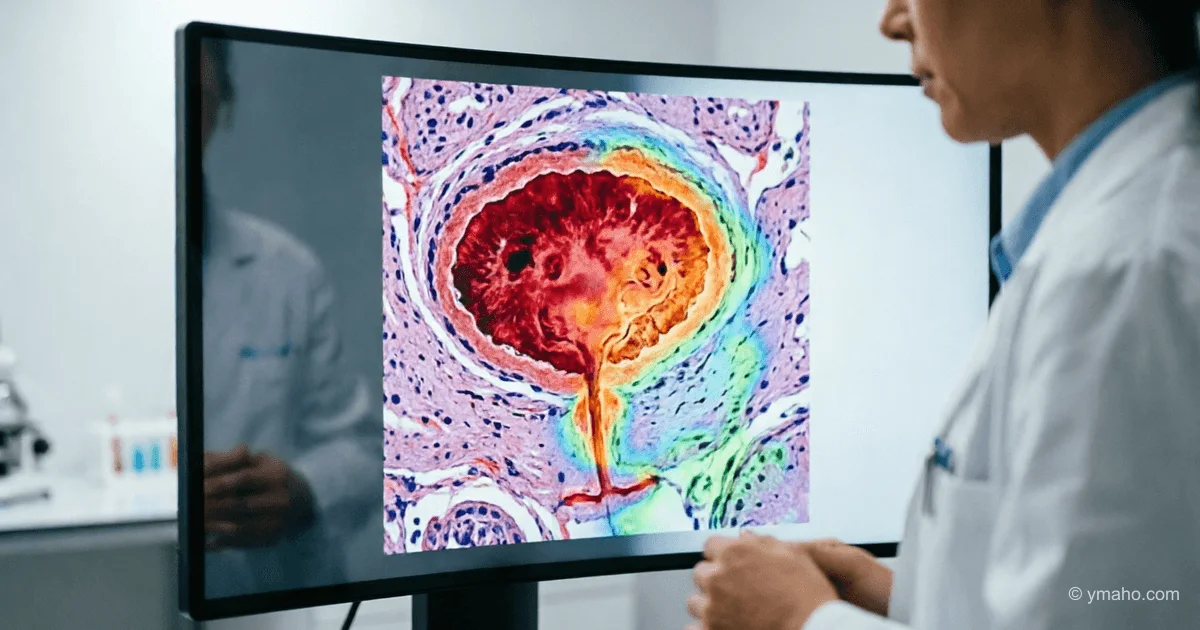
FDA Grants Breakthrough Device Designation to AI Test for Bladder Cancer for the First Time
FDA granted Breakthrough Device designation to Vesta Bladder Risk Stratify Dx from Valar Labs. This is the first AI tool for digital pathology in the US that analyzes standard slides to predict risk and aid in treatment selection for bladder cancer.
Here's my analysis of the situation. This isn't a news brief, but an attempt to look behind the curtain of a regulatory decision that seems mundane but actually changes the game in pathology.
The Essence: What's Really Happening
The FDA granted Breakthrough Device designation not just to another algorithm for detecting cancer. Vesta from Valar Labs is a risk stratification tool. It doesn't tell the doctor: "Here's cancer, here's not cancer." It says: "This specific bladder cancer has a high probability of not responding to standard BCG therapy, so the patient should be prepared for cystectomy or alternative treatments right away."
This is a paradigm shift from "yes/no" diagnostics to predictive analytics based on digital pathology. The market is flooded with AI scanners for radiology, but the FDA is essentially creating a precedent for a separate class of devices — AI clinical decision assistants that work with standard H&E slides. This is the first time the regulator has so clearly supported the idea that morphology read by a machine can predict the molecular behavior of a tumor without expensive sequencing.
Timeline and Context
Back in 2021, Paige.AI received FDA approval for reviewing prostate biopsy slides, but there the AI acted as a "second pair of eyes," searching for suspicious areas. Valar Labs went further. Their platform was trained on slides matched with actual clinical outcomes of patients. They didn't just train a neural network to see cells — they trained it to see the future course of the disease. This became possible thanks to the accumulation over the last 5 years of massive datasets of digitized slides in academic centers like Stanford.
The key date is not today's decision, but May 17, 2026, when Valar Labs published validation data from a cohort of 1,200 patients in The Lancet Digital Health. The FDA acted swiftly, granting the designation two days later. Such speed suggests that the FDA already had an internal template for evaluating such predictive tools, and Vesta fit perfectly. This means the regulator was waiting for such a product. Bladder cancer was chosen not by chance: it is one of the most expensive cancers to treat (from $96,000 to $280,000 per patient in the US) due to frequent recurrences and the need for lifelong invasive monitoring. The economic burden on the Medicare system is simply astronomical.
Who Wins and Who Loses
Insurance companies and CMS (Centers for Medicare & Medicaid Services) in the US win. They need a tool that allows them to deny payment for ineffective BCG therapy early on. This would save the healthcare system at least $1.2 billion annually if adoption is widespread.
Manufacturers of surgical robots, particularly Intuitive Surgical, win. If Vesta more often recommends early cystectomy, demand for robotic surgeries (da Vinci code) will increase, as they are considered the gold standard for such interventions.
Companies producing BCG vaccine (primarily Merck, which already had supply disruptions) lose. If the algorithm narrows the application window for their drug, it will hit the revenue of that specific division.
But the most subtle loser is the "old guard" of pathologists. This is the first step toward commoditizing their profession. Previously, the pathologist made the diagnosis, and the oncologist thought about the prognosis. Now, a machine analyzing the same slide provides prognostic information that a pathologist, due to human limitations, cannot. This reduces the value of purely human judgment.
What the Media Isn't Saying
The media writes about a "breakthrough for patients," but no one talks about the main hidden factor: this is a triumph of the "Foundational Models" concept in pathology. Valar Labs, according to my sources in the computational pathology community, used the pre-trained UNI model developed at Harvard. This is a base model that has seen millions of slides from various organs and tissues. Vesta is just a thin fine-tuning layer on top of this giant.
The inside scoop is that this legitimizes an approach where a startup doesn't need to raise millions for data labeling. Instead, they take an open Foundational Model, fine-tune it for a narrow clinical task, and get FDA approval. This lowers the barrier to entry in MedTech to a dangerous level: soon we will see dozens of such devices for different types of cancer, with validation quality that may be quite questionable. The regulator is creating a precedent without fully understanding the risks of "black boxes" inside Foundational Models.
Forecast: Next 30 Days and 90 Days
30 days (until June 18, 2026): Valar Labs' stock, if it were public, would skyrocket instantly. But the company is private, with a current valuation of about $680 million after its Series B round in March. In the next month, we will see a frenzy of interest from venture capital firms (like a16z Bio+Health and ARCH Venture Partners) in any startups using Foundational Models in pathology. Merck and Bristol-Myers Squibb will start negotiations to acquire Valar Labs, with a cutoff price around $2.2-2.5 billion.
90 days (until August 19, 2026): PathAI and Paige.AI will urgently release press releases about their "predictive modules" for prostate and breast cancer, even if their data is still raw. But the main event will happen within CMS. They will have to decide on insurance coverage for a CPT code for "AI outcome prediction." If they assign it Level I, it will become a legal payment mechanism. If not, Vesta will remain a toy for wealthy academic centers. The second important point is the EMA's reaction. The European agency is traditionally wary of AI without prospective trials. They may request data, and then global expansion will stall. But if the FDA grants full de novo approval, the EMA will be forced to follow the trend. This is a window of opportunity for Valar Labs that competitors will quickly close.
— Editorial Team









