Cell Metabolism: Mechanism of Anti-Aging Fat Communication via the Hypothalamus Revealed
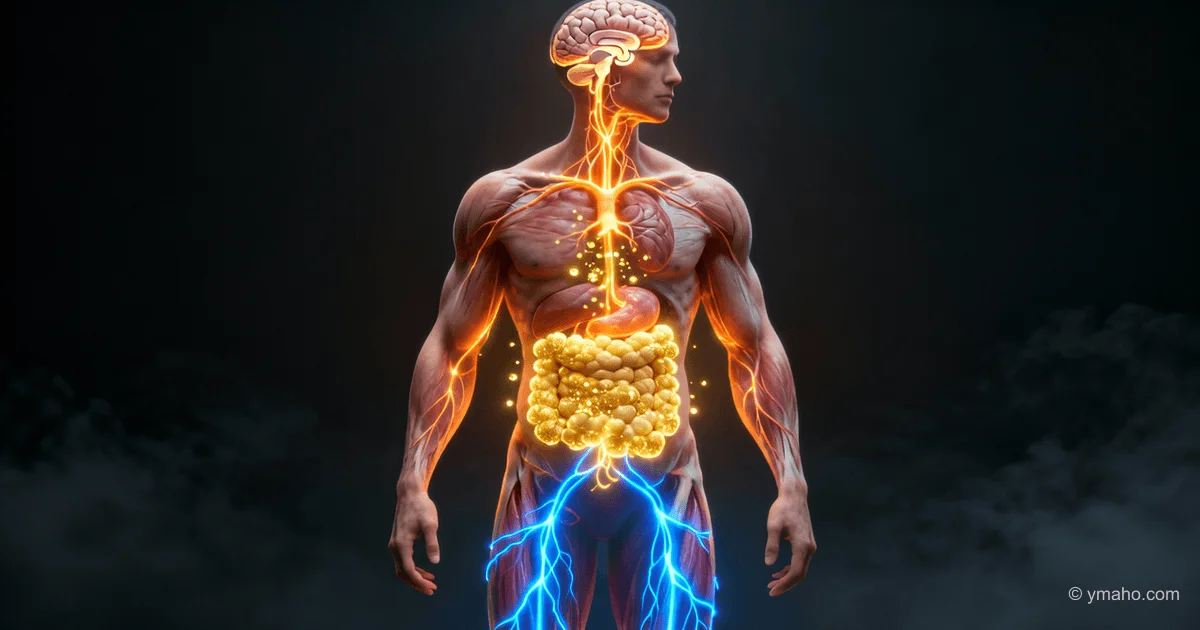
Alongside the muscle study, it turned out that S1PC activates eNAMPT secretion by adipose tissue, which through the bloodstream affects the hypothalamus, triggering sympathetic stimulation of muscles and opening a new pathway for anti-aging therapy targeting inter-organ communication.
Adipose Tissue as a Conductor of Aging: Why the Discovery of the "Fat-Brain-Muscle" Axis Changes the Game in Longevity
When two articles appear in the same issue of Cell Metabolism and both point to the same mechanism, it's not a coincidence. It's a signal. On May 7, 2026, a Japanese group led by Dr. Shin-ichiro Imai published a paper that not only complements the S1PC story but lays the foundation for a completely new paradigm in anti-aging medicine. And this paradigm sounds counterintuitive: healthy adipose tissue is not an enemy of longevity but a prerequisite for it.
The Essence: What's Really Happening
Formally, the article describes the mechanism of action of S1PC, a sulfur-containing compound from aged garlic extract. The molecule activates LKB1 in white adipose tissue, which through the LKB1-STRAD-MO25-SIRT1 cascade causes adipocytes to release exosomes loaded with eNAMPT into the bloodstream. The exosomes reach the hypothalamus, increase NAD+ levels there, the hypothalamus enhances sympathetic stimulation of skeletal muscles, and only then do the muscles start working better.
But the real story is not about garlic or even S1PC. The real story is about a radical revision of the role of adipose tissue in aging. Until today, the dominant paradigm in the longevity community was clear: fat is bad, less fat means longer life, adipocytes are passive calorie depots.
Imai and colleagues turn this picture upside down. In their model, adipose tissue is an active endocrine organ that orchestrates systemic aging through the "fat → hypothalamus → peripheral tissues" axis. Without sufficient mass of functional adipocytes, the signal is not generated. Human data confirm this: participants with a BMI below 18.5 showed no significant increase in eNAMPT after taking S1PC. Biohackers on extreme caloric restriction who pride themselves on minimal body fat may be depriving themselves of a key inter-organ communication channel necessary for healthy aging.
Timeline and Context
The story of this discovery is a classic example of how fundamental science builds a puzzle over decades before a complete picture emerges. The Institute for Research on Productive Aging in Tokyo, where the work was carried out, was established in 2019 specifically for a translational model: not waiting for academic discoveries to be picked up for commercialization, but purposefully guiding them from the lab to the product.
Key premise: the "NAD World" concept that Imai has been developing for the last 15 years. According to this model, eNAMPT secreted by adipose tissue serves as a systemic regulator of NAD+ levels in the hypothalamus, and the hypothalamus in turn coordinates the rate of aging of peripheral tissues. Until 2026, this was an elegant but difficult-to-prove hypothesis.
In parallel, Wakunaga Pharmaceutical had been developing technology for stabilizing sulfur-containing garlic compounds for decades. Unlike raw garlic, where allicin and its derivatives degrade quickly, the prolonged aging process creates a unique profile of stable compounds: S1PC, SAC, and others.
The intersection of the two lines occurred when researchers noticed that the physiological effects of S1PC—improved metabolism, anti-inflammatory action, endothelial protection—strikingly resembled those of NAD+ boosters. Hypothesis: S1PC works through an NAD+-dependent mechanism, but not directly, rather through activation of inter-organ communication.
Timeline of events leading to the publication:
- 2019: Establishment of IRPA under Imai's leadership
- 2020-2023: A series of studies establishing the role of eNAMPT-containing exosomes in systemic NAD+ regulation
- 2024: Identification of LKB1 as a target of S1PC in adipocytes
- 2025: Completion of an 8-month experiment on mice (15-23 months, dose 5 mg/kg/day) and a pilot human trial
- May 7, 2026: Publication in Cell Metabolism, synchronized with a parallel article by the same group
- June 2026: Planned presentation at the FASEB SRC on NAD+ metabolism in Melbourne, Florida
Who Wins and Who Loses
Wakunaga Pharmaceutical wins—and this is not a trivial "the company will make money on a supplement." Wakunaga has a unique position: it owns the patented AGE production technology and has years of experience in product standardization. S1PC, identified as the active ingredient with a clear mechanism, turns their flagship Kyolic from a "general health supplement" into a product with targeted action. Patent application US 63/796,082 has already been filed.
The concept of nutraceuticals with pharmaceutical-level evidence wins. S1PC—a natural compound from a product with centuries of consumption history—now has a mechanism of action described at the molecular level, human data from a double-blind placebo-controlled design, and a publication in a journal with an impact factor of 27-31.
People with normal BMI but age-related muscle weakness win. The study gives them a specific, potentially safe, and inexpensive intervention—and importantly, explains why it might work specifically for them.
Extreme calorie restrictors lose. The human data are crystal clear: without sufficient adipose tissue, the effect of S1PC on eNAMPT levels is absent. Design: participants with a BMI below 18.5 showed no significant increase in eNAMPT.
Manufacturers of bioavailable NAD+ boosters (NMN, NR) focusing on direct NAD+ elevation in peripheral tissues lose. S1PC does not directly compete with them—on the contrary, the study shows synergy: combining S1PC with NMN gave a significantly greater increase in eNAMPT than either agent alone. But the paradigm shift from "flood with NAD+ precursors" to "tune inter-organ communication" may redistribute consumer budgets.
Manufacturers of ordinary garlic capsules without standardization for S1PC lose. Once consumers learn that raw garlic contains almost no S1PC (the compound forms specifically during prolonged aging), simple dried powders will lose appeal for the longevity audience.
What the Media Isn't Saying
First non-obvious insight: the study revealed a biphasic eNAMPT response to S1PC—and this hints at the existence of two independent secretion pools. The first peak occurs 15-30 minutes after intake, the second around 300 minutes. The standard explanation is rapid secretion from a preformed pool of vesicles and delayed secretion from newly synthesized ones. But there is an alternative hypothesis that the researchers do not discuss publicly: the two peaks may reflect secretion from different adipose tissue depots. Visceral and subcutaneous fat have different innervation and different response dynamics to sympathetic stimuli. If so, S1PC could potentially be used as a tool for selective activation of specific fat depots.
Second non-obvious insight: S1PC penetrates the brain, muscles, and adipose tissue within 15 minutes, but eNAMPT-containing exosomes go exclusively to the hypothalamus. This is remarkable selectivity. The mechanism of tropism to the hypothalamus is not disclosed, but the fact itself means that somewhere on the surface of the exosomes there is a signal sequence or receptor that ensures targeted delivery. Deciphering this mechanism will pave the way for engineering artificial nanovesicles with programmable delivery to specific brain regions.
Third non-obvious insight: the conflict of interest here is not a bug but a model. Imai is president of IRPA and co-CEO of LongGen Bioscience, receiving royalties from MetroBiotech and IRPA through Washington University. In the article, the conflict of interest is managed through the Washington University Conflict of Interest Committee. The typical journalistic reflex is to present this as a sensation: "scientist profits from discovery." An insider knows: this is not corruption but a deliberately built "scientist-entrepreneur" model—the same one David Sinclair uses at Harvard. The idea: the only way to quickly bring a fundamental discovery to people is the researcher's involvement in commercialization.
Fourth non-obvious point: pure S1PC is not available on the market. The researchers used a specially produced powder with 17% S1PC content. To obtain a 25 mg dose from commercially available AGE, one would have to take volumes that are economically and physiologically impractical. This means there is a technological and regulatory gap of 1-2 years between publication and actual product availability for consumers.
Fifth non-obvious point: parallel publication on the "gut-brain" axis. In the same issue of Cell Metabolism—or in a synchronized publication—a Stanford group showed that vagus nerve stimulation and microbiome manipulations (Parabacteroides goldsteinii) reverse age-related cognitive decline through the "gut-brain" axis. S1PC activates the sympathetic channel, the Stanford group the parasympathetic one. Two articles published simultaneously effectively map the entire neuro-metabolic network connecting the periphery and the brain in aging. The editors of Cell Metabolism clearly thought about this when planning the issue.
Forecast: Next 30 Days
Second half of May 2026. Active discussion will begin on platforms like Rapamycin News and Longecity about the practical application of S1PC. The key question from biohackers: how to get an equivalent dose from available products? The answer will disappoint: no way. Extraction and standardization are required, available only to Wakunaga and their partners.
Late May to early June. Laboratories working with NAD+ boosters (NMN, NR) will start their own experiments to verify the synergy of S1PC with their molecules. The first independent preprints confirming or refuting synergy in other animal models are expected within 3-5 weeks.
June 2026. Presentation at FASEB SRC in Melbourne. This will be the first public discussion before an expert NAD+ audience. I expect at least one tough question about whether the effect is reproducible in female mice (the study was predominantly on males).
Forecast: Next 90 Days
July 2026. Wakunaga will likely announce the start of an expanded clinical trial of S1PC in elderly people with sarcopenia. Key design: long-term administration (at least 3-6 months), assessment of muscle strength and mass as primary endpoints. This will transform S1PC from a "promising mechanism" into a candidate for real clinical application.
August 2026. The FDA will begin informal consultations with Wakunaga about the regulatory status of S1PC. Possible scenarios: GRAS (Generally Recognized As Safe) recognition—an accelerated path for a dietary supplement, or an NDI (New Dietary Ingredient) notification requirement—a slower and more costly path. The outcome will determine the speed of entry into the US market.
September 2026. Competitors in the longevity space will start searching for other activators of the "adipose tissue → hypothalamus" axis, alternative to S1PC. At least three companies are expected to announce screening programs in this direction.
Strategic conclusion: this publication marks the moment when longevity research transitions from the era of single molecules (resveratrol, NMN, rapamycin) to the era of inter-organ communication. Adipose tissue in this picture is not a passive depot or an enemy, but a central network node coordinating the rate of aging. Practical implication: anti-aging protocols must consider the state of adipose tissue as an active endocrine organ, not just minimize its amount.
Monetary estimate: the longevity nutraceutical market in 2026 is about $60-70 billion USD. The segment of "evidence-based nutraceuticals with a known mechanism of action" is about $5-7 billion. S1PC-containing products, if clinical data are confirmed, could capture $300-500 million of this segment within 3-5 years—not as a blockbuster, but as a precedent that changes industry standards.
— Editorial Team









