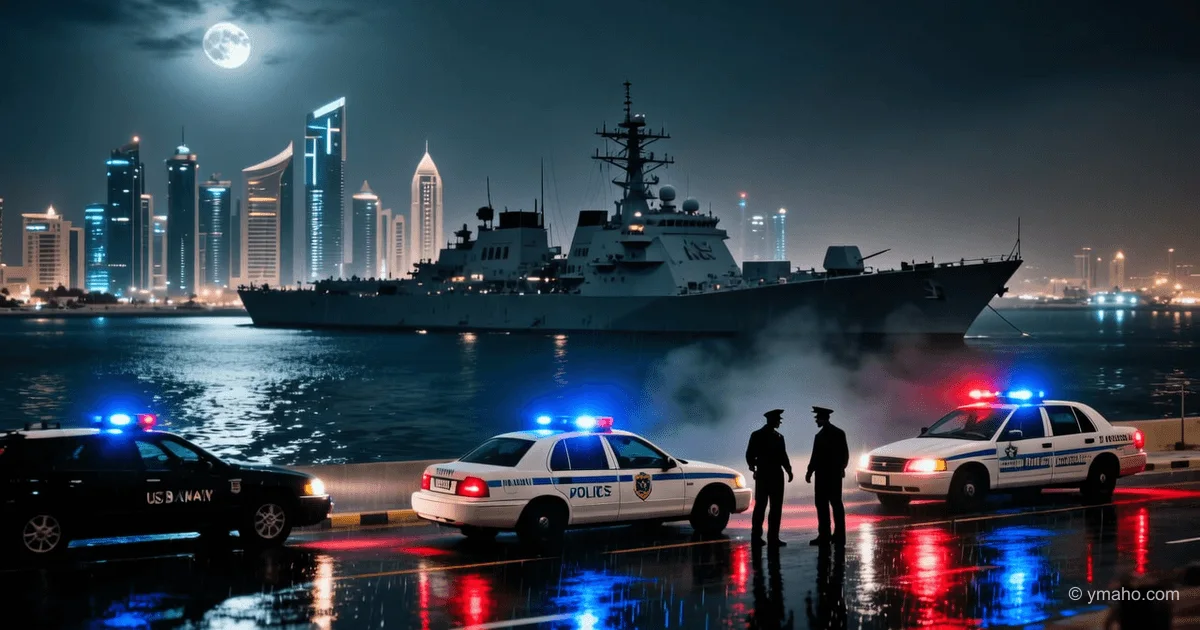
Bahrain Announces Detention of 41 People Linked to Iran's IRGC
The country hosting the US Navy's headquarters has announced the arrest of a group suspected of ties to Iran's Islamic Revolutionary Guard Corps amid a fragile ceasefire.
Forty-one arrests in Manama: when a US ally goes for a total purge
The Essence: What's Really Happening
The mass arrest of 41 people in Bahrain is no routine police operation. Authorities claim to have uncovered the "core structure" of a network linked to the Islamic Revolutionary Guard Corps (IRGC). The charges are unprecedentedly broad: espionage for a foreign state, supporting Iranian aggression, and—key point—"spreading Iranian influence through media, mosques, charitable and educational institutions, including schools and kindergartens."
The mention of schools and kindergartens is no accident. It signals that Manama is moving from targeting specific suspects to purging ideological infrastructure. Iran's concept of "velayat-e faqih"—rule by a jurist—is cited in Bahraini documents as the network's ideological foundation. This is no longer counterintelligence but a fight against political Islam as a system.
Human rights activists have reacted strongly. Saeed Ahmed Alwadaei, director of the London-based Bahrain Institute for Rights and Democracy (BIRD), called the operation "unprecedented in scale—not even seen at the peak of the 2011 crackdown." According to him, those detained include "some of the country's most prominent Shia religious figures." Bahrain is a Sunni monarchy with a Shia majority, and each such arrest strikes at the kingdom's most sensitive nerve.
Timeline and Context
The May 9 arrests are the culmination of a three-month spiral. On February 28, the US and Israel launched a military operation against Iran; in response, the IRGC struck US military facilities in Bahrain, Jordan, Iraq, Qatar, Kuwait, the UAE, and Saudi Arabia. Bahrain, home to the US Fifth Fleet headquarters, suffered more than other Gulf states—the strikes hit civilian and energy infrastructure.
Since March, a wave of arrests has targeted dozens of people for expressing sympathy with Iran. Human Rights Watch documented this trend and expressed concern. In April, the kingdom stripped citizenship from 69 people accused of supporting Iranian attacks. By May, the number of arrests on charges of espionage and transmitting sensitive information exceeded two hundred. Bahrain recalled its ambassador from Tehran and expelled Iranian diplomats.
Concurrently, Manama initiated UN Security Council resolutions condemning Iranian attacks and demanding protection of navigation in the Strait of Hormuz. A previous resolution, backed by the US and paving the way for legitimizing military force, was blocked by Russian and Chinese vetoes. Now a new text, coordinated with Saudi Arabia, the UAE, Kuwait, and Qatar, is on the table.
Iran responded to the arrests with a direct threat. Ebrahim Azizi, head of the Iranian parliament's national security commission, posted a warning on social media: "Taking the side of a US-backed resolution will have serious consequences. The Strait of Hormuz is a vital artery; do not risk closing it to yourselves FOREVER."
Who Wins and Who Loses
Bahrain's monarchy—tactical winner. The arrests consolidate the Sunni establishment, demonstrate loyalty to Washington, and provide a carte blanche to suppress any opposition under the pretext of fighting Iranian influence. For Manama, this is a moment to tighten the screws that it could not afford in peacetime.
Iran—operational loser, but not strategic. Losing an agent network at a critical moment is a serious blow. But the very fact that 41 people are accused of links to the IRGC in tiny Bahrain confirms Tehran's narrative of its broad influence. Moreover, the repression of Shia gives Iranian propaganda a trump card: Sunni regimes persecute co-religionists.
The US—in an ambiguous position. Washington relies on the Fifth Fleet base in Bahrain, making it an indirect beneficiary of the purge. But public association with repression of Shia clergy is toxic for America's image in the region—especially now, when the US tries to portray its conflict with Iran as a fight against the regime, not against Shiism.
Bahrain's Shia majority—the main victim. The scale of arrests confirms what human rights groups have said for years: the Sunni monarchy uses the confrontation with Iran to suppress internal opposition. "Sympathy for Iranian attacks" becomes a universal charge requiring no proof.
What the Media Leaves Out
Insight one: the arrests are a cover operation for internal consolidation.
The formal pretext is espionage for the IRGC. The real goal is neutralizing the Shia community as a political factor. The network is accused not just of gathering intelligence but of "spreading Iranian influence through media, mosques, charitable and educational institutions, including schools and kindergartens." This means the targets are not agents but civil society institutions—schools, charities, religious centers. Manama is using the military crisis to dismantle parallel Shia structures it could not touch for years.
Insight two: the number "41" is not the end but the beginning.
Bahrain's Interior Ministry explicitly stated that "the investigation continues to identify other individuals involved in the group's activities." Given that the total number of arrests since March has already exceeded 200, the current operation is just another phase. Human rights groups fear the number of detainees could double in the coming weeks.
Insight three: Iran sees the Bahrain arrests as part of a coordinated campaign.
The coincidence of the arrests with the push in the UN Security Council for a new anti-Iran resolution, coordinated with Saudi Arabia, the UAE, Kuwait, and Qatar, is no accident. Tehran sees a unified strategy: diplomatic isolation plus repression of Shia communities. Azizi's threat—"The Strait of Hormuz is a vital artery; do not risk closing it to yourselves forever"—is addressed not only to Bahrain but to all Arabian monarchies.
Insight four: Human Rights Watch and BIRD document a scale not seen since 2011.
The Bahrain Institute for Rights and Democracy called the operation "unprecedented—not even seen at the peak of the 2011 crackdown." Back then, during the Arab Spring, the Sunni monarchy crushed mass protests with Saudi troops. The current wave differs: it is targeted but penetrates deeper into society—targeting religious leaders, not street activists.
Forecast: Next 30 Days and 90 Days
Next 30 days (until June 9):
Arrests will continue. Investigative actions will cover the schools, charities, and media mentioned in the charges. At least several dozen more people will join the detainees.
The UN Security Council will vote on the new resolution. If it passes, Iran may carry out Azizi's threat and tighten the blockade of the Strait of Hormuz. If Russia and China veto again, Bahrain will bet on bilateral sanctions with the US.
Inside Bahrain, tensions will peak. The Shia community, deprived of religious leaders, will face a choice: silent submission or a new wave of protests. The latter is unlikely under wartime conditions but cannot be entirely ruled out.
90-day horizon (until August 9):
Bahrain will complete formal legal proceedings against the detainees. Sentences will be harsh—up to life imprisonment and additional citizenship revocations. This will cement a new norm: expressing sympathy for Iran or having ties to Shia structures suspected of links to the IRGC becomes a criminal offense.
For the region as a whole, the Bahrain case will set a precedent: other Sunni Gulf monarchies with Shia minorities—Saudi Arabia, Kuwait—may follow Manama's example and tighten internal control. Iran, in turn, will use the repression to mobilize the Shia diaspora and strengthen proxy networks in other countries.
Strategic outcome: Bahrain is transforming from a quiet US Fifth Fleet base into the front line of an ideological war between Sunni monarchies and Shia Iran. The 41 arrests are just the first salvo in this new phase of conflict, where the front runs not through the Strait of Hormuz but through the kingdom's mosques, schools, and kindergartens.
— Editorial Team









