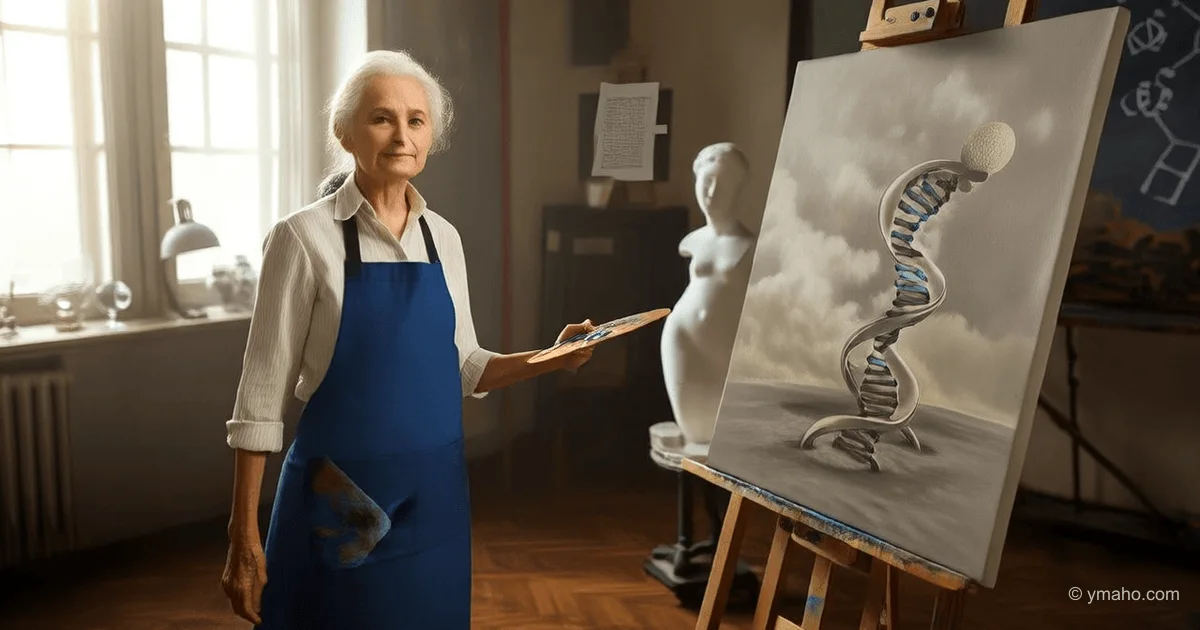
Engaging with Art Slows Biological Aging
A study by University College London involving 3,500 people showed a link between regular engagement with art and slower epigenetic aging. The analysis was conducted using several "epigenetic clocks" based on DNA methylation.
Epigenetics at the service of art: why the UCL study is not about painting, but about shifting the entire anti-aging paradigm
The Essence: What Is Really Happening
On May 11, 2026, the journal Innovation in Aging published a study by Daisy Fancourt's group at University College London — and headlines followed the usual pattern: "Art Slows Aging." Sounds nice. But the real shift, which the media collectively missed, lies in a completely different plane. For the first time in the history of epigenetic research, an authoritative scientific group published a paper where leisure activity — not "sport," not "diet," but art and culture — showed an effect on biological aging comparable to physical exercise.
The key figure: a 4% slowing of the aging rate on the DunedinPACE clock with weekly engagement in art — and exactly the same 4% for weekly physical activity. The effect size is identical. Daisy Fancourt said the phrase that had been expected from her for twenty years: "Arts engagement was related to 4% slower aging rates… This is actually the same reduction in biological aging that we saw for physical activity."
Steve Horvath — the creator of the Horvath clock, the man whose name became synonymous with epigenetic aging — reacted with surprise: "Honestly, it really surprises me… I think this is a very rigorous study, and what is particularly new to me is that arts engagement may have comparable effects to physical activity." When Horvath says "surprises me," it's not a figure of speech. It's a signal that the data passed through the most skeptical expert in the field.
Feifei Bu, the lead statistician of the group, put it succinctly: "This study provides the first evidence that ACEng, a much more recently recognised health behaviour, is related to epigenetic ageing." Behind this academic language lies a tectonic shift: art has just moved from the category of "pleasant hobby" to the category of "health behaviour" — officially, with reference to DNA methylation.
Timeline and Context
- November 2024 — first preprint on medRxiv.
- September 2025 — second version of the preprint with refined methodology.
- March 18, 2026 — article accepted by Innovation in Aging (Oxford University Press).
- March 5, 2026 — final version on medRxiv.
- May 11, 2026 — official publication.
The study used data from 3,556 adults from the UK Household Longitudinal Study for 2010–2012. Seven epigenetic clocks — Horvath, Hannum, Horvath2018, Lin, PhenoAge, DunedinPoAm, and DunedinPACE. And here lies the first non-obvious detail: the effect appeared only on three of the seven clocks — PhenoAge, DunedinPoAm, and DunedinPACE. Old clocks (Horvath2013, Hannum) — zero. Lin — zero. This is not a bug, but an insight: old clocks generally capture lifestyle effects poorly. The fact that the effect is visible only on new-generation clocks suggests that art influences precisely those aging mechanisms that these clocks measure — inflammation, immunosuppression, metabolic risk.
Who Wins and Who Loses
Winners.
UCL Social Biobehavioural Research Group and personally Daisy Fancourt. She gains a unique position: leader of a new scientific field at the intersection of cultural policy and biogerontology. This translates into grants, citations, and seats on WHO committees on healthy aging.
Museums, galleries, concert halls, libraries. They have just received scientific evidence of their role in public health — an argument they desperately lacked when fighting for budgets. Expect the British Museum, Tate, Royal Albert Hall to start including epigenetic data in their grant applications.
Social prescribing link workers — especially in the NHS, where social prescribing of art is already practiced. Now they have a biological, not just psychosocial, justification.
Losers.
Fitness industry. Not tomorrow — but the study undermines the monopoly of physical activity on the status of "the only proven lifestyle anti-aging intervention." If art gives the same 4% on DunedinPACE as sport — why not both? Or, for people with limited mobility, why not art instead?
Pharma companies promoting anti-aging supplements with minimal evidence base. The UCL study shows that free activities — reading books, listening to music, singing in a choir — produce a measurable epigenetic effect. Selling supplements for $150 a month becomes a bit harder.
Skeptics of "social determinants of health" who claim that "real" medicine is only molecules and pills. Fancourt's paper with its doubly robust estimation and seven epigenetic clocks is exactly the level of methodological rigor that is hard to dismiss as "just correlation."
What the Media Are Not Saying
Insight #1: 4% is not about years of life, but about risk of death and dementia.
Journalists write about "biologically a year younger" — and the reader shrugs: "only a year?" But this is not a year of lifespan. PhenoAge is a clock calibrated not to chronology but to phenotypic risk. One year difference on PhenoAge correlates with a certain percentage increase in all-cause mortality and an increased risk of age-related diseases. DunedinPACE is the pace of aging, not age. A 4% reduction in pace is not "a year of life," but a constant slowdown in the rate of damage accumulation.
Feifei Bu directly states: the association was found not with longevity per se, but with the "biological process of ageing." A 4% reduction in aging rate when scaled over decades is no longer "a year difference," but potentially 3–5 additional years of healthy life. However, the study is still observational, and extrapolation to mortality is not possible.
Insight #2: Diversity of activities is more important than frequency — and this is a bombshell for the design of public health interventions.
The most underrated finding of the study is hidden in the section on diversity. Fancourt says: "It's not just about doing arts regularly, but also about doing a range of different arts activities." Participants engaged in a wide range of activities — reading plus music plus museums plus dance — showed better results than those who did one thing with the same frequency.
Reason: different types of art activate different mechanisms. Reading — cognitive stimulation. Choral singing — social interaction plus breath control. Dance — physical activity plus coordination. Museums — aesthetic experience plus walking. The combination yields a synergistic effect.
This has direct implications for how future public health guidelines should look. Not "exercise 150 minutes per week," but "engage in diverse cultural activities weekly." A fundamentally different framework.
Insight #3: The mechanism is not art, but stress.
The study is observational. Causality is not proven — and the authors honestly admit this. But their working hypothesis and comments from independent experts point to one central mechanism: chronic stress.
Doug Vaughan from Northwestern puts it bluntly: "The arts, or being creative or enjoying the arts, is a non-pharmacological intervention… The biology is pretty clear" — referring to the link between chronic stress and accelerated epigenetic aging. Art reduces cortisol, activates the parasympathetic system, induces a flow state. Reduced inflammation is a downstream effect of stress reduction.
Sebnem Unlusoy, Chief Longevity Officer at the London Regenerative Institute, adds: "Chronic stress can accelerate aging through increased cortisol levels, inflammation and nervous system dysregulation, whereas activities such as music, painting, or dance may promote relaxation and emotional regulation."
This is important because it means: any activity that reduces chronic stress can potentially influence epigenetic aging. Art is just one pathway.
Forecast: Next 30 Days and 90 Days
Days 1–30 (mid-May to mid-June 2026):
The publication will trigger a cascade of comments in Nature Aging and Lancet Healthy Longevity — leading journals in aging research. The tone will be mixed: from "fascinating and rigorous" to "correlation is not causation, epigenetic clocks are still controversial." But the overall verdict — the study is methodologically strong.
WHO will include a reference to the study in ongoing work on healthy aging guidelines. The Department of Social Determinants of Health has long promoted cultural engagement — now they have epigenetic data to argue with.
Major cultural institutions will start promoting the study. The British Museum, Tate, Royal Opera House will issue press releases with headlines like "Science confirms: art keeps you young."
The fitness industry will ignore or respond with cautious skepticism: "arts engagement correlates with higher SES, which itself correlates with slower aging." This is a valid objection, but the authors controlled for income and education.
Days 31–90 (June–August 2026):
The first preprint attempting to replicate the finding on an independent population will appear — most likely on the Health and Retirement Study (USA) or ELSA (England). If the effect replicates, the study's status will rise from "intriguing finding" to "established fact."
One of the major insurance companies (likely Vitality in the UK or a similar structure in Europe) will announce that it includes "cultural engagement" in its healthy lifestyle incentive program. Discounts on museum memberships alongside discounts on gym memberships.
UCL will announce the launch of an interventional study: a randomized controlled trial where one group is prescribed weekly arts engagement, another is not, and DunedinPACE is measured after 12 months. This is exactly what is needed to move from "association" to "causation."
Fancourt will receive a major grant from the Wellcome Trust or European Research Council to expand the study to several countries. The amount — likely in the range of €3–5 million.
The boundary between "cultural policy" and "healthcare" will begin to institutionally blur. In the NHS, social prescribing already exists, but it is a niche practice. Epigenetic data provide an argument for scaling up. In a year or two, we can expect NICE to include arts engagement in clinical guidelines for the prevention of age-related diseases.
Fundamentally, this study is not about art. It is about the definition of "healthy lifestyle" having just expanded. For decades, we had a simple formula: don't smoke, eat right, move. Now a fourth pillar appears — cultural engagement. And this is not an opinion piece in a Sunday newspaper. It is a peer-reviewed article in an Oxford journal with doubly robust estimation on 3,556 participants and seven epigenetic clocks. Fancourt and her group have just rewritten the definition of what it means to "age healthily." The rest will have to catch up.
— Editorial Team









