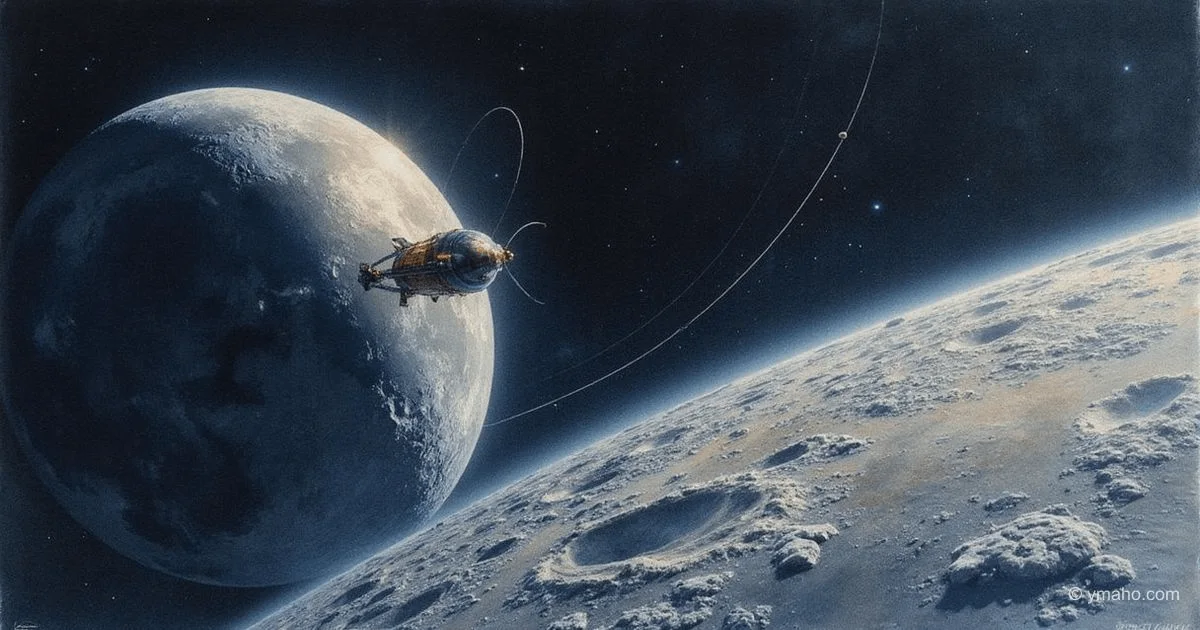
Humans Are Back Near the Moon — Here’s Why That Matters
For the first time in over 50 years, people are traveling through the moon’s neighborhood. On April 6, 2026, four astronauts aboard NASA’s Orion spacecraft crossed into lunar space—the zone where the moon’s gravity starts pulling harder than Earth’s. This isn’t just a nostalgic trip; it’s the first step toward returning humans to the lunar surface and eventually heading to Mars.
A Long-Awaited Return
The last time humans ventured this close to the moon was during Apollo 17 in December 1972. Since then, all space travel has stayed within low Earth orbit—like the International Space Station’s altitude, about 250 miles up. Artemis 2 breaks that boundary. The crew includes NASA astronauts Reid Wiseman, Victor Glover, and Christina Koch, plus Jeremy Hansen from the Canadian Space Agency. They’re not landing, but they’re flying farther from Earth than any humans ever have.
Think of it like sailing past the harbor into open ocean for the first time in decades. You’re not docking yet—but you’re proving your ship can handle deep waters.
What They’re Doing Out There
During their mission, the astronauts will loop around the far side of the moon—a region never seen directly by human eyes until now. At their farthest point, they’ll be about 252,757 miles from Earth, beating the Apollo 13 distance record by over 4,000 miles.
While cruising, they’ll:
- Observe the moon’s surface to help scientists understand its geology
- Test life-support systems in deep space
- Witness a total solar eclipse—visible only from their unique vantage point beyond the moon
- Let the moon’s gravity naturally slingshot them back toward Earth
That last part is key: instead of firing engines to turn around, they’re using the moon like a cosmic ramp. It’s similar to how a skateboarder uses a half-pipe to gain speed without pushing—just with gravity instead of wheels.
Why This Isn’t Just a Joyride
Artemis 2 is a test flight. Everything—from communications to radiation shielding—is being evaluated for future missions. If all goes well, Artemis 3 (planned for 2027) will land two astronauts near the moon’s south pole, where ice may exist in permanently shadowed craters. That ice could one day be turned into water, oxygen, or even rocket fuel.
This mission also marks the first time a woman (Christina Koch) and a person of color (Victor Glover) have traveled so far into space. Representation matters—not just symbolically, but because diverse teams solve problems better, especially when lives are on the line millions of miles from home.
What Does This Mean for Regular People?
You won’t be booking a moon ticket next year. But this mission builds the foundation for sustainable space exploration. Technologies tested here—like advanced navigation, emergency protocols, and closed-loop life support—could improve satellite reliability, medical monitoring, and even climate modeling on Earth. Plus, seeing humans venture beyond our planet again reminds us of what’s possible when nations collaborate on big, peaceful goals.
Key Takeaways
- Humans have returned to lunar space for the first time since 1972
- The Artemis 2 crew is flying farther from Earth than any previous mission
- They’re testing systems needed for future moon landings and Mars trips
- The mission includes historic firsts for diversity in deep space
- Lunar gravity is being used as a natural “slingshot” to return home
— Editorial Team









