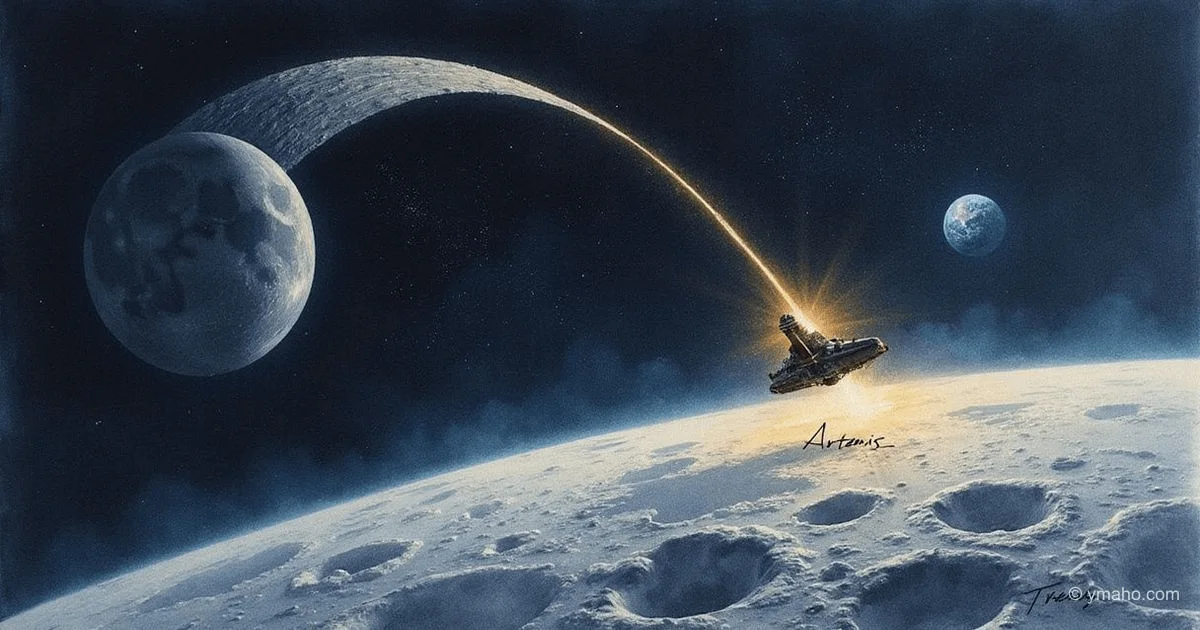
Artemis 2 Astronauts Break Distance Record on Historic Moon Flyby
Four astronauts aboard NASA’s Artemis 2 mission have just traveled farther from Earth than any humans in history—surpassing a record set over 50 years ago during the dramatic Apollo 13 mission. This isn’t just about setting a new number; it marks humanity’s return to deep space after decades and opens the door to future missions to the Moon, Mars, and beyond.
A New Record Built on Old Courage
On April 6, 2026, at 1:57 p.m. EDT, the Orion spacecraft carrying the Artemis 2 crew passed 248,655 miles from Earth—the distance reached by Apollo 13 in 1970. By evening, they’ll hit about 252,760 miles before swinging back home. That extra 4,000 miles might not sound like much, but in space travel, every mile beyond low Earth orbit is hard-won.
Apollo 13’s record was accidental. An oxygen tank exploded mid-mission, forcing the crew to abort their planned Moon landing and loop around the far side of the Moon as part of an emergency return path. Their survival became one of NASA’s greatest triumphs. Artemis 2, by contrast, is flying exactly as planned—a test flight to prove that modern spacecraft can safely carry people into deep space.
Before he passed away in 2025, Apollo 13 commander Jim Lovell recorded a message for the Artemis 2 crew. “Welcome to my old neighborhood,” he said warmly, passing the torch to a new generation. His words echoed the spirit of Apollo 8’s famous Christmas Eve broadcast, reminding us that space exploration has always been as much about perspective as it is about distance.
Why This Journey Matters
Artemis 2 isn’t landing on the Moon—it’s a “shakeout cruise” designed to test life support, navigation, and communication systems far from Earth. Think of it like taking a brand-new car on a cross-country road trip before trusting it with daily commutes. The stakes are high: if something goes wrong out there, help is days away, not minutes.
This mission also breaks barriers in who gets to explore deep space:
- Victor Glover is the first person of color to travel beyond low Earth orbit.
- Christina Koch is the first woman to do so.
- Jeremy Hansen is the first non-American astronaut to reach this distance.
Their presence signals a shift: space is no longer the exclusive domain of a narrow slice of humanity. It’s becoming more inclusive, reflecting the diversity of the planet they’re leaving behind.
What Does This Mean for Regular People?
You might wonder: why should I care about astronauts flying far from Earth? For one, the technologies tested on Artemis 2—like radiation shielding, water recycling, and emergency navigation—often find their way into everyday life, from medical devices to disaster response tools. More importantly, these missions remind us of our shared place in the cosmos. Seeing Earth as a small blue dot against the blackness of space has repeatedly inspired global cooperation and environmental awareness.
And this is just the beginning. If all goes well, NASA plans to land astronauts near the Moon’s south pole by late 2028, eventually building a lunar base as a stepping stone to Mars. Artemis 2 proves we’re ready to take that next step—not just technologically, but as a species.
Key Takeaways
- Artemis 2 broke the all-time human distance-from-Earth record on April 6, 2026.
- The mission is a critical test flight for future Moon landings and Mars missions.
- It includes historic firsts for diversity in deep space travel.
- Unlike Apollo 13’s unplanned record, this one was intentional and part of a larger strategy.
- The journey reconnects humanity with deep space exploration after a 50-year gap since Apollo 17.
— Editorial Team









