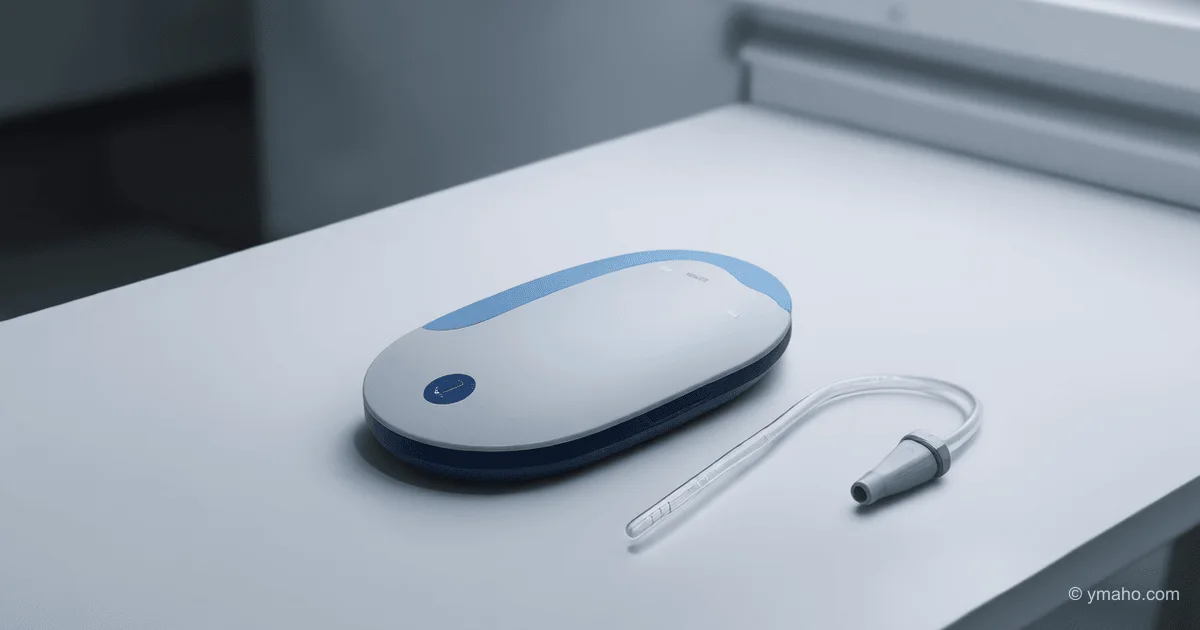
FDA Approves First Reusable Intermittent Catheter System Aurie
The Aurie system, featuring a catheter rated for 100 uses and a portable disinfection device, received FDA de novo clearance. This creates a new device class, reducing costs and dependence on single-use catheters.
The Catheter That Will Kill the Disposable Plastic Industry: Why FDA de novo for Aurie Is Not a Niche Urology Story
The Bottom Line: What's Really Happening
On April 30, 2026, the FDA published decision DEN250023 — a de novo classification for the Aurie Reusable No-Touch Intermittent Catheter System. This is not a routine 510(k) clearance where a manufacturer proves equivalence to an existing device. De novo is a completely different legal mechanism: it applies when no predicate device exists on the market. The regulator created a brand-new product code SHV and a new device class — "Reusable intermittent urinary catheter system." In an industry where single-use catheters have dominated for decades, this is a tectonic shift.
Most media outlets framed the news as "patient convenience" and "eco-friendliness." But behind the words "sustainability" lies a hard business calculation. The intermittent catheter market was valued at $2.49 billion in 2024, with projections up to $3.89 billion by 2032. It is controlled by giants: Coloplast, Hollister, Bard Medical, Medtronic, Teleflex — companies with multi-billion-dollar market caps. Their business model is built on single-use and constant repeat sales. One patient uses up to 2,000 catheters per year. Now, a seven-person startup from Syracuse is crashing into this model with a device rated for 100 uses.
Timeline and Context
The problem Aurie solves is as old as urology itself. Up to 56% of patients with neurogenic bladder reuse single-use catheters — not for medical reasons, but for financial ones. Basic catheters without a no-touch mechanism can cost $5–10 each, or over $10,000 per year without insurance. Safe no-touch versions with introducer and protective sleeve cost four times more. Meanwhile, the risk of urinary tract infections among catheter users reaches 2.5 complicated UTIs per year.
Aurie's story spans nearly a decade of R&D. In 2024, the Journal of Urology published initial data on antimicrobial efficacy: the system reduced bacterial load below the detection limit after each processing cycle, even after 101 repetitions. The FDA granted the project STeP (Safer Technologies Program) status — a program for devices promising significant safety improvements over existing options.
April 24, 2026 — FDA publishes the decision on DEN250023. April 30 — formal letter to CathBuddy. May 11 — public press release from Aurie.
Who Wins and Who Loses
Winners.
CathBuddy, Inc. — a seven-person company from Syracuse that operated in startup mode for years. De novo classification means not just permission to sell — it grants exclusivity over the entire newly created device class. Any competitor wanting to launch a reusable catheter must prove substantial equivalence to Aurie, not to single-use devices. This is a massive barrier. Additionally, the company gains pioneer status in the eyes of investors and potential buyers — which directly impacts valuation at the next funding round.
Veterans Health Administration (VHA). Aurie announced that the first launch will take place in VHA spinal cord injury hospitals. This is no coincidence. Veterans with spinal cord injuries represent one of the largest populations of intermittent catheter users in the US. VHA is a government payer highly sensitive to budget. Switching to a reusable system for this population saves tens of millions of USD per year.
Patients with high out-of-pocket costs. Even with insurance, many Americans pay $500–1,000 per year for catheters. Without insurance, costs run into five figures. Aurie estimates its system at roughly $6,000–7,000 per year, but the goal is full insurance coverage. If Medicare and private insurers include the system in their formularies, patient costs will plummet.
The environment. One user discards about 2,000 catheters per year. In the US alone, that's hundreds of millions of units of plastic medical waste. This is not a marketing mantra but a real volume of waste straining hospital and municipal budgets.
Losers.
Coloplast, Bard, Hollister, Medtronic, Teleflex. Their business model is Razor and Blades: the basic catheterization kit is nearly free, money is made on the "blades" — single-use catheters. A system lasting 100 cycles breaks this model. For now, the threat is limited to adult males (the only approved population), but expansion to women and children is a matter of time.
Manufacturers of cheap non-no-touch catheters. Aurie brings no-touch safety to mass affordability. Insurers and physicians gain an argument: why cover riskier cheap options when, for the same money, you can give a patient a safe reusable system?
Small distributors and DME (durable medical equipment) companies whose business relies on monthly shipments of single-use catheters. Switching to one system every three months reduces transaction frequency by tens of times.
What the Media Isn't Saying
Insight #1: FDA approved Aurie without clinical data.
In FDA documents, it's black and white: "No clinical data provided. Safety and effectiveness supported by non-clinical performance testing." No randomized trials, no comparison with single-use catheters on clinical outcomes. Only bench tests, microbiological validation, and human factors engineering.
Usually, this is insufficient for de novo — recall how much clinical data FDA required for Neuralink. But Aurie is Class II, not a life-sustaining device. And FDA deliberately took an accelerated track: STeP status plus de novo without clinical data. Why? Because the epidemic of UTIs among catheterized patients is a silent crisis. Hundreds of thousands of catheter-associated UTIs are recorded annually in the US. Antibiotic resistance makes them increasingly dangerous. FDA essentially said: the microbiology math is convincing enough to give the system a chance; we'll collect real-world data post-market.
Insight #2: Aurie has no AI — but that's not a weakness, it's a strategy.
In an era when every startup weaves an AI narrative into its pitch deck, Aurie is purely hardware plus software as a controller. The "smart" part is usage tracking and automated disinfection cycle with microprocessor control. No artificial intelligence. This is a deliberate choice: FDA finds it much easier to approve software with deterministic behavior than AI/ML algorithms with uncertain decision boundaries. CathBuddy chose the fastest regulatory path — and won.
Insight #3: The portable washer-disinfector is a future platform, not an accessory.
Media describe the disinfection device as an "accessory" to the catheter. That's a mistake. The automatic cleaning and disinfection device is a platform that could be adapted in the future for other reusable devices: endoscopic accessories, home-use surgical instruments, CPAP components. CathBuddy received de novo not for the catheter alone, but for the system — and that opens space for portfolio expansion without a new regulatory cycle.
Forecast: Next 30 Days and 90 Days
Days 1–30 (mid-May to mid-June 2026):
Aurie will begin negotiations with the Veterans Health Administration for pilot implementations in two to three spinal cord injury hospitals. Simultaneously, the company will announce a Series B funding round. Current investors see de novo as a signal: regulatory uncertainty is removed, time to scale. The company's valuation will likely increase 2–3 times over the previous round, approaching $80–120 million.
Major insurers — primarily Medicare and UnitedHealth — will receive coverage applications. Given the system's price ($6,000–7,000 per year) versus $10,000+ for disposable options, the economic argument is clear.
Competitors from the big urology business will start behind-the-scenes work: either preparing their own reusable developments (which will take at least 3–4 years given the regulatory cycle) or evaluating CathBuddy as an acquisition target.
Days 31–90 (June to August 2026):
Launch in the first VHA hospitals. The key metric everyone will watch is not sales, but real-world patient adherence to the cleaning protocol. FDA approved the system under a strict condition: safety depends on whether the user performs all disinfection steps before each use. If in real life patients skip cleaning cycles, UTI rates will rise — and FDA may tighten post-market surveillance.
One of the major urology societies (AUA or SUNA) will issue updated guidelines, for the first time including reusable systems in the standard of care for certain populations.
CathBuddy will initiate a clinical study protocol for expanded indications — most likely including women. This would open roughly half the market that is currently closed.
Historical parallel: In the 1970s, the syringe market was entirely single-use. The idea of a reusable syringe seemed absurd and dangerous. Then came safe sterilization systems, autonomous disinfectors, and — crucially — economic logic supported by insurers. Today, reusable surgical instruments are the standard. Aurie is trying to do the same for the catheter market. And FDA de novo is not the finish line, but the starting shot in a war that will redefine the urology business for the next decade. At stake: $2.5 billion and millions of patients tired of paying for plastic they throw away five minutes after use.
— Editorial Team









