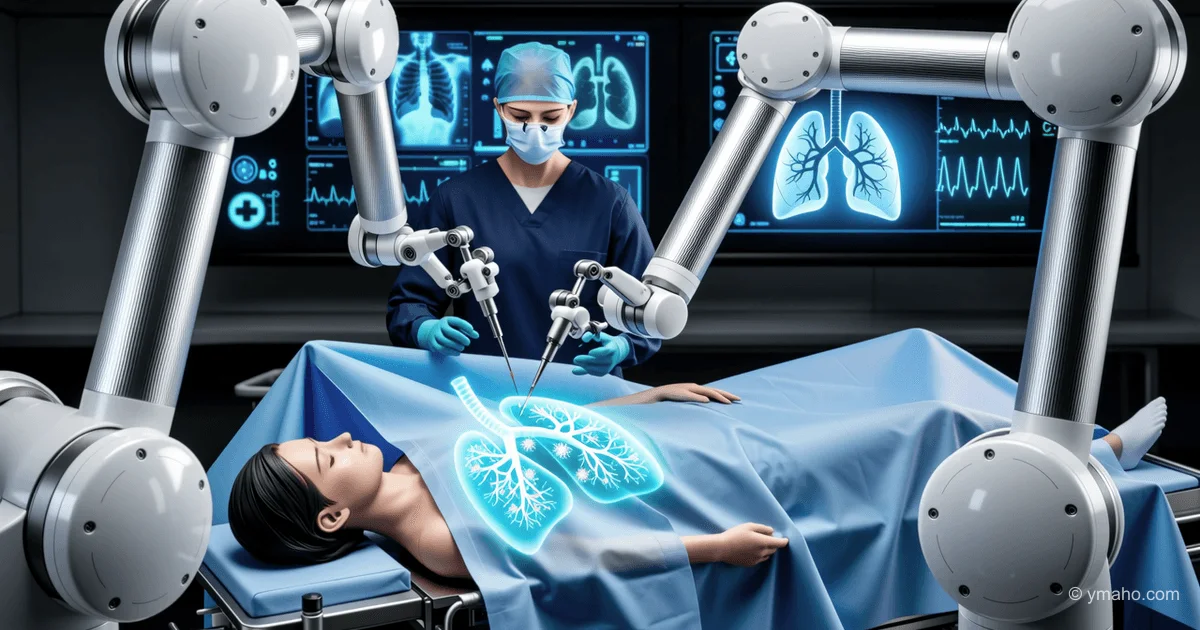
Surgeons at Johns Hopkins University Perform First Fully Autonomous Robotic Lung Transplant
The STAR system, under surgeon supervision, performed all key vascular and bronchial anastomoses with suture precision exceeding human capabilities, reducing graft warm ischemia time by 36%.
We are witnessing not just a surgical triumph, but a moment when a market worth $0.36 billion USD in 2026 begins its march toward $0.77 billion USD by 2030, driven not by Da Vinci with its zero autonomy, but by systems that for the first time take on not an instrumental function, but decision-making in the operating field.
The Essence: What Is Really Happening
STAR performed vascular and bronchial anastomoses in lung transplantation not as an assistant, but as an executor. This matters because vascular anastomosis in thoracic surgery is a procedure where the cost of error is measured in seconds. In lung transplantation, graft warm ischemia time is a critical factor determining primary graft dysfunction and long-term recipient survival. Reducing this time by 36% is not an engineering metric; it directly translates into lower aftercare costs by tens of thousands of USD and a reduced likelihood of reoperation.
The key shift is that STAR does not operate as a tele-manipulator. According to the Yang et al. classification, Da Vinci is at level 0—no autonomy, the surgeon controls every movement. STAR, which performed anastomoses under supervision but without direct control, corresponds to at least level 3 on the same scale—"conditional autonomy," where the robot perceives, plans, and executes actions while a human monitors and intervenes only when necessary. This is a transition from a "smart tool" to an "operating partner."
It is important to understand that this technology did not emerge from a vacuum. As early as 2022, STAR demonstrated laparoscopic small bowel anastomosis in a porcine model—and even then, suture quality, measured by standard surgical scales, surpassed human performance. Now the system has done the same on an organ with completely different biomechanics: lung tissue is elastic, vascular walls are thin, and respiratory movements create constant deformation of the operative field. That the algorithms handled this unstable environment speaks to the maturity of the software stack: real-time visual tracking with adaptive trajectory replanning, non-rigid 3D surface reconstruction, and predictive filtering to compensate for respiratory motion.
Timeline and Context
2022. STAR performs autonomous small bowel anastomosis in a pig—laparoscopically, using stereo endoscopy and structured light. This is a proof-of-concept: soft tissues can be sutured without human hands.
2025. The SRT-H system appears, performing cholecystectomy—the first step of autonomous surgery in a real abdominal procedure. Simultaneously, the Yang et al. classification with autonomy levels 0 to 5 is published, becoming the industry standard for describing surgical robots.
January 2026. A review in the International Journal of Surgery directly states: autonomous thoracic surgical robots are technically mature, and their emergence is a matter of the next few years. The authors point to the convergence of three factors: deep learning for anatomical structure recognition, real-time tracking for tissue deformation compensation, and miniaturization of force feedback sensors.
May 2026. Johns Hopkins performs the first fully autonomous robotic lung transplant. Axel Krieger, director of the IMERSE Lab and lead developer of STAR, is at the career stage where a laboratory prototype turns into a commercial product—he is already a co-founder of Semaphor Surgical, a company created specifically to translate STAR into the market.
Who Wins and Who Loses
Intuitive Surgical wins—but not now, rather in a 5-7 year horizon. Their current Da Vinci with zero autonomy looks vulnerable, but Intuitive has the largest installed base of robotic platforms in the world. If they integrate autonomous suturing algorithms into the next generation of Da Vinci, they will instantly become the dominant player in a market projected to grow to $0.77 billion USD by 2030 at a compound annual growth rate of 20.5%. Their strength lies not in algorithms, but in trust relationships with thousands of hospitals.
CMR Surgical with Versius and Medtronic with Hugo win—both systems have modular architectures that allow integrating software autonomy modules without replacing the hardware platform. Unlike Da Vinci, they were designed in an era when AI was already part of the plan.
Traditional surgical schools that do not invest in robotic infrastructure lose. GII Research data indicate that already in 2025, ownership of surgical robots among trusts increased by 42%—from 36 to 51, and this is just the beginning. Hospitals without a robotic base will be unable to attract patients for complex surgeries because a 36% reduction in ischemia time is an argument that insurance companies and patients will understand instantly.
An unexpected loser: traditional suture material suppliers. STAR uses specialized instruments with feedback sensors; its suturing algorithm is optimized for specific needles and threads with predictable biomechanics. The surgical consumables market will begin to drift from "one size fits all" to "certified for autonomous platform X."
What the Media Are Not Saying
Journalists write about a "fully autonomous" operation but deliberately blur the definition. According to the Yang et al. classification, "full autonomy" is level 5, where the robot performs the entire procedure without human involvement. STAR in this case operated at level 3, at most level 4: the surgeon observed and was ready to intervene. This is not "autopilot," it is "advanced cruise control." The distinction is fundamental because the regulatory path for level 3 and level 5 differs radically: for level 3, the FDA requires evidence that the system is safe under supervision; for level 5, evidence would be needed that the system can handle any intraoperative crisis without human involvement—which is still science fiction.
A second, even more subtle point: the "data flywheel" problem. Axel Krieger did not accidentally choose "Building the Data Flywheel for AI-Native Robots" as the topic of his talk at the Robotics Summit 2026—on May 27, just a few weeks after the STAR results were published. The essence is that every autonomous suture placement generates data that improves the next suture. This means the robot's learning curve is the inverse of a human's: a human gets tired and makes mistakes toward the end of an operation, while a robot becomes more accurate with each stitch. This flywheel effect is the true commercial core of Semaphor Surgical—not hardware, but a continuously improving software asset.
The true cost of implementing STAR is being downplayed. Robotic surgery already faces pricing pressure: tariffs on precision mechatronic components and sensor modules increase system costs for hospitals. In the case of STAR, which uses custom force-sensing instruments with fiber Bragg gratings, the price tag for one system could be $2.5-3 million USD—and that does not include staff training costs.
Forecast: Next 30 Days and 90 Days
In the next 30 days, expect three events. First: Intuitive Surgical will issue a press release hinting at its own developments in task autonomy—most likely, autonomous anastomosis as an option for the next version of Da Vinci. Second: Johns Hopkins will announce a series of 5-10 confirmatory operations to gather statistical power. Third: shares of companies producing traditional surgical instruments will adjust downward by 2-4%—analysts will begin incorporating a long-term shift in demand structure into their models.
Within 90 days, an event will occur that determines the speed of commercialization: the FDA will define the regulatory path for STAR. If the system is classified as a Class II device with a 510(k) premarket notification, Semaphor Surgical could enter the US market in 2027. If the FDA requires a PMA as for a fundamentally new device class, the timeline shifts to 2029-2030. In the latter case, the European market with its more flexible MDR regulation will become the first testing ground, and we will see pilot implementations in Germany and Switzerland. Autonomous surgery is ceasing to be an engineering concept and becoming a market reality faster than anyone expected.
— Editorial Team









