Marcia Kilgore Opens Beauty Pie's First Boutique in Liberty: Beauty Without Markups Goes Offline
Legendary online brand Beauty Pie, which sells luxury cosmetics at cost, has launched its first physical corner in London. Now shoppers can test cult products, including an LED cap for treating hair thinning, before purchasing.
The Gist: What's Really Happening
Beauty Pie opens in Liberty — but it's not about retail. Marcia Kilgore is testing whether "honest luxury" can be sold in a space where every jar screams status, while preserving the brand's key asset: price transparency. This isn't a store opening. It's a stress test of the business model.
Liberty's owner and Kilgore herself call the format a "strategic test of omnichannel distribution." The narrow space isn't designed for comfort: "There's not even anywhere to sit," Kilgore admits. Why this matters: a brand that built its identity around "we don't spend money on retail" is entering retail. This is either the start of a new era or the end of uniqueness.
Insider insight: Liberty isn't about sales. It's about legitimization in the eyes of skeptics. Three-quarters of consumers in the US and UK demand full ingredient transparency, and 65% are willing to pay more for cost breakdown disclosure. But it's one thing to trust Beauty Pie's website, and another to see the product on the same shelf as Augustinus Bader and Dr. Barbara Sturm. Here, retail is validation. After Liberty, the antithesis "cheap means worse" is finally shattered in the consumer's mind.
Timeline and Context
September 2025. Beauty Pie launches Youthbomb London Lab on Carnaby Street — a three-day immersive pop-up. First test of physical touch.
Late 2025. The company posts a job opening for Retail Partnerships Lead. Internal preparation for offline is in full swing.
April 21, 2026. Instagram teaser: "You know we don't do retail. Well, forget that."
April 27, 2026. Official announcement: Beauty Pie enters Liberty Beauty Hall on a permanent basis.
May 8, 2026. Opening of permanent corner in Liberty. Pricing: club members keep insider prices, others pay guest prices.
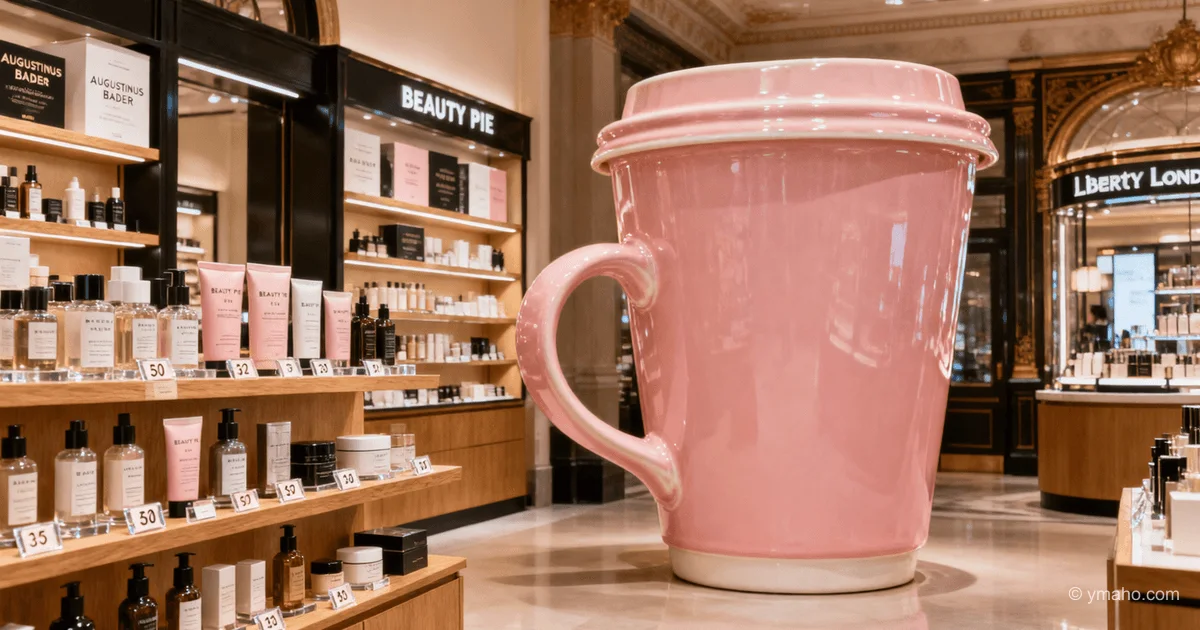
May 12, 2026. Launch of atrium installation — a giant upside-down pink coffee cup, a "coffee bar without coffee" where they hand out "cream shots." An allegory for overturning the luxury model.
May 9, 2026. We are here. Checkpoint: the first day after the corner opens, three days before the atrium buzz.
Who Wins and Who Loses
Winners:
- Liberty. The department store gets the loudest DTC disruptor in its beauty hall — traffic and PR you can't buy. Natalie Guselli, head of beauty at Liberty: "Their model challenges traditional conventions, which perfectly aligns with how our customers discover new products."
- Beauty Pie (if the test succeeds). Offline touch solves the conversion problem: "People want to feel the texture, smell the scent, see the color on skin," says Kilgore. A product at £44 is a serious threshold for a blind online purchase. The corner lowers the barrier.
- Skeptical consumers. Those who didn't believe in "factory price" without proof can now compare textures and scents with shelf neighbors.
- The DTC brand formula. If the model works, the road to retail opens for dozens of digital brands seeking physical validation.
Losers:
- Traditional mid-segment luxury. Brands sitting between mass market and premium lose their argument. When a shopper sees Beauty Pie next to iconic jars and understands the real production cost — €6.30 for a cream vs. €45 at retail — the question "what am I paying for" becomes devastating.
- Pure DTC players without an offline strategy. After Liberty, investors will start asking: "Where's your retail test?"
- Old-school marketing agencies. Kilgore's transparent model doesn't need celebrity ambassadors or multi-million ad campaigns.
What the Media Aren't Saying
1. No one knows how much Beauty Pie pays Liberty — and that changes everything.
Media write: "retail test." But no one has dug into the lease terms. Kilgore admits Liberty costs "not as much as a standalone store in a comparable area." This is key. If Liberty gave preferential terms for a buzzworthy anchor tenant, the test's economics aren't representative. Any other brand, inspired by the "success," will hit market rates and get burned. Conclusions from this case can't be scaled without cost data.
2. Guest pricing undermines the membership model.
Previously, a subscription was the only entry point. Now you can walk in off the street and buy without commitment, albeit at a smaller discount. The psychological anchor "membership = exclusivity" blurs. If the share of guest sales exceeds a threshold, the subscription model loses appeal: why pay $65 a year if the price difference isn't critical?
3. The LED cap in Liberty is a test of medical positioning, not just a "device."
Among the products at the corner is an LED cap for treating hair thinning. This isn't a cosmetic gadget; it's a device with medical claims. By displaying it in Liberty, Beauty Pie tests whether premium retail is ready to sell haircare in a health, not vanity, context. The success or failure of this unit will predict whether scalp care brands will enter department stores.
4. The "coffee shop without coffee" isn't a pop-up, but a hint at Beauty Pie Café as the next asset.
The atrium installation with "cream shots" is a classic MVP. The brand tests the hypothesis: can experiential beauty be sold in a food retail format? If traffic confirms it, within 12 months we'll see a permanent Beauty Pie Café or an experiential corner in a spa format.
Forecast: Next 30 Days and 90 Days
30 days (until June 8, 2026)
First numbers from Liberty will leak to trade press. I expect conversion from foot traffic to membership at 3-5% of corner visitors — this will be spun as a "success" in PR materials. The atrium installation will draw queues and become an Instagram boom: the giant pink cup is made for user-generated content. Traditional luxury brands in Liberty will start asking management about "neighboring a discounter." Kilgore will give a first interview hinting: "We're thinking about the East and West Coasts of the US" — and the market will start calculating future valuation.
90 days (until August 7, 2026)
Beauty Pie will announce a second corner — likely in the US. If Liberty data shows ROI higher than digital acquisition costs, the company will announce a pilot with an East Coast retailer — potentially Nordstrom or Saks. Key point: will Kilgore keep the promise of "tiny spaces" or be tempted by scale? If the corner remains a test format, the model proves sustainable. If Beauty Pie starts opening full-fledged stores, it's the beginning of the end for price transparency, because retail operating costs will require raising prices.
The main signal by August: will other DTC brands appear on Liberty's shelves with a "membership + retail" model? If so, Kilgore hasn't just opened a store — she's rewritten the rules for digital brands going offline.
— Editorial Team









