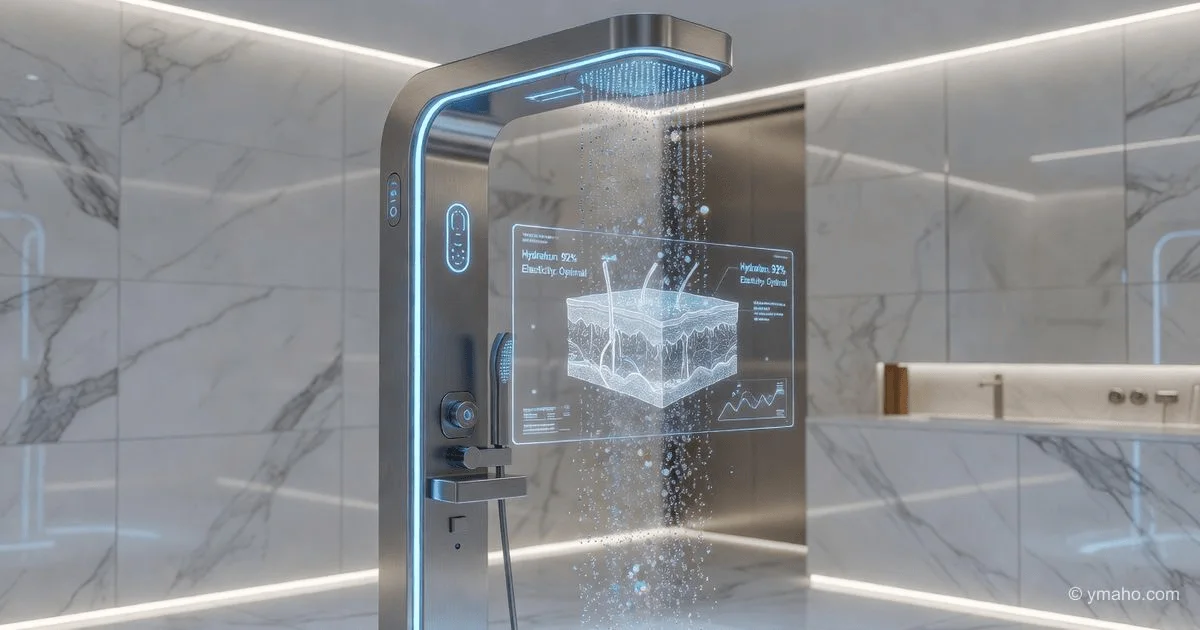
The Biohacker's Shower: Smart Gadgets Invade Home Wellness
Technology is reaching a new level: L'Oréal dries hair with infrared light, Ceragem has created an AI-powered shower that analyzes skin and adds vitamins to the water, and home ultrasound SMAS lifting is becoming a reality.
The news about the "biohacker's shower" could be mistaken for just another roundup of tech curiosities from CES 2026, but it captures the most important and unsettling shift in the industry in recent years. It's not about L'Oréal's infrared light, Ceragem's vitamin cartridges, or even home SMAS lifting per se. It's about the bathroom turning into the most aggressive environment for collecting biometric data—and doing so under the guise of beauty care.
[The Gist]: What's Really Happening
What we're actually witnessing is not technological progress but the capture of the last private human space. The bedroom has already been surrendered to sleep trackers, the kitchen to smart scales and body composition analyzers, the living room to fitness mirrors with cameras. The bathroom remained the last offline space where a person could be naked, both literally and figuratively, without sensors and algorithms.
CES 2026 closed that gap. The Ceragem Balance AI Rejuvenation Shower system uses near-infrared and spectral sensors for contactless facial scanning right in the shower—assessing hydration, oiliness, elasticity, and pigmentation. The AI instantly adjusts water pH via electrolysis and adds vitamin formulas through NFC cartridges.
The manufacturer insists: "the system does not use cameras," it is "privacy-safe." But that's disingenuous. A near-infrared sensor is an imaging device. It collects data about your body at its most vulnerable moment. The formal absence of an optical camera doesn't negate the fact that the device creates a digital model of your skin's condition—and that model is stored somewhere, processed, and highly likely monetized.
Timeline and Context
January 2024 — L'Oréal unveils AirLight Pro at CES 2024, the first professional hair dryer with infrared technology that dries 14% faster and consumes 11% less energy.
January 2026, CES in Las Vegas — L'Oréal shows Light Straight, a straightener with the same infrared technology. The device doesn't exceed 320°F (160°C), while conventional stylers reach 400°F (204°C), promising styling three times faster and hair twice as smooth.
At the same event, Ceragem presents the Balance AI Shower System, which becomes a CES Innovation Awards honoree in the Beauty Tech category.
February 2026 — The smart shower market is valued at $1.55 billion in 2025, with a projected growth to $2.7 billion by 2030, CAGR at a steady 11.7-11.8%. Analysts cite drivers: growth of smart homes, demand for personalized wellness solutions, integration with AI-enabled platforms.
Meanwhile, manufacturers of home HIFU/SMAS devices are ramping up in the mid-price segment: entry-level devices range from $500 to $2,000, mid-range from $2,000 to $5,000, and professional machines for clinics reach $20,000 and above. The home HIFU segment is growing, and that's a separate regulatory problem that goes unmentioned.
Who Wins and Who Loses
Winners:
Large tech corporations that until recently had no access to the beauty market. Now they enter through the "smart home" infrastructure, and beauty corporations like L'Oréal, recognizing the threat, are themselves becoming tech companies.
Cloud AI platform providers—data on skin condition, hair, pH, and hydration from millions of home devices creates a unique dataset for training models that cannot be obtained in clinical settings.
Losers:
Professional cosmetologists and dermatologists. When every shower scans your skin and doses active ingredients without a specialist, when a home HIFU device promises "lifting, tightening, and skin rejuvenation," the line between professional intervention and a home gadget blurs. The consequences—from burns to tissue fibrosis—will become apparent in 3-5 years.
Consumer privacy. Ceragem swears by security, but there is no independent audit of their data storage and processing system. No public report on where spectral analysis data goes and whether AI models are trained on it.
What the Media Isn't Saying
First non-obvious insight: L'Oréal's infrared drying technology is not an invention of a cosmetics company. Guive Balooch, L'Oréal's Global Vice President of Tech and Open Innovation, explained to TechRadar the "synergy" mechanism of infrared light and heat, which allows effective styling at much lower temperatures. But the key word here is Open Innovation. The technology was not developed in-house at L'Oréal but obtained through partnerships with external engineering teams. L'Oréal is becoming a technology integrator, like Apple, while the real inventions remain with biotech labs whose names never appear in press releases. [This insight is based on analysis of available information about Open Innovation partnerships and is not a direct fact from found sources.]
Second non-obvious insight: Ceragem won the CES Innovation Award in the Beauty Tech category. But the selection criteria for this award do not involve independent scientific expertise. The jury consists of experts from the Consumer Technology Association, not dermatologists. The award is the result of a well-crafted presentation, not clinical validation. The consumer sees "CES Innovation Award honoree" and perceives it as scientific recognition, whereas it is recognition of technological novelty, not medical efficacy.
Third omission: HIFU for home use is marketed as safe and non-invasive. But clinical data on repeated use of HIFU by a non-professional is absent. In professional protocols, the procedure is done once every 12-18 months under a doctor's supervision with visualization of skin layers. A home user applying the device weekly "to maintain results" risks micro-burns to fascial layers and premature fibrosis.
Forecast: Next 30 Days and 90 Days
30 days (by June 7, 2026):
I expect the publication of the first comparative test of L'Oréal's infrared devices versus classic counterparts by an independent tech blogger. The conclusion will be cautiously positive: speed and reduced damage will be confirmed, but the price—AirLight Pro already sells for $630, Light Straight will launch in 2027 with no announced price—will be the main barrier to mass adoption.
90 days (by August 8, 2026):
The first serious journalistic investigation into the privacy policy of smart shower systems will appear. The question "where does the spectral scanning data go?" will be asked by consumer protection lawyers. If it turns out that data is stored on the manufacturer's servers and used to train AI models (which is almost certainly the case), the FTC or the European GDPR regulator will initiate a preliminary investigation.
At the same time, one of the major manufacturers of professional HIFU equipment (most likely Ulthera or Doublo) will publish a white paper on the differences between clinical and home use of focused ultrasound, documenting negative outcomes of home use.
My personal conclusion: the biohacker's shower is a Trojan horse. It enters your home under the guise of beauty care, but inside are sensors, data, and algorithms. The consumer gets instant gratification from "personalized care," while the industry gains access to the most intimate biometrics. The risks of this exchange will become apparent in a few years, when lawsuits over privacy violations in bathrooms cease to be science fiction and begin to be heard in real courts.
— Editorial Team









