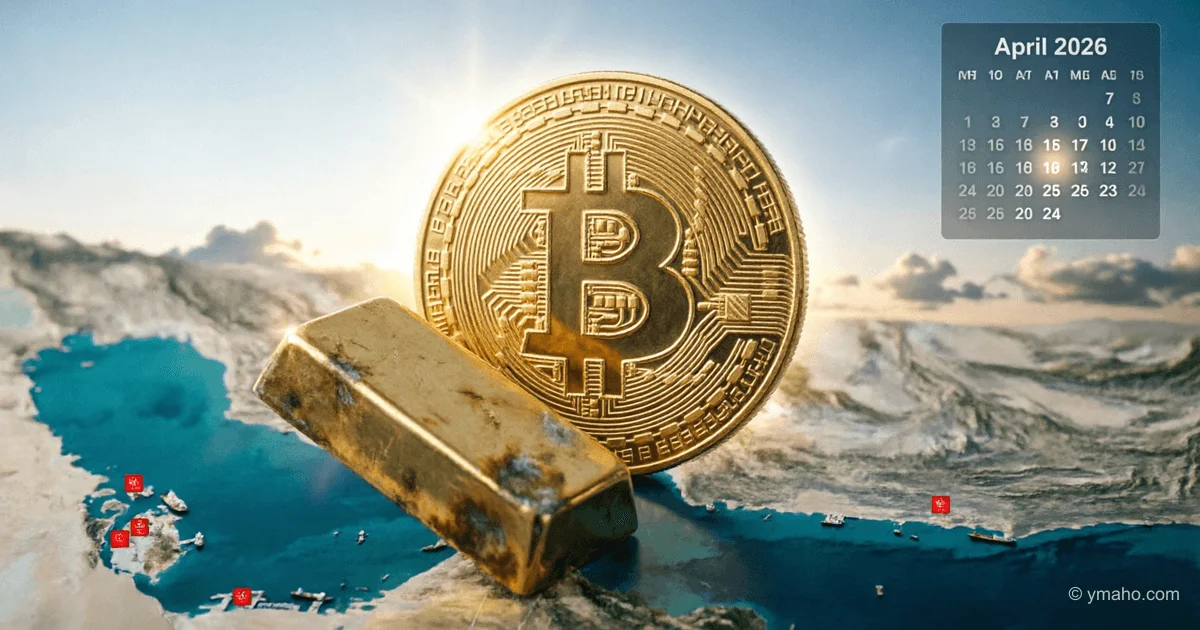
Bitcoin Posts Best April in 6 Years Amid Geopolitical Uncertainty
BTC sees one of its best Aprils yet, driven by high retail greed and corporate news from Visa and Tether. Santiment analysts warn of a possible short-term correction amid the frenzy, while Russia discusses full-fledged crypto market regulation.
Bitcoin vs. Chaos: Why Digital Gold Outperforms Physical Gold in Times of Crisis
Introduction
April 2026 will go down in crypto history as the month Bitcoin finally changed its stripes. While missiles blocked the Strait of Hormuz and oil prices surged to $112 a barrel, the leading cryptocurrency gained roughly 10% over the month, approaching the $80,000 mark. Meanwhile, the traditional safe haven—gold—lost over 12% of its value.
"Over two months of the military conflict in the Persian Gulf, traditional safe-haven assets and cryptocurrencies have swapped roles," notes Alexander Baryshnikov, managing director of the Mining fund. Bitcoin, once considered an ultra-risky asset just a year ago, is now behaving as a diversifier, while gold acts like a commodity under macroeconomic pressure.
But analysts warn: market euphoria has reached "ultra-FOMO" levels, which almost always signals a correction. At the same time, institutional demand remains high, and Russia is preparing for full-scale crypto market legalization.
Event Details and Timeline
Market: From Fear to Greed in 72 Hours. Bitcoin's April rally was swift and emotional. On Monday, April 20, BTC was trading around $76,000, with social media sentiment in "deep fear" territory. Then, in just three days, the situation changed dramatically: Bitcoin jumped above $78,000, inching closer to the psychological $80,000 mark. Analytics firm Santiment recorded a shift from one extreme to the other—the market entered "ultra-FOMO mode" (fear of missing out).
From a technical standpoint, Bitcoin broke through several key levels. Closing above the 61.8% Fibonacci retracement at $78,490, the asset overcame a major resistance zone. BTC closed in the green for four consecutive weeks, and spot ETFs saw inflows of $823.7 million in the last week of April alone.
Peak: $79,472 and Pullback to $76,000. On April 22, Bitcoin hit a local high of $79,472. The drivers were: first, capital rotation from gold into cryptocurrencies; second, sustained inflows into US spot ETFs; and third, expectations of de-escalation in the US-Iran conflict.
However, it failed to hold above $80,000. By April 27, the price had corrected to $76,337. The reasons were multiple: ETF outflows of $263.18 million, breaking a nine-day inflow streak; the University of Michigan consumer sentiment index falling to an all-time low of 49.8 points; and rising inflation expectations, which hinder the Fed from easing policy.
Key Factor: Geopolitics. Throughout April, Bitcoin's price was sensitive to news from US-Iran negotiations. As Investing.com notes, "the current diplomatic stalemate remains the main source of market uncertainty." Bitcoin demonstrated its ability to rise even on weekends when traditional markets were closed, acting as a liquidity tool during geopolitical shocks.
Impact and Significance (for the World / Industry / Society)
Gold and Bitcoin Have Swapped Roles. The most significant observation of the past two months is the divergence between traditional and digital safe-haven assets. From February 28 to April 28, 2026, gold fell from $5,278 to $4,099, then recovered to $4,616, ending with a net decline of 12.3%.
The reason is simple and alarming for physical metal proponents: central banks, especially in Asia, began selling gold to free up reserves under pressure from oil inflation. Additional pressure came from the Fed's hawkish rhetoric: high rates and rising bond yields became direct competitors for the metal, which offers no coupon income.
Bitcoin, on the other hand, evolved from a "risk asset" to a "digital safe haven" during crises. As Alexander Baryshnikov notes, "at the moment of the shock on February 28, it rose 17% in four days, reaching $74,050, acting as a liquidity tool on weekends when traditional markets were closed."
Institutional Demand as a Backbone. Despite the correction at month-end, ETF data remains impressive. For four consecutive weeks, US spot Bitcoin ETFs recorded positive net inflows: $996 million, then $823.7 million. BlackRock's IBIT attracted about $3 billion since the start of the year, ranking in the top 1% of all ETFs by inflows.
However, Glassnode analysts note a nuance: net purchase volume rose 199%, but total trading turnover fell 13.8%. This suggests that the current rally is driven by relatively low speculative activity—meaning real institutional money, not leveraged retail players, is behind it.
But There Are Warning Signs. According to analyst Carmelo Alemán, part of April's rally was driven by futures market activity rather than spot demand. Open interest rose from $24.9 billion to $28 billion, and liquidations of short positions in Bitcoin and Ether exceeded $1.1 billion. Such a structure often makes the market vulnerable to reversals if spot buying pressure weakens.
Key Players' Reactions
Visa and WeFi: A Giant Enters On-Chain Banking. On April 28, it was announced that payment giant Visa had partnered with WeFi, a blockchain company founded by former Tether CEO Reeve Collins. The goal is to build infrastructure for blockchain-based banking services, providing users with IBAN accounts.
"We are updating the pipeline system, essentially giving people bank accounts because they will soon have their own IBAN numbers," Collins said. The key feature: users retain control of their private keys without handing them over to centralized exchanges.
The launch is planned for Europe, Asia, and Latin America. Matthieu Altwerg, Head of Visa Products in Europe, noted: "This partnership demonstrates how the global Visa network interacts with blockchain models while operating within existing regulatory frameworks."
This move is not isolated. Visa has already acquired Bridge, a stablecoin company, and Stripe is expanding its crypto card business to over 100 countries. The payment industry is gearing up for mass adoption of digital assets.
Russia: Legalization on the Horizon. On April 21, the State Duma passed in first reading a bill regulating cryptocurrency and digital rights operations. The document lays the foundation for a national crypto market infrastructure with clear participant admission conditions.
Anatoly Aksakov, head of the State Duma Committee on Financial Markets, explained: "After passing a test, citizens will be able to legally invest in cryptocurrencies through licensed platforms and intermediaries—exchanges, brokers, trust managers. In fact, the process will not differ from trading on the classic stock market."
The bill also introduces a system of digital depositories supervised by the Central Bank and creates licensed crypto exchanges. Cryptocurrency will be allowed for foreign trade settlements. Most changes will take effect on July 1, 2026.
Notably, when asked by a Communist Party deputy why Russia is moving toward legalization while China has banned cryptocurrencies, the response was: Hong Kong allows them, and crucially, after sanctions were imposed, cryptocurrency became necessary for international settlements.
Santiment and Analysts: FOMO Concerns. While the market celebrates, analytics firm Santiment urges caution. "Price predictions for a coin are a great way to see what the opposite likely price path will look like," experts said, pointing out that excessive retail optimism often acts as a contrarian signal.
Trader Peter Brandt also cools the enthusiasm: "Those of you predicting $250,000 in 2026, stop eating mushrooms. This is called a channel. It does not rule out further price increases, but it is NOT a bullish reversal pattern."
Analyst Ted Pillows highlights technical indicators: Bitcoin lost its uptrend on the 4-week chart, the Coinbase premium turned negative, and the RSI is forming lower highs and lower lows. In his view, if the $77,500 level is not quickly reclaimed, the risk of a deeper correction increases.
Forecast and Conclusions
Short-Term Forecast: Correction Likely. Analysts agree: the $80,000 level is not just a psychological barrier but a zone of high option contract concentration. Santiment states that a sustained break above $80,000 would be more convincing "if optimism cooled down a bit."
Key support is around $68,400, and a break below opens the door to $60,000. Traders are also watching the $72,000 level and fundamental support near $65,000.
Medium-Term Forecast: All Depends on the Fed and Geopolitics. As Alexander Baryshnikov emphasizes, "the medium-term bullish scenario only materializes with simultaneous stabilization of the conflict and a Fed pivot—neither looks inevitable yet."
Institutional demand remains a strong support factor, but it is sensitive to macroeconomics. If the Fed continues to hold rates high (as markets expect), ETF inflows could slow. If geopolitical tensions ease, Bitcoin could get an additional boost as capital moves from safe havens to risk assets—and BTC, which has behaved as a safe haven, could unexpectedly benefit from both scenarios.
Long-Term Forecast: Bitcoin Changes Status. The most important takeaway from April is that Bitcoin passed a successful "stress test" of a geopolitical crisis. Unlike previous conflicts (the start of the war in Ukraine, the escalation in Israel in 2023), when BTC fell along with markets, this time it showed resilience and even growth.
Visa seems to believe in the long-term potential: the partnership with WeFi is not a speculative play but a strategic bet that on-chain banking will become a reality in the coming years.
Key Takeaway. Bitcoin completed its best April in 6 years, but market euphoria has reached dangerous levels. Santiment warns: "Wherever the crowd goes, run in the opposite direction"—and there is some truth to that. However, the long-term trend remains bullish: institutions are entering, regulators (at least in Russia) are legalizing, and Visa is building on-chain infrastructure. And while traditional markets remain frozen in anticipation, Bitcoin has proven that in a chaotic world, digital decentralization can be more than just speculation—it can be insurance.
— Editorial Team









