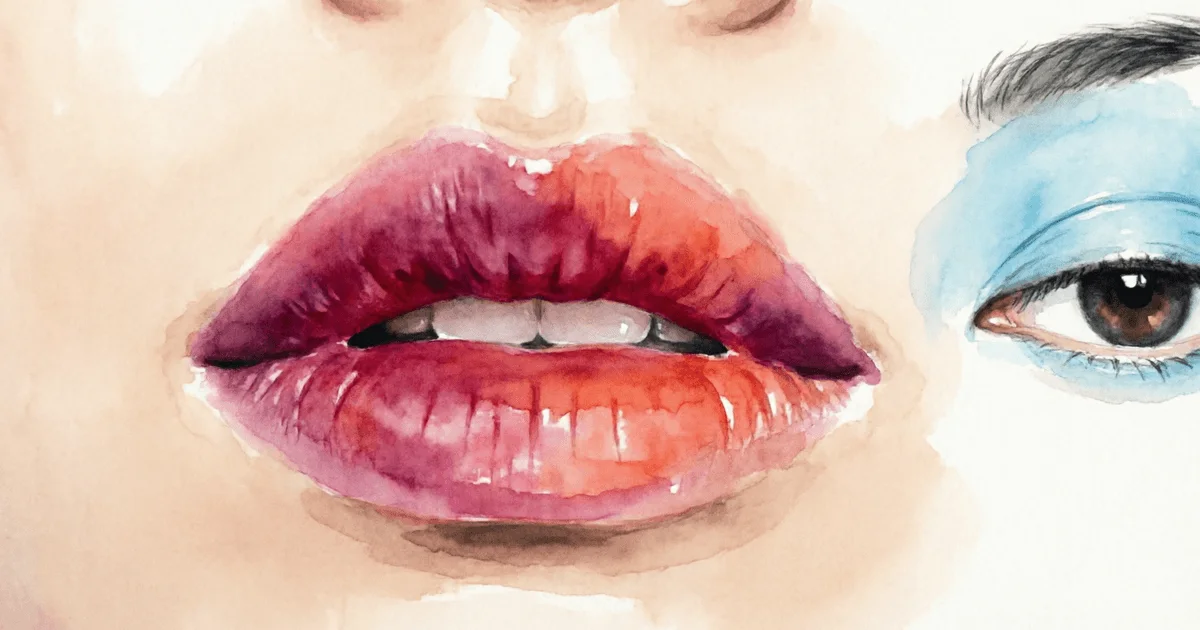
Blurred Lips (#blurredlips) and Watercolor Makeup — the Top Beauty Trends from the Red Carpet
Soft, "kissed" lips with a blurred contour and gradient effect, along with translucent, dewy textures in eye and face makeup, are in vogue. These styles, spotted at Met Gala 2026, aim to enhance natural beauty without graphic precision.
As a product and visual merchandising consultant for major beauty retailers, I see the triumph of "blurred lips" and "watercolor makeup" at Met Gala 2026 not as an aesthetic choice by makeup artists, but as a planned industry operation to shift the technological paradigm in the mass segment. What the glossies present as "tenderness and naturalness" is actually a forced migration of consumers from sharp contours to diffuse techniques, which collapses the market for classic lipsticks and opens the floodgates for a new class of high-margin tints and balms. We are witnessing not just a trend, but a strategic dismantling of graphic precision in favor of "lazy luxury," where understatement costs more than loud accuracy.
The Essence: What's Really Happening
The true nature of the #blurredlips trend taking over red carpets is a paradigm shift from "color" to "texture." Vogue accurately captures this shift: in 2026, finishes, not shades, became defining. But behind this observation lies hard business logic. A sharp lip contour requires perfect symmetry, long-lasting pigment, and dense coverage—which means costly waxes, polymers, and pigments in the formula. A blurred contour, which Chanel makeup artist Kate Lee recommends creating by blending from the center of the lips outward, forgives any imperfections and allows for a much cheaper water-based formula.
This is not just a change in technique. It's a legalization of "imperfection" that drastically reduces product cost while maintaining a retail price comparable to luxury lipstick. Brands like Violette_FR sell Lip Nectar—essentially tinted water—at the price of a full luxury product, marketing it as "French chic." Victoria Beckham Beauty released the Water Tint Bronzer, which sold out instantly, proving that consumers are willing to pay a premium for a "blurred veil" instead of a dense contour. This is not a trend toward naturalness, but a trend toward radically lowering production costs while keeping luxury price tags.
Timeline and Context
The key mutation occurred in late 2025 to early 2026, when makeup artist Nina Park, who works with Bella Hadid and Zoe Kravitz, popularized the "blurred kiss" technique. But the real explosion came thanks to Korean brands Fwee, Rom&nd, and PeriPera—makeup artist Casey Spickard admits she sees these products in clients' makeup bags more and more often. K-beauty has long practiced "velvet" finishes, and their labs were the first to develop formulas that create a "pillowy" effect without a clear boundary.
Met Gala 2026, held on May 5, became the moment of canonization. Zoe Kravitz showcased the "strongest version" of blurred lips, while Hailey Bieber presented a softer take. That same evening, Gigi Hadid, Nicole Kidman, and Karlie Kloss stepped out with "watercolor" blush and "ghost lashes," completely forgoing mascara. It was a synchronized show of force: the industry demonstrated that "nothing" on the face is the new "everything."
Meanwhile, TikTok Shop recorded a 96% year-over-year increase in searches for "maximalist makeup," but mass consumers didn't go for radical makeup; instead, they chose a hybrid: "clinical skincare + creative makeup." Blurred lips and watercolor proved to be the perfect compromise—they allow for bright colors without intimidating graphic precision.
Who Wins and Who Loses
The main beneficiaries are Korean and French niche brands that have captured the "tint and balm" niche. Rom&nd, PeriPera, and Fwee are pushing classic luxury lipsticks out of Gen Z's makeup bags. Victoria Beckham Beauty has staked its claim in the "watercolor bronzer" segment with the Colour Wash product, which will "define makeup in 2026." Chanel is also ahead: their N°1 De Chanel Lip and Cheek Balm in Berry Boost went viral after being used on Margot Robbie.
Losing out are manufacturers of classic matte lipsticks and liquid lip glosses. Their formulas require graphic precision, and the industry has declared graphic precision "outdated." Also losing are brands that invested in "contouring kits": the blurred technique doesn't require three shades of concealer and cream contour. A collapse in sales of classic sharp lip liners is inevitable—consumers are switching to "unsharpable pencils" like Hailey Bieber's Rhode Lip Shape.
A separate loser is mass-market with slow production cycles. While giants like Maybelline launch Cloudtopia blush with a "mousse texture," niche Korean brands have already captured the shelf.
What the Media Isn't Saying
The most carefully hidden fact: blurred lips and watercolor makeup are a solution to the "Instagram face" problem in the era of 4K cameras. A sharp contour, flawless in daylight, looks like a mask under the unforgiving resolution of modern smartphones. Diffuse technique is an optical illusion: the gradient creates the illusion of volume and moisture where the skin has already begun to lose elasticity.
The second non-obvious insight is the connection to medical skincare. "Watercolor" textures require an ideal barrier: if the skin is flaky, the blurred pigment will accentuate every scale. Thus, the trend toward "weightless makeup" pushes consumers to buy expensive hydrating primers and barrier creams. Those who sell "blurriness" also sell the preparation for it.
Forecast: Next 30 Days and 90 Days
First 30 days. In June 2026, the "tint war" will begin. Every mass-market brand will launch its own version of a "water blush" priced at $9–15. K-beauty brands will release limited summer collections of "watercolor palettes" for lips and cheeks. The first viral failures will appear: water-based tints will run and oxidize on oily skin, sparking a wave of negative reviews.
90 days. By September 2026, segmentation will occur: luxury will move into "intelligent blur" (formulas with micro-pigments that adapt to skin pH), while mass-market will get stuck with "messy" streaks. Amid criticism, a counter-trend will emerge—"structural graphics," bringing back sharp lines as an antidote to "sloppiness." However, the foundation is already laid: "blurred lips" and "watercolor cheeks" have become basic techniques for the TikTok generation, and a return to hard contours will be seen as an anachronism. The classic lipstick is dead—long live the $35 tint.
— Editorial Team









