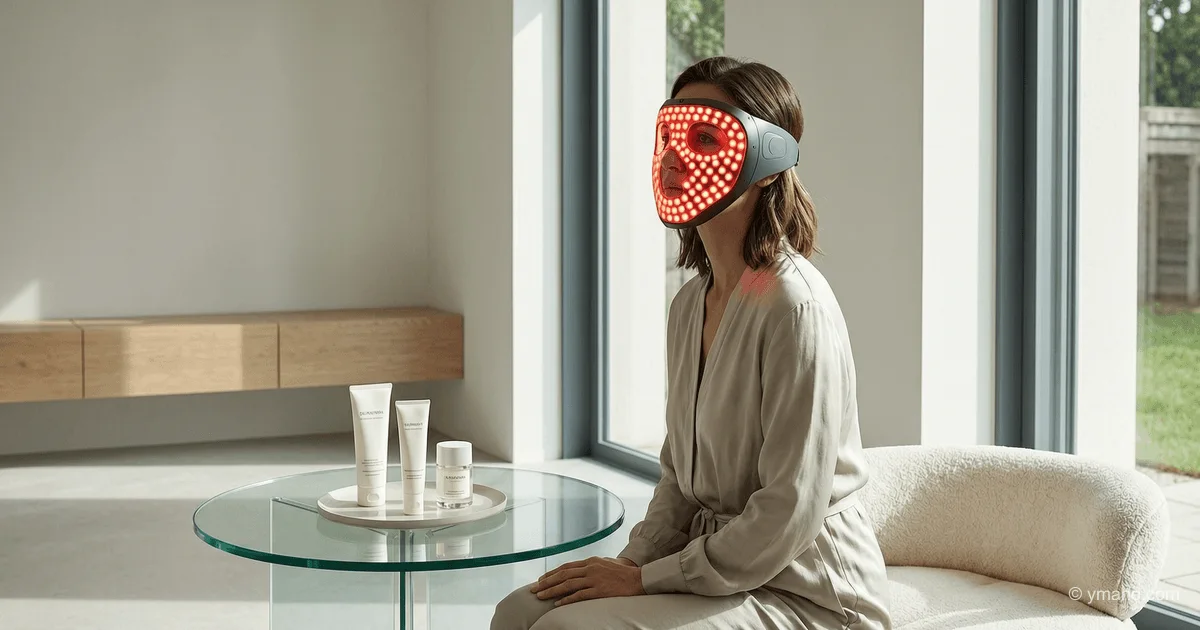
Experts Predict a Boom in Portable LED Face Masks
With the rise of the "skinnification" trend, beauty devices are becoming more popular. LED masks for home care are noted as a fast-growing category, and innovations toward more portable designs are expected in 2026.
From storefront to venture portfolio: why portable LED masks are turning skincare into a battle of tech giants
The Gist: What's Really Happening
Experts predict a boom in portable LED face masks, and the media presents it as a cute story about "home cosmetology." But let's call a spade a spade. Right now, in May 2026, we are not witnessing a trend in beauty gadgets. We are witnessing a tectonic shift in the industry that is reshaping a $5.04 billion market growing at 13.3% annually.
The elephant in the room: portable LED masks are not a replacement for cream. They are a replacement for the dermatologist. And a battle is unfolding over this transition between consumer brands, cosmetic clinics, and, most interestingly, venture capitalists who smell an Apple 2007 moment.
The global market for portable LED masks is already valued at $131.85 million in 2026 and is heading toward $209.32 million by 2032, with a CAGR of 8.41%. The entire segment of personal face and skin devices, which includes LED, RF, and microcurrent gadgets, will reach $7.91 billion by 2030. This is not a niche story—it's mass consumer tech that is redefining what "home care" means.
Timeline and Context
The roadmap of this trend is engineered with almost surgical precision.
Phase One: Clinical Validation (2020–2023). Photobiomodulation technology, originally developed by NASA for wound healing in astronauts in zero gravity, received dermatological confirmation. Studies showed that red light at around 633 nm and near-infrared at 830 nm stimulate the mitochondrial enzyme cytochrome c oxidase, triggering a cascade: increased ATP production, nitric oxide release, modulation of reactive oxygen species, and subsequent stimulation of collagen synthesis. A 2025 JAAD consensus review confirmed the efficacy of PBM for androgenetic alopecia, wound healing, and acute radiation therapy. The technology received scientific clearance for the consumer market.
Phase Two: Skinnification and the K-Beauty Effect (2024–2025). This phase saw synergy with the "skinnification" trend, noted by LookFantastic in May 2026: consumers became fluent in the language of peptides, lipids, and PDRN, and LED masks turned into a fast-growing category. K-beauty brands, which saw a 174% revenue increase on LookFantastic in 2025, set the bar: rapid innovation, AI-optimized formulas, hundreds of new products per month.
Phase Three: Portable Revolution (2026). Once the technology became consumer-friendly, the race for portability began. The global market for personal face devices is already at $5.04 billion, with a forecast of $7.91 billion by 2030. Consumers increasingly prefer portable and easy-to-use devices. This is not about cosmetics—it's about UX.
Who Wins and Who Loses
Several groups of players win, the most obvious being LED mask manufacturers. The current average price point for devices, according to Women's Health, which tested LED masks in early 2026, is $300–$600. This is not a $30 cream bought once a month. It's a device with a 3–5 year lifecycle—a model investors love.
In the Russian market, the dynamics are even more explosive. LED mask turnover on Wildberries in Q1 2026 showed a 220% year-on-year increase. This means that Russian consumers, facing economic constraints, did not abandon LED masks but instead view them as a replacement for more expensive salon treatments.
Cosmetic clinics find themselves in a difficult position. Yulia Frangulova, chair of the council of the self-regulatory organization "National Association of Aesthetic Medicine Clinics," frankly admits: "Using devices can improve blood microcirculation in tissues, after which a short-term refreshed face effect is observed, but that's the maximum." However, consumers vote with their wallets differently.
The dermatological community is forming a more nuanced position. A review by Dermatology Times on May 1, 2026, debunking social media myths about LED devices, concludes: "Is it a myth? Both yes and no! The biology of PBM is real and the mechanism is well characterized. For photoaging—fine lines, skin texture, collagen stimulation—clinical evidence confirms that consistent use of sufficiently powerful home LED devices can yield modest but measurable improvements." The key word is "modest." And the key problem: "Consumer masks vary tremendously in actual emitted power, wavelength accuracy, and dose delivery, and many cannot demonstrate the parameters needed to replicate what was studied in trials."
Losers: dermatologists who fail to restructure their business model. Losers: traditional cosmetics manufacturers who do not invest in the device direction. Losers: consumers who buy cheap masks from AliExpress for $20–$40: a 2025 pilot study published in PMC found wide heterogeneity among consumer devices in output power, stability, and actual irradiation dose, with beam divergence angles reaching 74 degrees in some devices—meaning actual energy delivery is significantly less than claimed.
What the Media Isn't Saying
The first non-obvious insight: the LED mask boom is a response to a crisis of trust in cosmetic ingredients. The 2026 consumer is tired of marketing promises of "revolutionary serums." An LED mask is a device that either works or doesn't. It's a hardware approach in an industry built on software promises (creams). The company that first creates an LED mask with objective efficacy metrics in a companion app will win the market.
The second insight: the invisible battle for standardization. Clinical PBM systems operate in the range of 100+ mW/cm², while most home LED masks deliver 20–40 mW/cm². Many consumer devices do not disclose irradiance data at all, making it impossible to verify whether a therapeutic dose is achieved. Moreover, some users, trying to speed up results, use masks longer than recommended, which can lead to adverse effects. The market is ripe for regulation, and brands that first introduce voluntary parameter certification will gain a competitive edge.
The third insight is the deepest and concerns the Russian context. The 220% growth in LED mask sales on Wildberries is not so much about a love of technology as it is about consumer economic strategy. The average price of an LED mask on Wildberries is about 1,600 rubles. For comparison, one visit to a dermatologist for LED therapy at a clinic costs $50–$150. Russian consumers, facing inflation and reduced disposable income, are making a rational bet on a home device that pays for itself in 3–5 treatments.
The fourth insight: portability as a strategy. GII Research's forecast for the portable LED face device market indicates the segment will grow from $105.12 million in 2025 to $183.42 million by 2032, with a CAGR of 8.27%. Meanwhile, the global market for all LED masks (including non-portable) is $131.85 million in 2026. The difference between these figures shows that portable models dominate and grow faster than stationary ones.
Forecast: Next 30 Days and 90 Days
30 days (by June 7, 2026). The LED mask market will enter the summer season, when demand for home treatments traditionally rises. Expect at least 2–3 major cosmetic brands to announce the launch of their own LED devices. A key indicator is the emergence of the first masks with clinical-grade parameters (irradiance 100+ mW/cm²) in the consumer segment. This will blur the line between home and professional use.
90 days (by August 7, 2026). By the end of summer, we will see the first consolidation attempts: large beauty corporations will start acquiring successful LED startups. The portability trend will mutate into a trend for companion app ecosystems: a mask that syncs with a phone, tracks progress, and adapts the protocol to skin type will become a must-have.
Market risks: regulatory intervention. If the FDA or Roszdravnadzor tightens requirements for consumer LED devices, some budget brands will leave the market, and the average price for quality masks will rise to $400–$600.
Final takeaway: the boom in portable LED masks is not a story about yet another beauty gadget. It's a story about how consumer hardware enters the services market and redistributes $5 billion. And those who understand the difference between a $30 mask with unverified parameters and a $400 clinical-grade device will not only look better—they will own shares in the companies building this market.
— Editorial Team









