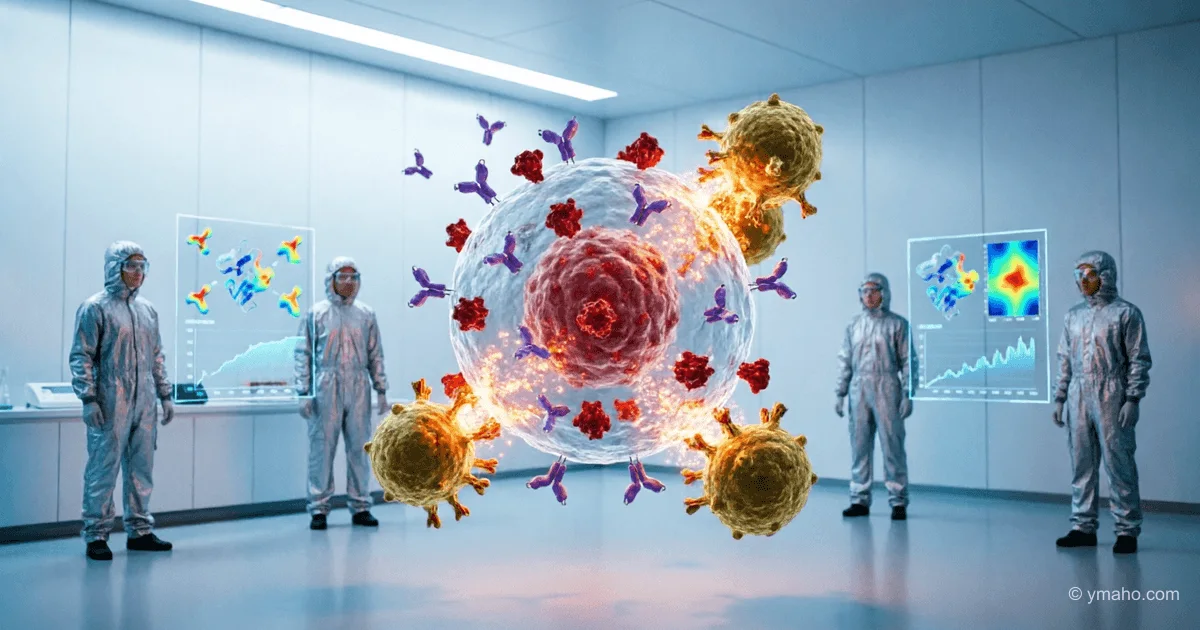
Nature: Global Landscape of Innovative Cancer Drugs Shifts Toward Breakthrough Technologies
A major review in Nature shows that among candidates for 'first-in-class' cancer drugs, the share of cell and gene therapy, antibody conjugates, and PROTACs is growing. Technological breakthroughs are expanding the boundaries of drug applicability for previously undruggable targets.
This shift should be seen not as a statistical exercise, but as drawing a line under the era of 'low-hanging fruit' in oncology and the beginning of a completely different game.
The Essence: What Is Really Happening
The publication in Nature is not just a report on the increase in the number of 'first-in-class' molecules. It is a documentary record of the death of the rational drug design paradigm in its old understanding. Previously, we found a target (protein), made a key (inhibitor), and inserted it into the lock. Now, judging by the structure of PFIC candidates, there are almost no targets left in the conventional sense. The growing share of PROTACs, cell therapy, and conjugates means the industry has moved from inhibition to forced degradation and cell engineering. In Nature's analytical framework, this is called 'innovation archetypes,' but in reality, it is simply an admission: we can no longer pretend that cancer is just a broken enzyme that can be plugged with a stopper.
Nature's main message is that the technological platform (modality) is now more important than the specific biological target. We are delving into such thickets of 'undruggable' targets that without new weapons—whether PROTAC or CAR-T—we simply cannot approach them.
Timeline and Context
This shift has been brewing since 2017—since the approval of the first CAR-Ts. But Nature records the turning point now, analyzing the pool from 2009 to 2024. The key marker: in the clinical trial pipeline, the ratio has flipped. Previously, FIC was based on target novelty (52 out of 93 approved), but today, new technological modalities are leading the 'potential FIC' candidates.
Why is this happening now? Because the 'gold rush' around PD-1/PD-L1 and CD47 has ended in sobering. The article includes a harsh historical excursion—from mechlorethamine and methotrexate to pembrolizumab—to show that each leap was a change in concept, not target. We are now at the same inflection point as the transition from cytotoxics to targeted therapy.
Who Wins and Who Loses
Platform companies and CDMOs win. If modality wins, not target, then the value of an individual molecule patent decreases, while the value of owning a production platform (viral vectors, editing technologies, ADC linkers) skyrockets. Those who build a 'conveyor belt' win: Arvinas with PROTACs, Moderna with mRNA, large players like Pfizer and Roche that can buy platforms for $2–5 billion and churn out drugs on them.
Classic biotech startups focused on a single target lose. Previously, a Stanford professor could find a new kinase, raise $15 million for it, and go public. Now, venture funds like a16z Bio+Health or ARCH Venture Partners look at this skeptically: if the target is not amenable to PROTAC, ADC, or CAR-T, the chances of success are minimal. This creates a 'funding desert' for traditional small molecules.
An unexpected loser is the US regulatory system. The FDA is used to thinking in terms of 'molecule—target—indication.' But how do you regulate a drug that has no permanent target because it is a killer cell (CAR-T) or a molecule that simply tags a protein for disposal (PROTAC)? The FDA lacks the expertise, and this will lead to slower approvals in the FIC segment in 3–4 years, when a wave of such applications reaches PDUFA deadlines.
What the Media Are Not Saying
The media have highlighted 'growth in PROTACs and cell therapy.' But everyone missed the main nuance from Nature's methodology: the study strictly separated 'new target' from 'new mutation.' Many so-called 'breakthrough technologies' are actually old targets with new mutations (e.g., KRAS G12D inhibitors vs. old G12C). This is not a scientific breakthrough but fine-tuning and an attempt to extend patent protection.
Insight: Behind the growth figures of PFIC lies a monstrous level of clinical attrition. Nature writes about 'bottlenecks': high failure rates in the clinic. In fact, looking at data for PROTACs and cell therapy in Phase II, failures are due not to bad science but to CMC (Chemistry, Manufacturing, and Controls) logistics. We have learned to invent magic bullets, but we have not learned to produce them stably and deliver them into the body without the dose cost exceeding $400,000. This gap between scientific drive and manufacturing hell is the main barrier, which Nature mentions in passing.
Forecast: Next 30 Days and 90 Days
30 days (by June 18, 2026): We will see a wave of valuation corrections in the venture market. Analysts will begin to look more skeptically at companies that cannot clearly classify themselves into one of the four 'innovation archetypes' according to Nature's classification. Startups will rush to rewrite their pitch decks to fit into the trend of 'new modalities' or 'multispecificity.' At least one alliance between big pharma and a PROTAC startup for $500–700 million will be announced.
90 days (by August 19, 2026): At ASCO and other summer venues, aggressive hype will begin around 'CONJUGATE + IO' combinations (conjugates plus immunotherapy). But more importantly, the FDA will be forced to issue clarifications on regulating new modalities, especially in light of recent safety issues with CAR-T (secondary lymphomas). This will cool the market by a 5–7% correction in the XBI index. If the FDA hints that the approach to 'platforms' will be stricter, the PFIC candidate bubble will begin to deflate, leaving afloat only those with a real CMC mass production plan, not just a beautiful genetic scheme.
— Editorial Team









