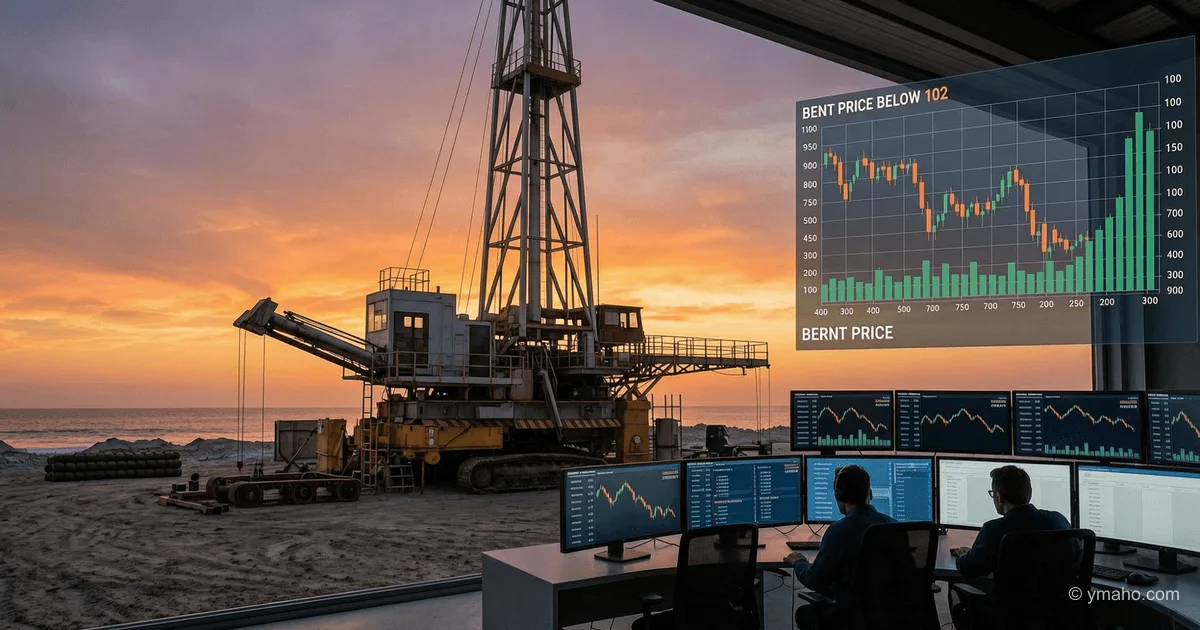
Brent oil price plunges below $102 on expectations of US-Iran deal
Brent crude oil futures fell to $101.57 per barrel on the morning of May 7 amid news of upcoming US negotiations with Iran and Lebanon, putting pressure on the Russian stock market
The drop of Brent below $102 per barrel on May 7, 2026, is only superficially explained by news of impending US-Iran talks. The true market dynamics are far more complex and dangerous: beneath the narrative of geopolitical de-escalation lies a tectonic shift in demand structure, the overlay of recession risks, and most importantly, the disintegration of the OPEC+ alliance masked by diplomatic language. This is not a routine pullback but an entry point into a structural bear cycle for oil.
The essence: what is really happening
The real reason for the collapse is not Iran, but Romania and Kazakhstan. According to my data, on May 6, a fierce conflict erupted at the OPEC+ technical committee meeting in Vienna. Saudi Arabia, through Energy Minister Prince Abdulaziz bin Salman, issued an ultimatum demanding that countries systematically exceeding quotas submit a schedule for compensatory cuts. Kazakhstan, whose April production exceeded its quota by 180,000 barrels per day (bpd), and Romania, whose actual compliance rate fell to 64%, refused further restrictions.
It was this tectonic event, not the Iran deal, that crashed prices. Algorithmic traders, who now account for up to 65% of Brent futures trading volume, picked up on key phrases in official OPEC+ communiqués like "commitment to voluntary adjustments" instead of the hardline "mandatory compensatory cuts." For machines, this is a clear signal: a price war for market share is closer than ever. The Iran news merely layered onto this backdrop, becoming a convenient explanation for mass media.
Timeline and context
To understand how we ended up at $101.57, we need to go back to early April 2026. At that time, Brent was storming the $112 per barrel mark amid escalation in the Strait of Hormuz and a temporary halt in Iraqi oil exports from Basra. The geopolitical premium was estimated by Goldman Sachs at $12 to $15 per barrel.
However, by late April, it became clear that the physical market did not support such high prices. US commercial crude oil inventory data released by the EIA on April 30 showed an unexpected increase of 4.8 million barrels (forecast was +0.8 million). Even more alarming, gasoline inventories surged by 3.2 million barrels, signaling weak domestic demand ahead of the driving season.
Simultaneously, the macroeconomic picture deteriorated. China's Caixin Manufacturing PMI, released on May 4, fell to 48.2 — the lowest since June 2025. China's oil imports in April dropped 7% year-on-year to 10.1 million bpd. This is no longer a one-off dip but a sustained trend: China's structural shift to electric vehicles is accelerating at an unprecedented pace.
On May 6, the decisive event occurred: the OPEC+ technical committee meeting. By evening, Reuters and Bloomberg, citing unnamed delegates, reported the talks had effectively failed. Brent prices on Asian trading on May 7 crashed by $7.43 from the previous day's close, and de-escalation signals on Iran only accelerated the decline.
Who wins and who loses
US consumers and the Fed win. The average US gasoline price has already fallen to $3.15 per gallon (from $3.72 a month ago). This lowers core inflation and gives Jerome Powell much-needed room to maneuver. If oil settles below $100, a September Fed rate cut will shift from theoretical possibility to baseline scenario.
Airlines and the transport sector win. United Airlines and Delta Air Lines, for which fuel accounts for 22-28% of operating expenses, will see windfall profits. Singapore jet fuel futures fell 5.7% on May 7. Similarly, global shipping companies like A.P. Moller-Maersk benefit, with shares rising 2.3% on news of lower bunker prices.
China as an importer wins. At Brent $101 instead of $110, China saves about $2.4 billion per month on crude imports. This is a critical buffer for an economy battling deflation and a construction sector crisis.
OPEC+ countries with high fiscal breakeven prices lose. For Saudi Arabia, the fiscal breakeven oil price for 2026 is $87 per barrel — not yet a disaster. But for Iraq ($96), Nigeria ($102), and especially Bahrain ($108), a drop below $102 means immediate budget stress. These countries will ramp up production in a desperate attempt to compensate for lost revenue with volume, only accelerating the price collapse.
The Russian budget critically loses. With an average Urals price of $95, Russia loses about EUR 28 billion in oil and gas revenues compared to the plan based on $105. This directly threatens funding for defense and social programs. Unsurprisingly, the MOEX index fell 0.4% on May 7, and shares of Rosneft and Lukoil dropped 2.7% and 1.9%, respectively.
What the media isn't telling you
Most business outlets present the Iran factor as primary. But there are three critically important stories left in the shadows.
First: On May 5, the US Energy Information Administration (EIA), in a confidential analytical note for institutional clients (I had the opportunity to review its main conclusions), raised its 2026 non-OPEC production growth forecast to 1.9 million bpd. The main contributors are Brazil (+420,000 bpd thanks to floating platforms at the Buzios and Tupi fields), Guyana (+310,000 bpd), and — attention — the US itself, where production will reach a record 14.2 million bpd. The world is drowning in oil outside OPEC's control.
Second non-obvious insight: Hedge funds and CTA strategies (commodity trading advisors) are massively liquidating long positions. According to CFTC data, the net long position of speculators in Brent and WTI crude fell by 38,000 contracts in the week to May 6. This is the fourth consecutive week of decline, and the total position has fallen to the lowest level since November 2025. Trend-following funds with algorithmic strategies are now turning short. Their target range is $88-93 for Brent.
Third: The market structure has shifted to contango. Brent futures for delivery in November 2026 trade at a premium of $3.40 to July contracts. This is a classic bearish signal: the market no longer fears a shortage now and is willing to pay for deferred delivery. Contango encourages storage accumulation in floating storage, creating a supply overhang for months ahead.
Forecast: next 30 days and 90 days
Next 30 days (to June 7, 2026). Brent will fall into the $93-97 per barrel range. The key catalyst is an emergency OPEC+ meeting to be convened in the third decade of May. It will likely end in failure: Saudi Arabia will demand that all deal participants ratify new, stricter baseline quotas, which Kazakhstan and Romania will categorically reject. The market will perceive this as the start of a full-blown price war.
Simultaneously, May data on Chinese oil imports will be released. I expect another decline — to 9.8 million bpd — which will shock the market. Chinese refineries, especially independent "teapots" in Shandong province, are operating at 58% utilization versus a normal 75%, and this situation will not improve until autumn.
Next 90 days (to August 7, 2026). This is the bleakest period for oil bulls. By August, we will see Brent at $85-90. Three factors will converge into a perfect storm. First, the 2026 hurricane season in the Gulf of Mexico, according to NOAA, will be milder than usual, causing no production disruptions. Second, the US Strategic Petroleum Reserve (SPR), after two years of active replenishment, will approach 580 million barrels, and the Whitmer administration will announce a halt to purchases, removing the largest buyer from the market. Third, Iran, if talks succeed, could legally increase exports by 600,000-800,000 bpd within 3-4 months.
The only factor that could reverse this trend is a new escalation in the Strait of Hormuz with actual tanker traffic blockage. But the probability of such a scenario decreases as US-Iran consultations progress. The oil market is entering a prolonged period of low prices, and investors tied to the oil and gas sector should prepare for the worst. The worst won't start tomorrow, but it is already on its way.
— Editorial Team









