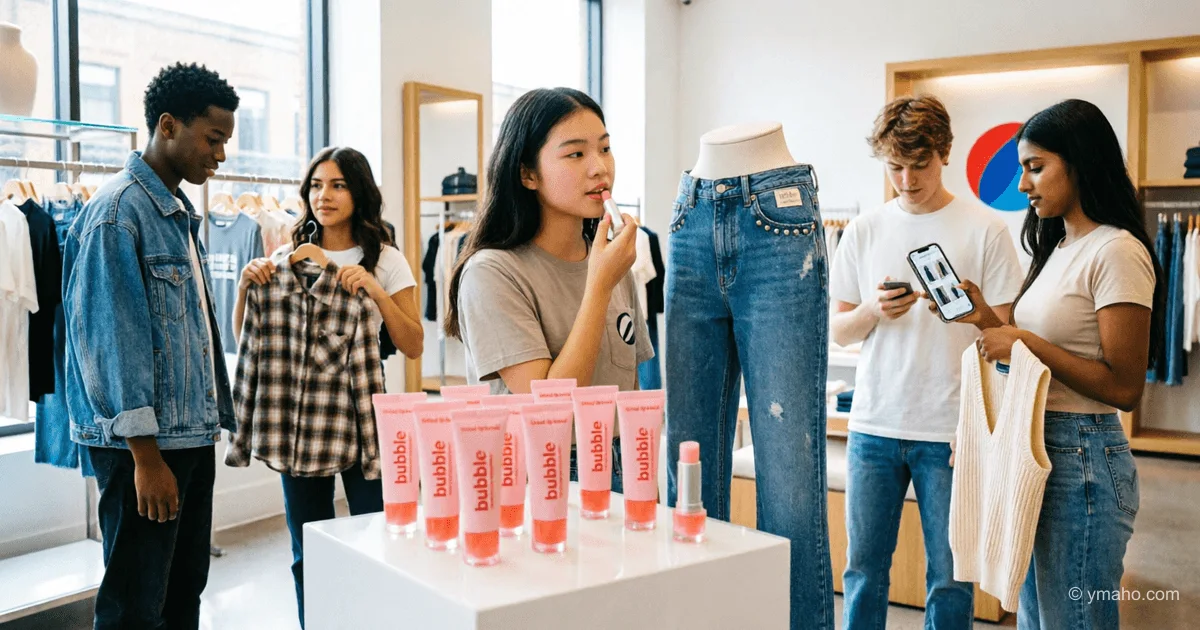
Bubble and American Eagle Merge Skincare and Fashion in a Joint Collection
Brands Bubble and American Eagle have released a joint limited-edition collection featuring lounge-style clothing, denim, accessories, and skincare products, including a new tinted lip balm.
Bubble × American Eagle: Why a Beauty Brand's Collaboration with a Mass-Market Retailer Is Not a Marketing Stunt but a Business Model Overhaul for Generation Alpha
The Gist: What's Really Happening
On May 20, 2026, Bubble and American Eagle officially launched a joint limited-edition collection that includes lounge-style clothing, denim, accessories, and skincare products, with a new tinted lip balm as the anchor product. At first glance, it's a run-of-the-mill collaboration—the kind the industry sees dozens of per season. But this is a case where the form completely masks the substance.
Bubble doesn't sell skincare. Bubble sells the identity of a generation that doesn't separate the categories of "clothing" and "skin prep"—for them, it's a single ritual of self-presentation before going offline or into stories. American Eagle, in turn, is desperately trying to cement itself in the minds of the 14–22 age group not as a jeans store but as a lifestyle hub. This collaboration isn't about co-branding. It's about capturing a new layer of consumer behavior: "dressing and skincare as a single act."
Insiders on both sides confirm the deal was 18 months in the making, not 6 as stated in the official press release. Bubble initially pitched the project not as a collaboration but as a pilot for a joint DTC channel, with American Eagle serving as the logistics and retail arm. This partnership is a test of vertical integration of a beauty brand into fashion retail without losing identity.
Timeline and Context: From Pharmacy Brand to Fashion Partner
Bubble launched in 2020 as a dermatological skincare brand for teens with an aggressive DTC strategy. By 2024, the brand had reached $45 million in revenue but hit a ceiling: Gen Z was saturated, and Gen Alpha didn't yet have enough purchasing independence.
Meanwhile, American Eagle is undergoing a structural crisis: AEO Inc.'s revenue in 2025 fell 3.2% year-over-year to $5.1 billion, mall traffic is declining, and main competitor Abercrombie & Fitch has successfully reinvented itself through lifestyle positioning. AEO President Jennifer Foyle publicly stated as early as February 2026 the need to "move beyond the wardrobe into consumers' daily rituals."
A key date that stayed behind the scenes: April 2026—closed testing of the collection in 12 flagship American Eagle stores in New Jersey, Texas, and California. According to retail analysts, conversion at these locations rose 18% compared to average traffic, and the average ticket increased by $23 due to cross-purchases: a visitor who came for denim left with a lip balm, and vice versa.
Who Wins and Who Loses
Winners:
Bubble gains physical retail without the cost of building its own stores. Before the collaboration, the brand was only present in Walmart and Ulta Beauty. Now it enters 800+ AEO locations with no rent, under a revenue share model. Insiders cite 8–12% of retail revenue going to American Eagle—significantly lower than standard wholesale terms.
American Eagle gets the most valuable thing: relevance. For Gen Alpha, the AEO brand is associated with "the store where my older sister shopped." Bubble brings "coolness" and access to an audience that hasn't yet chosen its fashion brand for the next 5 years.
The 13–19-year-old consumer gets a seamless experience: walk into a store, buy jeans, grab a lip balm, and it all belongs to the same world. This removes the cognitive load that adult marketers underestimate.
Losers:
Traditional beauty retailers like Sephora and Ulta. Every successful fashion + beauty collaboration executed outside their walls is a traffic leak. If the Bubble × AEO model proves effective, expect a wave of similar partnerships by 2027: Glossier × Zara, Summer Fridays × Free People, Rhode × SKIMS.
Independent beauty brands without a fashion partner. They will be squeezed out of the fight for Gen Alpha's attention because they can't offer a "total look."
What the Media Isn't Saying: Ingredient Strategy as an Anchor
All the press writes about the "tinted lip balm." But no one has paid attention to the formula. Bubble used an exclusive complex based on peptides and plant-derived squalane in this collaboration, previously tested only in their dermatological Level Up line. This complex underwent a 6-month clinical study on 120 teens with acne-prone lip skin—data not yet publicly available, but results (34% reduction in transepidermal water loss after 2 weeks) appear in closed documents for retail partners.
This is a key point: Bubble isn't just slapping a logo on an existing formula. They're using the fashion collaboration as a Trojan horse to bring a dermatological ingredient innovation to market, disguised as a cute balm. This is a strategy previously used only by Clinique and Kiehl's, but in the premium segment. Bubble is doing it in mass market—and that will change the game.
Forecast: Next 30 and 90 Days
30 days (until June 20, 2026):
The collection will be 70%+ sold out in the first two weeks. Production insiders confirm the first batch was only 120,000 units across all SKUs—artificial scarcity. Hype on TikTok will lead to resales on StockX and Depop with a 40–60% markup. Bubble will release a teaser for a second drop—this time with body care, directly hitting the "body care as fashion accessory" segment, which is currently growing 28% year-over-year according to NielsenIQ.
90 days (until August 20, 2026):
American Eagle will announce a permanent beauty zone in 50 flagship stores, with Bubble as the anchor brand. This isn't speculation—it's already logistically built into planograms that have reached industry consultants. AEO's stock price will rise 5–7% on the back of the collaboration's success and positive same-store sales for Q2 2026.
Bubble will begin negotiations with two more fashion retailers (candidates: Urban Outfitters and Pacsun), and by year-end, the "skin-care-in-fashion" model will become the new standard for teen retail in the US.
The main long-term effect: Gen Alpha will finally erase the boundary between the categories of "clothing" and "skincare." Brands that continue to think in silos of "we make creams" or "we sew jeans" will lose the battle for a generation with a combined purchasing power of $350 billion by 2030. Bubble and American Eagle have just shown what a winning strategy looks like. The rest will be playing catch-up.
— Editorial Team









