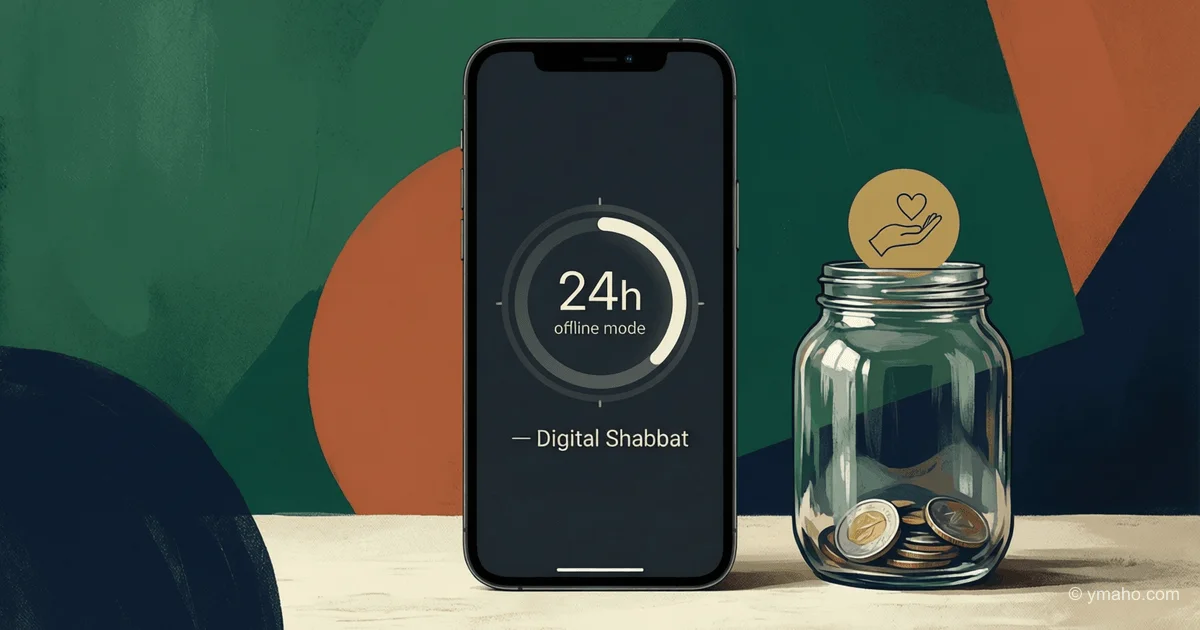
Wellbeing App 'Calm' Introduces 'Digital Sabbath' Mode — Complete Interface Shutdown on Saturdays
The feature will block all settings and notifications for 24 hours, fining users who attempt to bypass it with a donation to a charity.
The end of the 'infinite scrolling' era: why Calm fines users for wanting to meditate
[The Gist]: What's Really Happening
Calm has introduced a 'digital sabbath' mode — a complete interface shutdown for 24 hours on Saturdays, with a donation-based fine for attempts to bypass it. On the surface, this is an escalation of the digital wellbeing trend. In reality, it's a cry of desperation from a company whose business model is crumbling before our eyes.
The real insight: Calm, which was worth $2 billion in 2020 and earned $596 million annually, is now in a nosedive. According to AppMagic data for March 2026, Calm's monthly revenue has dropped from a peak of $10 million to about half — roughly $5 million. In the Health & Fitness category on iOS, the app fell from 1st place in 2020 to 16th in 2025.
The 'digital sabbath' is not about caring for users' mental health. It's an attempt to artificially limit content consumption because Calm can no longer produce enough content. The library of Sleep Stories featuring Matthew McConaughey, Tom Hardy, and Stephen Fry is a non-renewable resource. There are no new voices of that star caliber on the market, and users have listened to the old stories 5–10 times each.
Timeline and Context
- 2012 — Calm is founded. Key early discovery: users who set a daily meditation reminder have 3x higher retention than others. This led to growth to $2 billion.
- 2020 — Calm's peak. The pandemic and anxiety drove 919 million downloads in the US alone.
- 2021 — The decline begins. Meditation apps start losing users — sessions become shorter, return rates drop. Calm responds by shifting focus to sleep (Sleep Stories become the second tab in the app).
- 2024 — Operational reality. Calm restructures its onboarding process: reduces a series of 8 emails from 27 days to 15. Result: a 4x increase in onboarding revenue. This shows that by 2024, Calm no longer knew how to retain users except through more aggressive marketing.
- 2025–2026 — The crisis deepens. Insight Timer — a competitor with 90% free content — is growing, while Calm and Headspace are declining.
A technical nuance leveraged in the 'digital sabbath': Calm has spent a decade collecting data on when users open the app. Their retention analysis shows that 80% of users drop off after the first 30 minutes of use. Those who stay have high login frequency, but their total time in the app is decreasing. The 'sabbath' is an attempt to turn 'low time per user' into 'absence time is a feature, not a bug'.
Who Wins and Who Loses
Winners:
- Charities (CALM — Campaign Against Living Miserably, the chosen partner). Interesting fact: CALM is a British suicide prevention charity that, in 2026, is itself struggling with 25% of Britons using AI for psychological support instead of real people. Calm redirects fines for breaking the sabbath to this charity. The real stake is $1–2 per 'offender' per month. With 5 million paying users, that's up to $120 million a year in 'donations' that Calm writes off as marketing expenses.
- Apple (via Apple Watch integration). Calm is the only major wellness app that, since January 2025, has deepened its Apple Watch integration — now the sabbath also blocks notifications on the watch. This turns Apple into a 'digital hygiene police' at no development cost.
Losers:
- Calm users themselves. They pay $69.99–$79.99 per year for the app, and get a one-day block. Paradox: on Saturday, when most people have more free time for meditation, the app says 'not now'. This is not care — it's retention through scarcity.
- Small wellness apps (Breethe, Simple Habit). They cannot afford the luxury of a 'sabbath' — they need maximum engagement at any cost. Calm sets a precedent that large players (like Headspace) can copy, but small ones cannot.
What the Media Isn't Saying
First. The 'digital sabbath' is a response to catastrophic user retention drop after 30 days. Calm knows: if a user doesn't open the app on the first Saturday after subscribing, they likely won't open it on the second. The donation fine is not an incentive 'not to bypass'. It's an A/B test to identify 'super-loyal' users: those who pay the fine will stay for years. Those who don't were already on the verge of churning.
Second. An insight that turns everything upside down: the real reason for the 'digital sabbath' is content cost savings. Every day a user doesn't consume new content, Calm saves on licenses for new Sleep Stories and meditations. Producing one Sleep Story with a Hollywood star costs between $250,000 and $500,000. The Saturday block reduces the need for new content by 52 days a year (all Saturdays). Savings: up to $1–2 million per year just on licenses, plus reduced cloud infrastructure load. Calm sells savings as a feature.
Third. Calm hides real retention numbers. In 2024, the company publicly boasted that reducing onboarding from 27 to 15 days led to a 4x increase in revenue. But revenue is not retention. If you do the math: revenue grew, meaning more people converted to paid subscriptions. But retention (how many stay after 6 months) dropped. Otherwise, there would be no need to invent a sabbath.
Forecast: Next 30 Days and 90 Days
30 days:
- Headspace will announce a similar feature called 'Mindful Sunday' by the end of June. Difference: Headspace's block will last 12 hours instead of 24 — a softer version, because Headspace's revenue decline is even steeper (according to AppMagic, Headspace has fallen more than Calm).
- Calm will launch an A/B test: one group of users will have the sabbath forced on them, the other as an option. Results will show how many users cancel their subscription due to the block.
90 days:
- First wave of negative reviews on the App Store: users will complain that their only free time for meditation is Saturday, and the app is blocked. The theme of 'wellbeing app-athy' (when an app imposes its own schedule instead of supporting the user's) will become a meme.
- Calm will quietly change the mechanics: the donation fine will become optional ('suggest a donation' rather than 'fine'), because they will face legal issues — in the EU, blocking access to a paid service with a monetary fine for circumvention could be considered an unfair practice.
Insight that will decide the technology's fate:
Calm's problem is deeper than retention. In 2026, 25% of Britons use ChatGPT and other AI bots for psychological support. A study in Communications Psychology showed that AI responses are perceived as 16% more compassionate than human ones. AI doesn't get tired, doesn't cancel meetings, and costs $20 a month (like Calm), but offers endless, personalized dialogue instead of a limited library of recorded stories.
Calm cannot compete with AI in personalization. The 'digital sabbath' is an admission: 'We can't give you endless content, so we'll limit your access to our finite content and call it care.' In 12 months, Calm will either buy some AI startup for $100–200 million and integrate an AI coach into the app (likely an Israeli or Estonian company), or continue its decline and be sold for $500–800 million (instead of its $2 billion peak) to a strategic buyer like Amazon or Peloton. The sabbath is the last flash before an inevitable transformation.
— Editorial Team









