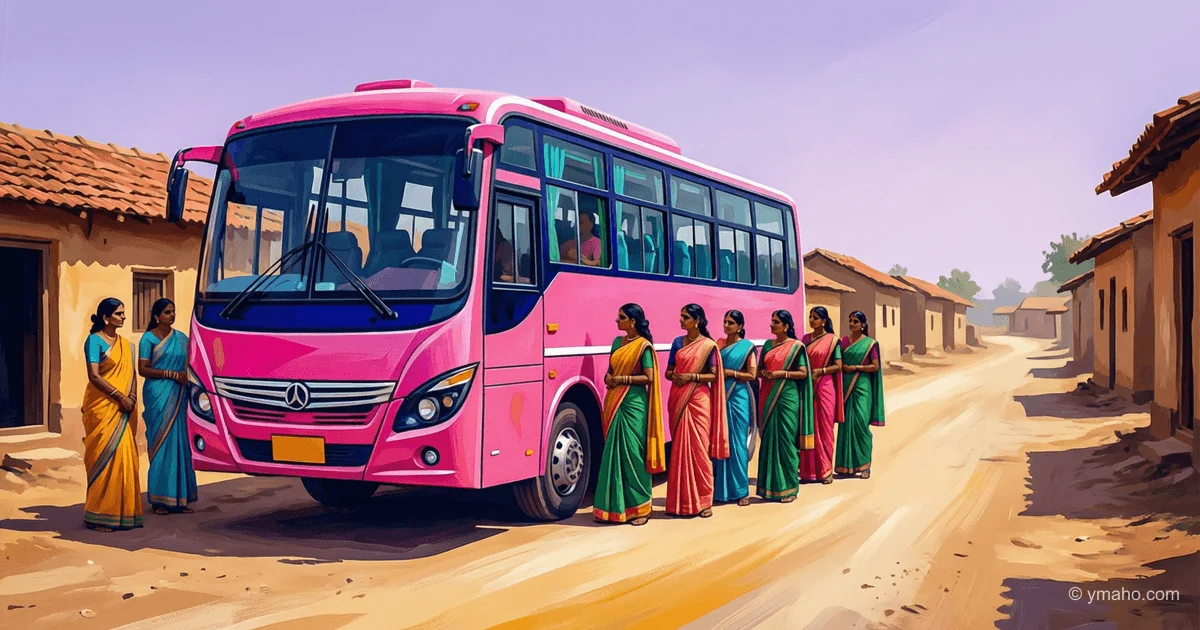
NCW Launches 'Cancer on Wheels': Mobile Mammography Units for Remote Regions of India
During World Menstrual Hygiene Week, the 'Cancer Screening on Wheels' initiative was launched. Mobile buses equipped with diagnostic tools aim to provide breast and cervical cancer screening for women in hard-to-reach areas.
'Cancer on Wheels': When Corporate Social Responsibility Meets an Unspoken Epidemic
What looks like a humanitarian initiative is actually a perfect storm of corporate PR, undisclosed data, and systemic public health failure
I'm writing this on May 24, 2026, and here's what strikes me: the news about buses for breast and cervical cancer screening in India is presented as a 'touching story about caring for women.' But no one asks the main question: why is this even necessary 79 years after the country's independence?
The answer is cynical and simple. Not because India lacks technology. But because Indian women don't have access to that technology if they live more than 50 kilometers from a major city. And the conversation about menstrual hygiene isn't about pads. It's about power, money, and control over the body.
[The Gist]: What's Really Happening
On May 22-23, 2026, during World Menstrual Hygiene Week, India's National Commission for Women (NCW), in collaboration with the SHEWings Foundation, launched the 'Cancer Screening on Wheels' initiative — mobile buses with diagnostic equipment for breast and cervical cancer screening.
The ceremony took place at the NCW auditorium in New Delhi. Attendees included: NCW Chairperson Vijaya Rahatkar, Minister of State for Women and Child Development Savitri Thakur, NHPC Women's Club President Shikha Gupta, and SHEWings founder Madan Mohit Bhardwaj.
But behind this list of names lies something far more interesting. The buses are equipped with the Thermalytix 360 system (AI thermography for breast screening), Pap test devices, and portable colposcopy. This isn't 'charity.' It's high-tech diagnostics on wheels.
And crucially: the initiative is implemented under a Memorandum of Understanding signed between SHEWings Foundation and NHPC Limited on February 13, 2026. NHPC is India's state-owned hydropower corporation with a market capitalization of about $4 billion. And they're using taxpayer money to drive mammography units through villages. Why? Because it counts as Corporate Social Responsibility (CSR), provides tax benefits, and creates a positive image ahead of tenders.
Timeline and Context
What you know: On May 23, 2026, India launched buses for cancer screening.
What you don't know: A month earlier, in April 2026, the Andhra Pradesh state government approved a preventive screening program for 5.64 million people (about 570,000 women per year) with 47 types of medical tests through 104 mobile medical units.
The program budget is 1.63 billion rupees per year (about $19.5 million at current exchange rates). That's $3.45 per person per year for comprehensive diagnostics.
I cite these numbers to show you the scale: the launch of three buses in Delhi is a drop in the bucket compared to Andhra Pradesh's systemic approach. But it's the Delhi case that gets all the international attention. Why? Because it has a brand ('Cancer Screening on Wheels'), celebrities (NHPC is a major PSU), and the right speakers.
This isn't a fight against cancer. It's a fight for the agenda.
Key figure that should have been in every headline but isn't: According to India's National Cancer Registry, the age-standardized incidence rate of cervical cancer in India is 17.71 per 100,000 person-years, and the mortality rate is 11.15 per 100,000. This is the second highest in the world after South Africa.
For comparison: in the US, the same figures are 6.4 and 2.3 respectively. Indian women die from cervical cancer five times more often than American women. And this gap hasn't narrowed in 20 years.
Who Wins and Who Loses
Winner: NHPC Limited.
Why is an energy company involved in women's health? Because Indian PSUs are required to spend at least 2% of their average net profit over three years on CSR. For fiscal year 2024-2025, NHPC earned about $300 million. 2% is $6 million.
Instead of simply transferring the money to the Ministry of Health (where it would dissolve in bureaucracy), NHPC signs a direct contract with SHEWings Foundation. SHEWings builds the buses. NHPC gets: (a) a PR event on national television, (b) a photo with the minister, (c) the right to report to shareholders on CSR compliance.
And yes, NHPC Women's Club President Shikha Gupta personally attended the launch and called the initiative 'admirable.' That's not a quote. It's a line in a report to the board of directors.
Winner (but more complex): SHEWings Foundation.
SHEWings Cancer Center appears to be a private clinic that secured a government contract to service the buses. Dr. Rajesh Mishra, SHEWings' medical director, personally explained the technology at the ceremony.
What does this mean? It means SHEWings gets taxpayer money for servicing each patient. If a bus screens 20,000 women per year (industry average estimate), and SHEWings receives, say, $15 per patient, that's $300,000 annual revenue from one bus. Multiply by three buses in Delhi, and you get nearly a million dollars. Of public funds.
Losers: Women in the villages of Uttar Pradesh and Bihar.
And here we get to the main point. According to India's Ministry of Health database, in 2025, 19,282 women died from breast cancer in Uttar Pradesh (a state with 240 million people). In Bihar — 4,027. In Rajasthan — 6,752.
Three buses in Delhi-NCR, where hospitals and diagnostic centers already exist, won't solve the problem. A woman from a village 300 kilometers from Lucknow still won't travel to Delhi, even if screening is free. Because she has no money for a ticket, no time (she works in the fields 12 hours a day), and no habit of checking her breasts (cultural taboo).
What the Media Isn't Saying
Insight: This initiative isn't about treating cancer. It's about 'prevention' and 'early detection,' which don't reduce mortality without follow-up steps.
Detecting cancer early is only half the battle. A woman from rural India with a positive Pap test needs to:
- Get to an oncology center (usually a 5-hour drive to the city)
- Pay for a biopsy ($50–100)
- Pay for treatment (chemotherapy at a private clinic: $500–2000 per course)
- Take 2–3 months off work (which for a daily wage worker means losing her only income)
None of these steps are solved by a bus. NCW and SHEWings don't talk about this. Because it falls outside their CSR reporting.
Second thing they're silent about: The Thermalytix 360 technology is not mammography. It's thermography. And its accuracy is controversial.
Thermalytix uses an infrared camera to measure skin temperature. Theoretically, cancerous tumors have increased blood supply and may be hotter. But in practice, thermography has a high rate of false positives (up to 30%) and does not replace mammography for definitive diagnosis.
The American Cancer Society explicitly states: thermography should not be used as a standalone screening test. But in SHEWings' buses, there's only thermography, no mammograph. Because a mammograph costs $50,000 and requires a radiologist, while Thermalytix costs $5,000 and can be operated by a nurse after a two-week course.
This isn't screening. It's a simulation of screening.
Forecast: Next 30 Days and 90 Days
30 days: Reportable numbers and a 'successful pilot.'
In a month, NHPC will issue a press release with numbers: 'In the first month, the buses screened X women, Y suspected cancers detected.' There will be photos of happy women in saris in front of a pink bus.
What they won't say: how many of those X women actually underwent full diagnostics and received treatment. And how many dropped out midway because they had no money.
90 days: Expansion to other states or quiet phase-out.
Depending on how the political PR plays out, two scenarios are possible:
Scenario A (positive): NHPC announces expansion of the program to Maharashtra and Gujarat — states where they have hydroelectric plants and where CSR budgets need to be 'utilized.' Buses will appear in Nagpur and Surat.
Scenario B (realistic): The program continues at minimal capacity but without additional funding. The buses operate, but their schedule is cut from 5 days a week to 2, because SHEWings can't hire qualified nurses for the money NHPC allocates.
Third scenario, which no one talks about: a technological breakthrough.
If Thermalytix 360 actually demonstrates high sensitivity (above 85% compared to mammography) in the Indian population, it could change global screening recommendations. Low-income African countries with no radiologists will buy Thermalytix in bulk. And both NHPC and SHEWings will get not just PR but an export contract.
But that's an 'if' the size of the Ostankino Tower.
Business takeaway for those reading between the lines: Don't look at the buses. Look at the company that owns the patent for Thermalytix. If it's a Bangalore startup (and judging by the name, it very well might be), and if first-quarter data shows sensitivity above 90%, this company will become an acquisition target for Siemens Healthineers or GE Healthcare within 12–18 months. The deal price: $200 to $500 million.
And if you're just a woman living in rural India — get on that bus if it comes to your village. But don't stop at thermography. Hire a rickshaw, go to the district hospital, and get a proper mammogram. Your life is worth more than $5 in gas.
— Editorial Team









