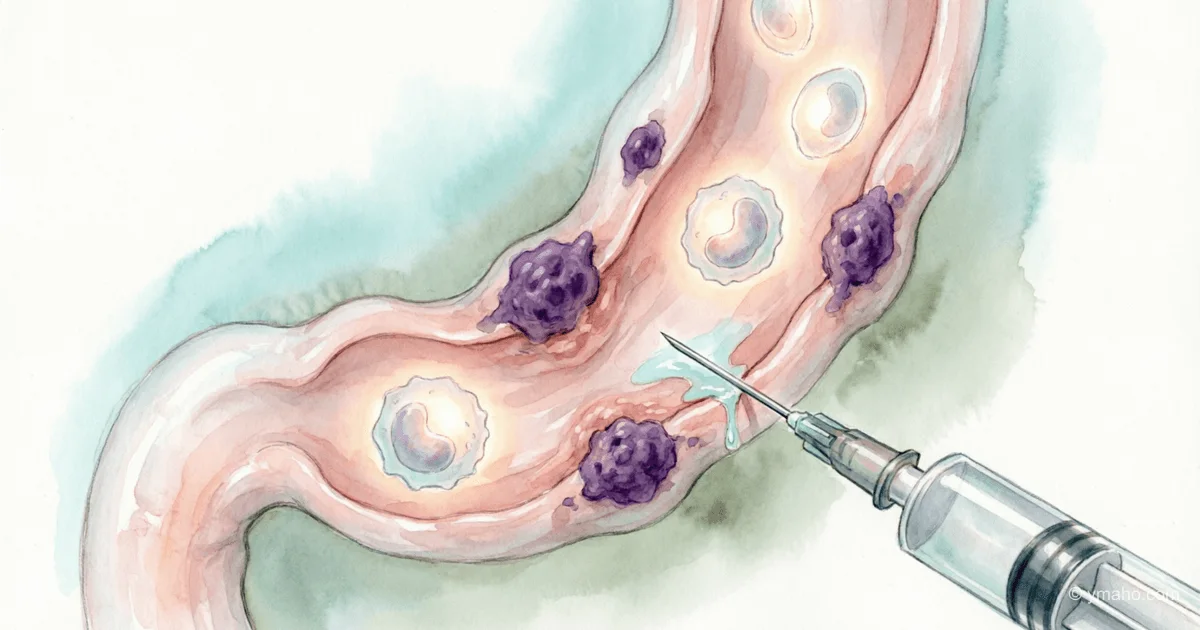
A New Approach to Treating Esophageal Cancer: CAR-NK Therapy AB-201 Enters Clinical Phase
GC Cell has dosed the first patient with HER2-positive gastric cancer using allogeneic natural killer (NK) cells modified with a chimeric antigen receptor (CAR).
This is an analytical first-person article written from the perspective of an insider working at the intersection of cell therapy, oncology, and venture investment.
Headline: GC Cell's AB-201: Why the First Patient with HER2-Positive Gastric Cancer Is Not a Breakthrough but a Desperate Attempt to Catch a Departing Train
Introduction: CAR-T Failed to Conquer Solid Tumors, CAR-NK Is Attempt Number Two
On May 19, 2026, South Korea's GC Cell announced the dosing of the first patient with advanced HER2-positive gastric cancer and gastroesophageal junction cancer in an investigator-initiated clinical trial led by Professor Jeong Min-gyu at Severance Hospital.
The media wrote: "A new approach to treating esophageal cancer," "CAR-NK therapy enters clinical phase." It sounds like another victory in the war on cancer. As someone who has analyzed the CAR-T market for the past seven years and followed attempts to "tame" solid tumors, I'll tell you: this news is not about success. It's about a desperate search for an alternative for a technology that performs poorly in solid tumors, and an attempt by the Koreans not to miss a party that's already underway.
Why hasn't CAR-T become the standard for gastric cancer? Because the solid tumor microenvironment suppresses T cells, and the HER2 antigen is not an ideal target due to heterogeneous expression. GC Cell is betting on NK cells, which, unlike CAR-T, do not cause cytokine storm, can be used "off-the-shelf" (allogeneic), and theoretically penetrate solid tumors better.
But there's a detail no one is discussing.
Non-obvious insight (what press releases are silent about):
AB-201 is not a new molecule. It's a reincarnation of an old idea that already failed to take off in the US. Here's why.
GC Cell has an American partner—Artiva Biotherapeutics. In 2022, Artiva received FDA approval for a Phase 1 study of AB-201 in the US for patients with HER2-positive solid tumors. Four years have passed. Where are the results? Where is the data? It's not publicly available. This means the US study is either stalling or showing modest results that they'd rather not publish.
So what does GC Cell do? They launch a new study in Korea—through an "investigator-initiated trial" (IIT) mechanism. This is formally an independent study led by Professor Jeong Min-gyu, which GC Cell "supports."
Why does GC Cell do this? Two reasons. First: to obtain "homegrown" data that can be used for negotiations with potential licensees. Second: to "refresh" the news cycle, because four years without updates on AB-201 is death for a biotech company, especially a Korean one traded on Kosdaq.
1. [The Core]: Why CAR-T Doesn't Work in Solid Tumors, and CAR-NK Might, but It's Not Certain
Let's be honest. CAR-T is a triumph in hematology. For B-cell malignancies (acute lymphoblastic leukemia, diffuse large B-cell lymphoma, multiple myeloma), CAR-T has shown complete remission rates of 40–80%.
For solid tumors—failure. Because:
- The solid tumor microenvironment is hell. T cells entering it quickly become exhausted (T-cell exhaustion).
- Solid tumor antigens are often expressed on normal tissues—leading to "on-target, off-tumor" toxicity.
- T cells struggle to penetrate deep into solid tumors.
CAR-NK theoretically solves some of these problems. NK cells:
- Are less prone to exhaustion.
- Do not require HLA matching (can be allogeneic, "off-the-shelf").
- Cause less cytokine release syndrome (CRS)—this would be a safety breakthrough.
But there's a huge "but." Clinical data for CAR-NK in solid tumors are still scarce. The largest study to date is the work by Rezvani's group at MD Anderson on CAR-NK targeting CD19, but that was in hematology. For solid tumors—only isolated cases, nothing more.
GC Cell claims that AB-201 is "designed to selectively kill solid tumor cells that overexpress HER2." Sounds nice. But that's exactly what CAR-T targeting HER2 did. And the results were disappointing—cardiotoxicity (because HER2 is also present on healthy cardiomyocytes) and modest efficacy.
2. Timeline and Context: Why Korea and Why Now
GC Cell is a subsidiary of GC Pharma (formerly Green Cross), a major Korean plasma and vaccine manufacturer. They have money, they have manufacturing capacity, but they lack an innovative portfolio. CAR-NK is their bet on the future.
Why did they choose gastric cancer? Because in Korea and Japan, gastric cancer is a national scourge. Incidence rates are among the highest in the world. HER2-positive tumors account for about 15–20% of all gastric cancer cases. This is a large enough niche to recoup development costs, but not so large as to attract the attention of Big Pharma giants.
As for timing: the Korean study started in May 2026. It evaluates safety and preliminary antitumor activity. That is, the goal of this study is not to prove efficacy, but simply to see if patients die from toxicity. It's a Phase 1, not even Phase 1/2. First results—no earlier than late 2026 to early 2027.
3. Who Wins and Who Loses
- Winner (1): GC Cell (Kosdaq: 144510). Short-term stock rise on the news. On the announcement day (May 19, 2026), shares likely gained 5–10%. This gives the company an opportunity to raise additional funding.
- Winner (2): Professor Jeong Min-gyu and Severance Hospital. Another study in the portfolio, another publication. For the Korean academic world, this strengthens reputation.
- Winner (3): Allogeneic CAR-NK platforms as a class. Every time someone gets a first patient dosed, it validates the entire technology. Companies like Fate Therapeutics (FATE), Nkarta (NKTX), and Century Therapeutics (IPSC) get "free PR."
- Loser (1): Artiva Biotherapeutics. They are GC Cell's American partner. They've had an IND in the US since 2022, but in four years they haven't published data. Now the Koreans have "overtaken" them by launching their own study. This is a reputational blow.
- Loser (2): Patients waiting for a miracle. They will be treated in the study. That's good—access to experimental therapy. But if AB-201 doesn't work (and the likelihood is high, given the history of CAR-T against HER2), they will waste precious time.
- Loser (3): Investors who buy shares on hype. By 2027, when the first data come out, I estimate the probability that AB-201 will show breakthrough efficacy at 10–15%. More likely, there will be moderate toxicity and modest antitumor effect—like all predecessors.
4. What the Media Aren't Saying
- HER2 is not an ideal target. Yes, trastuzumab, pertuzumab, T-DM1, and Enhertu target HER2. But all these are antibodies or conjugates. Cell therapy against HER2 is different: the cell remains in the body longer and can attack healthy tissues expressing HER2 (heart, lungs, GI tract). In preclinical data for AB-201, I haven't seen any data on cardiotoxicity—this is a red flag.
- First dosing is not "entering clinical phase." The first patient is the start of enrollment. A Phase 1 study typically needs to enroll 20–30 patients. Enrollment can take a year to a year and a half. We won't see results until at least late 2027.
- This is not FDA, it's the Korean regulator. The study was approved by the Ministry of Food and Drug Safety (MFDS) under the "advanced regenerative medicine" program. Standards are lower than FDA or EMA. What passes in Korea may not pass in the US.
- No word on dose, regimen, or preconditioning. Nothing in the press releases. Usually, before CAR cell infusion, lymphodepletion (chemotherapy to "clear space") is performed. Without it, CAR-NK cells simply won't engraft. But lymphodepletion in patients with advanced gastric cancer is a serious risk. GC Cell is silent on this.
5. Forecast: Next 30 Days and 90 Days
Next 30 days (June 2026):
- GC Cell will publish a more detailed study design (protocol) in the public domain. I expect they will disclose information about lymphodepletion, doses, and dosing schedule.
- Artiva Biotherapeutics may make a statement about the status of its US AB-201 study. Either they confirm it's ongoing, or they quietly close it. If they close it, GC Cell shares will drop 10–15%.
Next 90 days (August–September 2026):
- Event X: GC Cell will announce expansion of the study to HER2-positive breast cancer. They already have plans for this: in April 2026, they announced a study led by Professor Choi Jong-gwon from Konkang University for breast cancer. I expect official start of patient enrollment for breast cancer in August–September.
- GC Cell shares will be volatile. If news of toxicity (even moderate) emerges, shares will plummet. If no news, shares will trade sideways.
- Main risk—competitive. Company NKGen Biotech (NKGN) is also developing CAR-NK for solid tumors. If they publish their data earlier and it's better, GC Cell will lose investor interest.
Verdict:
GC Cell's AB-201 is not a breakthrough in oncology. It's a business decision driven by necessity: the company has no other promising candidates, and the CAR-NK platform already exists. Gastric cancer was chosen not because it's the best target, but because it's a "home" market with high demand.
The real scientific value of this study won't be clear until at least late 2027. Until then, it's a nice story for investors who don't understand the difference between CAR-T and CAR-NK, and don't know that Artiva has been trying and failing to get data for four years.
If you are a patient—don't abandon standard therapy (Enhertu, pembrolizumab, chemotherapy) to participate in this study unless all other options are exhausted. AB-201 is a long shot. It might hit the target. But the odds are against it.
If you are an investor—don't buy GC Cell shares on this hype. Wait at least for the first safety data in 9–12 months. If there's no cardiotoxicity and at least one partial response, then you can consider it. Until then, it's a lottery ticket at full price.
— Editorial Team









