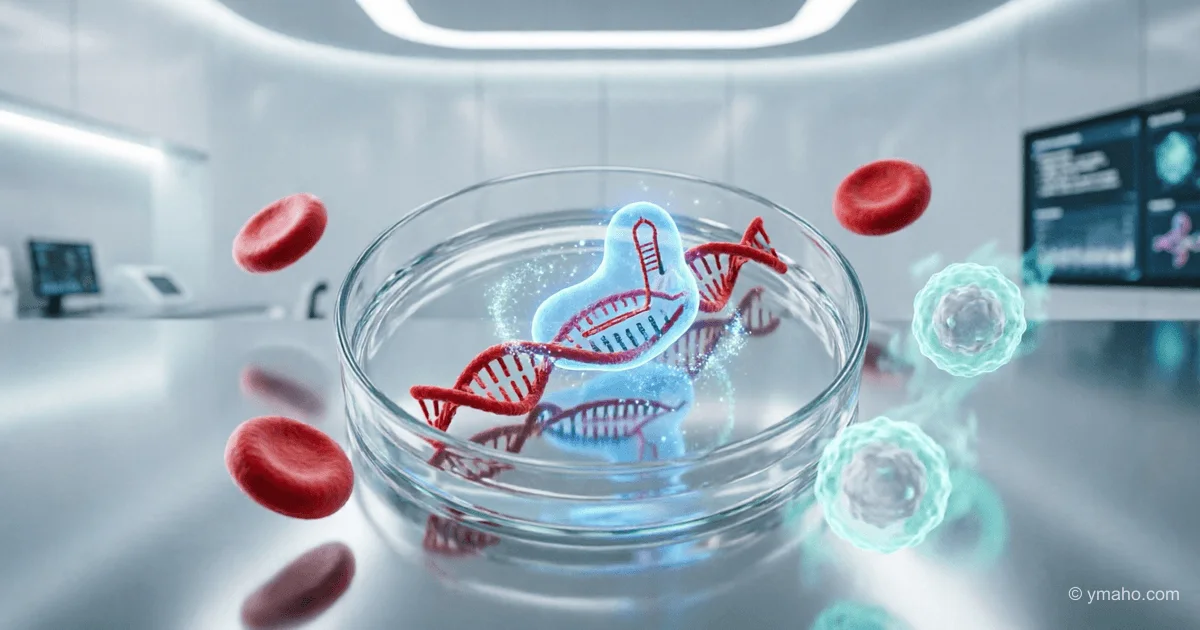
FDA Approves First CRISPR-Based Gene Therapy (Casgevy) for Sickle Cell Disease and Beta-Thalassemia
Casgevy, developed by Vertex and CRISPR Therapeutics, is a breakthrough as the world's first approved treatment using CRISPR/Cas9 gene editing, ushering in an era of precision gene therapy for inherited blood disorders.
Introduction
December 16, 2023, marked a date that forever changed medical history. On this day, the U.S. Food and Drug Administration (FDA) approved Casgevy (exagamglogene autotemcel) — the world's first gene therapy based on the revolutionary CRISPR/Cas9 genome editing technology. The indication is sickle cell disease (SCD) for patients aged 12 and older with recurrent vaso-occlusive crises. Just one month later, on January 16, 2024, the regulator expanded approval to include transfusion-dependent beta-thalassemia (TDT).
This event is not just another entry in the pharmaceutical chronicle. It marks the transition of genome editing from science fiction into routine clinical practice, opening an era of precision gene therapy for inherited diseases that were once considered a lifelong sentence. Casgevy, developed in partnership between Vertex Pharmaceuticals and CRISPR Therapeutics, is tangible proof that the "scissors" discovered in 2012 by Nobel laureates Emmanuelle Charpentier and Jennifer Doudna can not only cut DNA in a test tube but also cure the most severely ill patients.
Event Details and Timeline
The path of Casgevy to patients was long but triumphant. The story began in 2015 with a strategic agreement between Vertex and CRISPR Therapeutics aimed at developing CRISPR/Cas9-based therapies for genetic blood disorders.
Key Milestones:
- November 2023: The UK regulator MHRA became the first in the world to grant conditional approval for Casgevy to treat SCD and TDT.
- December 2023: The FDA approves the therapy for sickle cell disease. This historic decision made CRISPR therapy a reality for patients in the US.
- January 2024: The FDA expands approval to include beta-thalassemia. Concurrently, the therapy receives the green light in Saudi Arabia.
- 2025: Active commercialization begins. Over the year, 64 patients received a Casgevy infusion, and the number of initiated treatment procedures (from cell collection to infusion) nearly tripled compared to 2024, reaching 147 people. Total sales revenue in 2025 was $116 million.
- 2026 and Beyond: Companies plan to submit applications for approval of the therapy for children aged 5 to 11, significantly expanding the potential patient population.
How Does It Work?
Casgevy is an example of ex vivo gene therapy. The process involves several steps:
- Collection: The patient's own hematopoietic stem cells (blood-forming precursor cells) are harvested.
- Editing: In the lab, the BCL11A gene is "switched off" in these cells using CRISPR/Cas9. Normally, this gene is activated after birth and suppresses the production of fetal hemoglobin (HbF).
- Reinfusion: The edited cells are returned to the patient. Before this, the patient undergoes a course of chemotherapy (conditioning) to "make room" in the bone marrow for the new cells.
- Result: By disabling BCL11A, the body begins producing fetal hemoglobin again (reactivation level reaches ~30%), which is not subject to the defects characteristic of adult hemoglobin in these diseases. This effectively compensates for the disease: in thalassemia, the need for blood transfusions disappears, and in sickle cell disease, painful crises are resolved.
Impact and Significance (for the World / Industry / Society)
For the World and Science: Casgevy is the "landing" of CRISPR technology. It has proven that genome editing is safe and effective beyond laboratories. Although studies identified a potential risk of off-target editing in the CPS1 gene, more than 40 months of follow-up in patients with a variant of this gene revealed no clinically significant adverse effects related to treatment.
For the Industry: This event reshaped the gene therapy market. Interestingly, on the day of SCD approval, Casgevy had a competitor — Lyfgenia from Bluebird Bio. However, Casgevy was in a more advantageous position due to two factors: price ($2.2 million vs. $3.1 million) and safety profile (Lyfgenia received a black box warning due to the risk of blood cancer, while no such association was found for Casgevy). Venture investors and big pharma now have the green light to fund other CRISPR projects, from cardiovascular disease therapies to HIV treatment.
For Society: For patients with thalassemia and sickle cell disease, the therapy means a radical improvement in quality of life. Clinical data are excellent:
- SCD (12+ years): 100% of patients (45 out of 45) achieved the primary goal — no pain crises for at least 12 months. The median crisis-free period was 35.3 months.
- TDT (12+ years): 98.2% of patients (55 out of 56) achieved transfusion independence for a median of 41.4 months.
However, there is a flip side — the issue of accessibility. The therapy requires high-tech infrastructure and costs over $2 million. For African countries, where sickle cell disease is most prevalent, such therapy remains out of reach. At an FDA workshop in September 2024, challenges of global regulatory convergence for LMIC access to these advanced technologies were specifically discussed.
Reactions of Key Players
Vertex Pharmaceuticals and CRISPR Therapeutics: The partnership proved highly successful. Profits and costs are split 60% (Vertex) and 40% (CRISPR Therapeutics). Carmen Bozic, Chief Medical Officer of Vertex, called the data in children "transformational," emphasizing the potential for functional cure. CRISPR Therapeutics, for its part, is not resting on its laurels: the company plans to expand its network of centers (to 50 in the US and 25 in Europe) and is developing an in vivo editing platform that would eliminate the need for the complex cell extraction procedure.
Scientific Community: Reactions range from euphoria to concern. On one hand, the breakthrough is seen as confirmation of the precision medicine paradigm. In 2026, the researchers behind Casgevy were awarded the prestigious Breakthrough Prize in Life Sciences. On the other hand, journals like The New England Journal of Medicine (NEJM) actively discuss long-term risks and ethical aspects of widespread genome editing.
Market and Investors: By 2026, it became clear that early investor skepticism about commercialization was a thing of the past. Despite CRISPR Therapeutics' stock showing volatility, analysts look to the future with optimism. The Wall Street consensus is "Buy," and expected Casgevy revenue for 2026 is projected at $227 million. The complex treatment process (up to 12 months from collection to infusion) no longer deters patients willing to endure chemotherapy for a cure.
Forecast and Conclusions
The approval of Casgevy is not the finish line but the starting gun for a wave of innovation.
- Expanding Horizons: Right now (first half of 2026), regulatory submissions are underway for approval of Casgevy for children aged 5-11. This will increase the market by about a third.
- Technology Race: Casgevy uses a gene "knockout" method. However, more advanced technologies like prime editing for precise nucleotide replacement are already on the horizon. In May 2025, Science News described the rescue of an infant with a CPS1 mutation using a personalized therapy based on base editing, demonstrating the next level of precision.
- Key Problem — Access: For now, this therapy is designed for the "golden billion." The main challenge over the next 5-10 years will be finding a financing model (similar to installments or "pay-for-performance") that allows this technology to be applied where it is most needed — in developing countries in Africa and Asia.
Conclusion: Casgevy is the moment when science fiction became a clinical protocol. It has proven that you can take "scissors" and cut the disease out of DNA. Now humanity faces two tasks: make these scissors cheaper and learn to use them more safely. The rest of the CRISPR therapy world is waiting not for "if," but "when."
— Editorial Team









