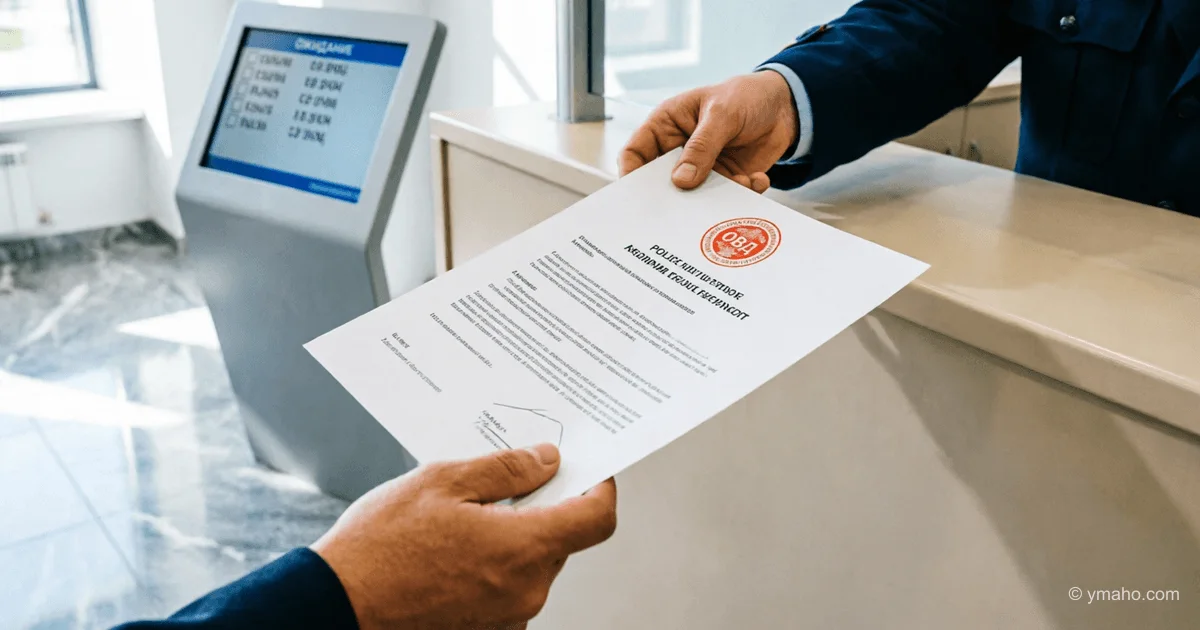
How to Get a Criminal Record Certificate via the MFC
Niche: News & Current Events Content Type: Step-by-Step Guide Why It Matters: A bureaucratic procedure with a clear goal, where a simple guide saves time and nerves.
The Gist: What You Need to Know First
A criminal record certificate is an official document confirming that you have no outstanding or unexpunged criminal record. It is required by employers when hiring for educational institutions, security companies, government agencies; for adoption; for obtaining a visa to several countries, including Schengen states and the USA; and for applying for a residence permit or citizenship.
The MFC acts as an intermediary between you and the Ministry of Internal Affairs. You submit your application through the public services center, and the certificate is issued by the Information Center of the Ministry of Internal Affairs. Processing time: up to 30 calendar days by law, but in practice, the finished document usually arrives at the MFC within 2-3 weeks. Expedited issuance in 3-5 days is impossible — that's a myth.
A key detail many overlook: the certificate has a limited validity period for presentation at the requesting organization. It is usually 30 or 90 days, depending on the organization that requested it. The certificate itself is valid indefinitely, but the recipient may set their own timeframe for relevance. Check this period with your employer or visa center before applying.
The state fee is about 14 USD for the standard processing time (30 days). The MFC does not charge any other fees, but if you order multiple copies, the fee is paid for each copy separately.
Step-by-Step Solution: From Visiting the MFC to Receiving the Certificate
Step 1. Choose a Suitable MFC
Not every "My Documents" office provides the service of issuing criminal record certificates. A full list of centers offering Ministry of Internal Affairs services is available on the official website of your regional MFC or on the State Services portal in the appointment booking section. Large city centers definitely accept applications. In rural areas, you may need to travel to the district center.
You can book an appointment in three ways:
- Through the State Services portal in the "Appointments with Agencies" section.
- By calling the MFC hotline in your region.
- By taking an electronic queue ticket on-site, but this is risky — during peak hours, there may be no free slots, and you'll waste time.
I recommend booking online in advance. Select the service "Issuance of certificates of criminal record (or lack thereof)," choose a convenient time, and confirm your visit. You will receive a confirmation email with your queue number.
Step 2. Prepare Your Documents
You will need:
- A valid Russian Federation passport with up-to-date information. If you have changed your passport and your registration is not yet entered in the new one, bring your old passport or an extract from the house register.
- A completed application form. You can fill it out at home by downloading it from the MFC or State Services website, or on-site with the help of a center employee.
- A receipt for payment of the state fee — about 14 USD. Get the payment details from the Ministry of Internal Affairs website or directly at the MFC. You can pay the fee at a terminal inside the center, online via a banking app, or at a bank branch.
- Your Taxpayer Identification Number (optional, but speeds up processing).
The application includes standard fields: full name (including all previous surnames if you have changed them), date and place of birth, passport details, registration address and actual residence address, purpose of obtaining the certificate, and number of copies.
Step 3. Submit the Application at the MFC
Arrive at the MFC at your scheduled time. An employee will check your passport, verify the information against your application, accept the payment receipt, and give you a receipt with the application registration number. The receipt includes the date of submission and the estimated completion date. Keep this document until you receive the certificate — without it, you will not be given the finished result.
The employee must inform you that the MFC does not produce the certificate but only forwards your documents to the Information Center of the Ministry of Internal Affairs. The processing time starts from the moment the application is registered in the Ministry's system, not from your visit to the MFC. Add 2-3 days for document transfer between the MFC and the agency.
Step 4. Track the Status of Your Application
The receipt contains the application number. You can check the status using this number:
- On the Ministry of Internal Affairs website in the "Online Services" section → "Application Status Check."
- By calling the MFC.
- On the State Services portal in your personal account (if you linked the application to your account).
When the status changes to "Ready for Issuance," you can go pick it up. In practice, many MFCs additionally notify applicants via SMS if you provided your phone number.
Step 5. Collect the Completed Certificate
Go to the same MFC where you submitted the application. Bring your passport and the receipt. The certificate is issued in person. The paper form has a series, number, the Ministry of Internal Affairs seal, and the signature of an authorized official.
An electronic version of the certificate with a digital signature is also available via State Services, but not all organizations accept electronic documents. For visa centers and foreign employers, a paper copy with a wet seal is almost always required. Order the paper version.
Practical Tips and Important Nuances
Certificate for a Visa: Translation and Apostille
If you need the certificate for travel abroad, check the requirements of the receiving country. Schengen countries, the USA, Canada, and the UK require a notarized translation of the certificate into the language of the destination country. A certificate in Russian is not accepted.
The process is as follows: get the certificate from the MFC → go to a translation bureau for a notarized translation. Translation cost: from 10 to 25 USD per document, depending on the language and urgency. For some countries, an apostille on the original certificate is additionally required. The apostille is affixed by the Ministry of Internal Affairs. Request it immediately when submitting your application — there is a corresponding field in the application. An apostilled certificate will cost an additional state fee of about 28 USD, and the processing time will increase by 5-7 days.
If You Do Not Live at Your Registered Address
The MFC accepts applications based on your actual place of residence, not just your registration address. Ministry of Internal Affairs checks are federal, and the certificate will contain data on all regions where you have been registered. No additional requests to other regions are required.
If You Have a Criminal Record
The certificate is called "on the presence (or absence) of a criminal record." If you had a criminal record that has been expunged or cleared, the certificate reflects this, indicating the article, term, and date of expungement. A clean certificate is issued only to those who have never been criminally charged or have been rehabilitated.
Expedited Certificate Is Impossible
Online, you may see offers to "help get a certificate in 3 days for an extra fee." These are almost always scams. The certificate is entered into the unified Ministry of Internal Affairs database, deadlines are regulated, and it is impossible to bypass them legally for money. If someone offers you an expedited certificate for 50-100 USD, you risk getting a fake document, the use of which is a criminal offense.
Common Mistakes and How to Avoid Them
Mistake 1: Confusing a Criminal Record Certificate with a Certificate of No Criminal Record for Civil Service
For employment in civil service, law enforcement, or military service under contract, an extended certificate with data on all criminal prosecutions, including those terminated, is required. A regular certificate obtained through the MFC does not contain this information. Check with your employer for the exact name of the required document. The extended certificate is obtained not through the MFC but directly through the HR department of the agency.
Mistake 2: Not Listing All Previous Surnames
If a woman has changed her surname multiple times upon marriage but only lists her current surname in the application, the Ministry of Internal Affairs system will find records under the current surname but may miss old ones. The certificate will include a note "information incomplete," and the document will not be accepted. List all surnames you have held, along with the dates of change.
Mistake 3: Requesting a Certificate for Another Person
The certificate is issued only to the applicant personally or to their legal representative with a notarized power of attorney. Even close relatives without a power of attorney cannot obtain your certificate. If you are in another city and cannot come, apply for an electronic version on State Services with an enhanced qualified signature.
Mistake 4: Not Checking the Certificate for Typos Upon Receipt
Right at the MFC, check every letter of your full name, date of birth, passport details, and purpose of issuance. If there is an error in the certificate (e.g., a misspelled letter in your surname), the document is invalid. You have the right to immediately submit a request for reissuance. The new processing time will start from scratch, but the state fee will not be charged again if the error was made by the agency. If you leave the MFC and discover the error later, the reissuance process becomes more complicated — you will have to prove that the error was not yours.
Summary: Brief Conclusion and Next Step
Getting a criminal record certificate through the MFC is a straightforward but not quick procedure. The entire process takes about 3-4 weeks from application submission to receiving the finished document. The cost is about 14 USD for a standard copy. Additional expenses may arise for translation and apostille if the certificate is needed for travel abroad.
Your next step: determine the exact purpose of the certificate (employer, visa, adoption), clarify the document requirements — whether an apostille or translation is needed, how many copies, and what validity period they consider relevant. Then book an appointment at the MFC via State Services for the nearest available date, download and fill out the application in advance, and pay the state fee. With this preparation, you will complete the entire process in one visit without queues or returns for missing documents.
— Editorial Team









