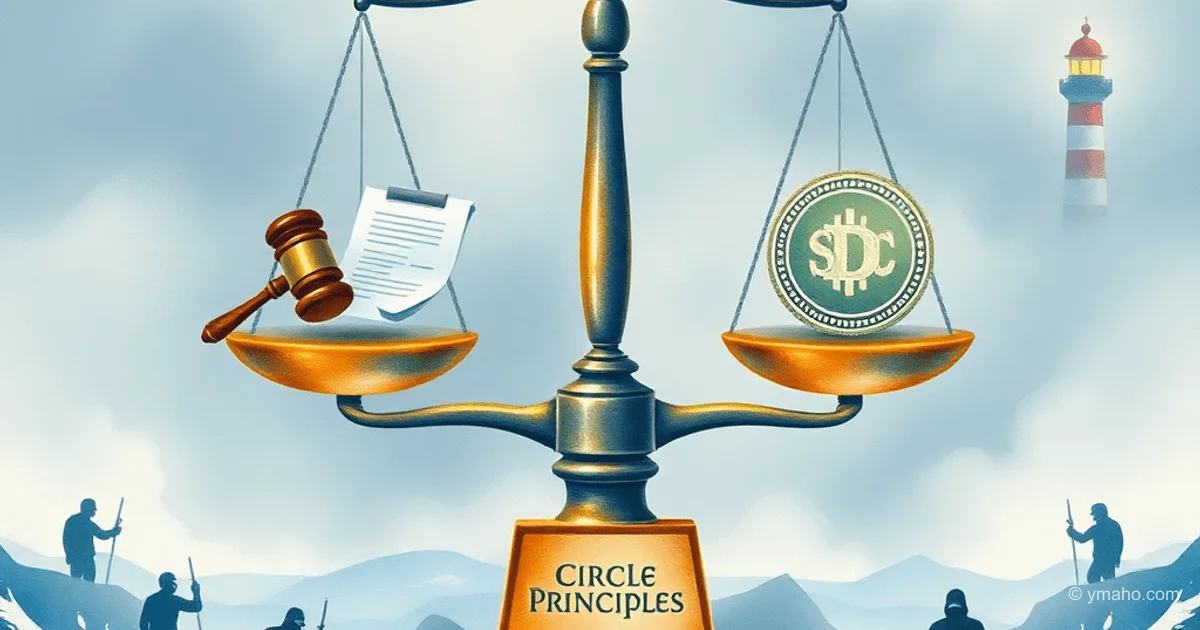
Circle Refuses to Freeze Crypto Addresses Without a Court Order—and Why It Matters to Everyone
Circle, the issuer of the USDC stablecoin, has officially stated that it will not freeze digital wallets, even if they are linked to hackers or scammers, unless required by a court or law enforcement agencies. This decision has sparked debate, but it touches on a fundamental question: in the world of cryptocurrencies, who has the authority to decide who can and cannot use their money?
To the average person, this may sound abstract. But imagine your bank account suddenly being blocked because the bank ‘suspects’ you of something—without a trial, without evidence, just based on an internal decision. That’s exactly the kind of situation Circle is trying to avoid in the realm of digital assets.
Why Circle doesn’t want to be the ‘judge’
At a press conference in Seoul, Circle CEO Jeremy Allaire emphasized that a private company should not assume the role of a moral arbiter. If a stablecoin issuer starts deciding on its own whose funds to freeze, it would set a dangerous precedent. Instead of protecting users from criminals, we’d end up with a system where corporations control access to money according to their own discretion.
Currently, Circle is only willing to act when there is:
- An official request from U.S. law enforcement agencies (such as the FBI or the Department of Justice).
- A court ruling confirming the address’s connection to criminal activity.
Allaire insists that such rules must be enshrined in law—for example, in the CLARITY Act currently under discussion. Without a clear legal framework, any action taken by the company would either be too slow or too arbitrary.
Criticism and real-world consequences
Independent researcher ZachXBT recently discovered that Circle did not freeze 230 million USDC stolen from the decentralized protocol Drift. These funds were transferred via Circle’s cross-chain bridge from Solana to Ethereum and remained withdrawable. In his view, the company could and should have intervened more quickly.
Cases like this raise a troubling question: if hackers know that stablecoins like USDC cannot be easily frozen, won’t the crypto market become even more attractive to criminals?
However, Circle counters that starting to block addresses without a legal basis would undermine trust in all stablecoins. After all, their primary value lies in predictability and their peg to the U.S. dollar—not in the internal policies of a private firm.
How this differs from CBDCs
Allaire also pointed out that, unlike central bank digital currencies (CBDCs), which governments can freeze instantly and without explanation, private stablecoins like USDC were originally designed as tools for financial freedom. Yes, they are regulated—but only within the bounds of the law, not at the whim of a government official or a CEO.
This key distinction highlights the difference: CBDCs are money under complete state control, while USDC is money protected by the rule of law.
What matters
- Circle refuses to freeze crypto addresses without a court order or a request from law enforcement.
- The company stresses the need to codify these rules into law (for example, through the CLARITY Act).
- Critics point to instances where millions of dollars in USDC remained accessible to hackers.
- The central conflict: security versus the principle of not acting as one’s own judge.
- This decision impacts trust in all stablecoins—and the future of digital money as a whole.
What does this mean for everyday people?
If you use USDC or other stablecoins, keep in mind that your funds are protected not from hackers, but from arbitrary actions. Circle won’t simply freeze your wallet, even if it mistakenly suspects you of something. On the other hand, if you fall victim to theft, recovering your funds will be difficult—until there is an official request from the authorities. This balance between freedom and security will determine how widely cryptocurrencies are adopted in daily life.
— Editorial Team









