Clashes in the Strait of Hormuz: Shots Fired and Conflicting Reports
Iranian Navy fired warning shots at approaching US warships. Accounts of the incidents differ: the US claims to have destroyed Iranian boats, Tehran denies this and reports civilian casualties.
Clashes in the Strait of Hormuz: Information War Amid Missile Barrages
Introduction
On May 4, 2026, the Strait of Hormuz became an arena not only for military confrontation but also for a fierce information war. The Iranian Navy fired warning shots at approaching US Navy vessels, triggering a chain of mutually exclusive statements. This incident marked the first direct confrontation since President Donald Trump announced Operation Project Freedom, aimed at unblocking the strategic waterway. The situation is unique in that each side paints its own picture of events: Washington reports the destruction of Iranian boats, while Tehran claims civilian deaths and denies the military nature of the targeted vessels. This gap in interpretations makes analyzing this event crucial for understanding the future trajectory of the conflict.
Event Details and Timeline
The events began to unfold rapidly after Trump announced the start of Project Freedom on May 3—a campaign to ensure safe passage for commercial vessels that had accumulated in the Persian Gulf. Tehran's response was immediate. On Monday morning, Iranian state television reported that the Iranian Army Navy fired warning shots with cruise missiles, rockets, and launched combat drones near US destroyers, which, according to the Iranian side, ignored warnings and attempted to enter the strait. An Iranian military official stated that warning fire was opened after the destroyers ignored an initial warning, using a "radar blackout trick."
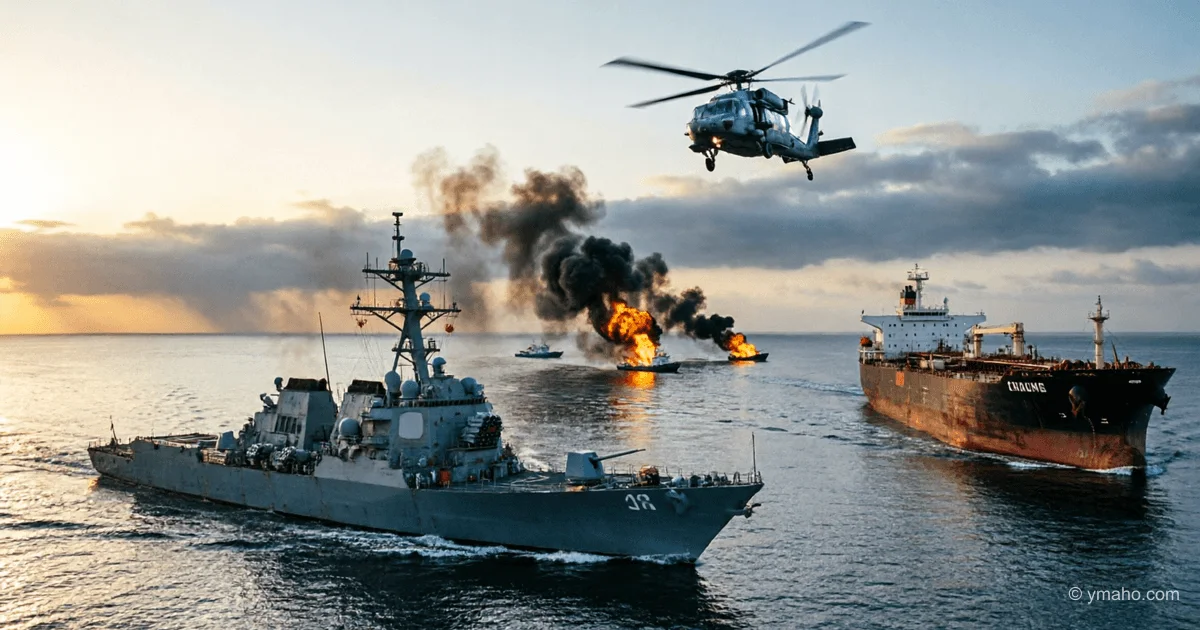
US Central Command (CENTCOM) presented a fundamentally different version. CENTCOM Commander Admiral Brad Cooper stated at a press conference that no US Navy ships were attacked or hit. Instead, American forces providing defense struck Iranian small boats. According to the military statement, AH-64 Apache attack helicopters and MH-60 Seahawk multi-role helicopters destroyed six small Iranian boats that posed a threat to commercial shipping. Admiral Cooper emphasized that all threats—whether missiles or drones targeting both military and commercial vessels—were successfully neutralized, and two US commercial ships safely passed through the strait.
Iran immediately refuted these claims. Tehran called CENTCOM's reports "baseless and absolute lies." Iranian military sources insist that the US attack hit not military boats but two civilian cargo vessels traveling from the Omani port of Khasab toward the Iranian coast. As a result of this strike, five civilians are said to have died. An Iranian military source described the US actions as "hasty and clumsy," driven by excessive fear of IRGC speedboat tactics.
Impact and Significance
The incident has far-reaching consequences beyond a tactical skirmish. The economic significance is enormous: historically, about one-fifth of the world's oil consumption passes through the Strait of Hormuz, and since February, about 2,000 commercial vessels have been stranded there. The US attempt to forcibly restore shipping under Project Freedom, involving 15,000 troops and over 100 aircraft, means the global economy has come close to full-scale war on a key energy route. Insurance rates for shipowners have already skyrocketed, and risks to supply chains are assessed as extreme.
However, the main innovation of this phase of the conflict has been total information warfare. The existence of two diametrically opposed pictures—destruction of military boats versus civilian sailor deaths—creates a situation where any further US action can be portrayed by Iran as a disproportionate use of force against civilians. This constrains Washington's propaganda machine and gives Tehran moral justification for escalation. Iran's argument about introducing a "smart control" zone in the Strait of Hormuz directly challenges the US mission and makes global commercial fleets hesitate to accept the offer of military escort.
Reactions of Key Players
The US response is characterized by demonstrative toughness in actions but caution in legal formulations. Admiral Cooper avoided directly answering whether the destruction of Iranian boats and mutual shelling ended the ceasefire regime that had been in place since early April. He characterized US actions as "defensive" and aimed at creating a protective umbrella for commercial vessels. Trump himself, commenting on the mission, resorted to unprecedentedly harsh rhetoric, threatening that Iran would be "wiped off the face of the earth" if it attempted to attack US-flagged ships.
Iran's position, in contrast, combines military audacity with diplomatic public play. Officials state that the country is fully prepared for "any scenario" and will not tolerate "bullying." Army Commander Amir Hatami declared regional security a "red line" for Iran. At the same time, accusations of civilian deaths are clearly aimed at the international community to portray the US as an aggressor. Notably, analysts cited by media characterize the situation as a "game of chicken," where sides balance on the brink, testing each other's resolve.
Forecast and Conclusions
The May 4 incident will likely become a prelude to the final collapse of the ceasefire regime. Project Freedom has so far shown limited effectiveness: despite CENTCOM's statements, analysts doubt that escort resources can ensure safety for all—12 destroyers cannot simultaneously cover hundreds of ships, and the threat from thousands of mobile anti-ship missiles and naval mines remains critical. Expert forecasts suggest that the limited US military success in destroying six boats is easily offset by Iran's "thousand cuts" tactics and new mine-laying operations.
On the information front, the advantage is also unclear. Tehran's claims of civilian deaths, even if unsubstantiated, create a toxic media backdrop for the US and fuel anti-war sentiment within America. Information warfare becomes a deterrent tool as important as missiles. The main conclusion is that a military solution to the Strait of Hormuz problem without completely clearing the Iranian coast of missile batteries is seen by analysts as "practically impossible." Continued operations will inevitably be accompanied by an increase in such clashes and casualties, dragging the region into a vortex of uncontrolled violence.
— Editorial Team









