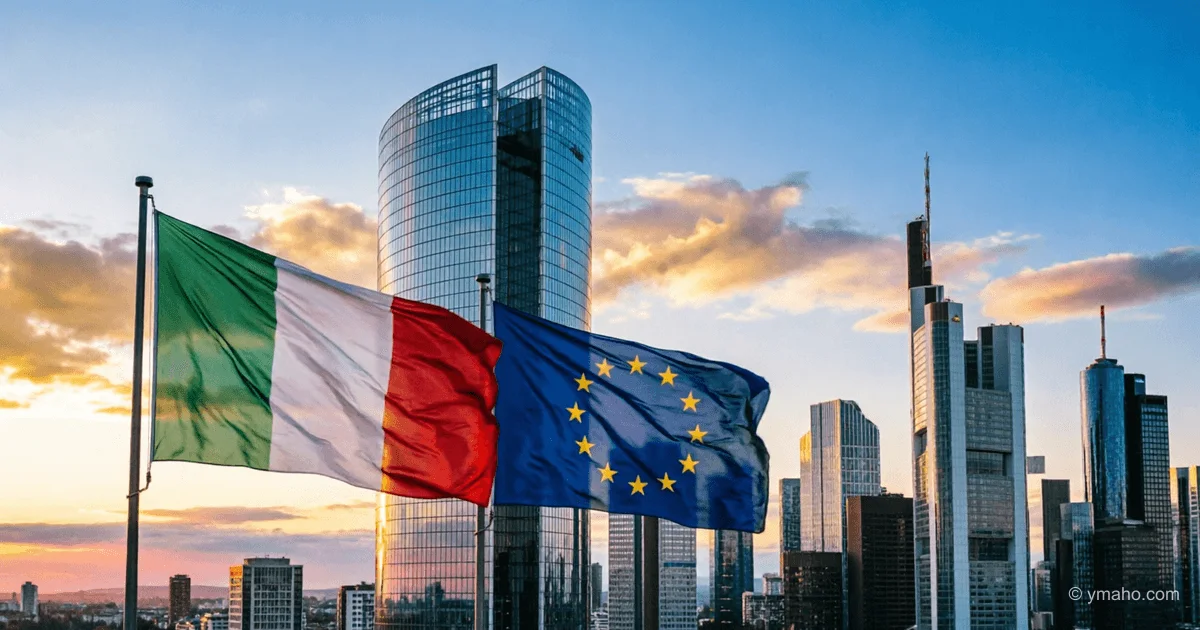
UniCredit Begins Commerzbank Takeover After Share Issue Approval
Shareholders of Italy's UniCredit approved the issuance of up to 470 million new shares on May 4 to finance the deal. The offer to buy Germany's Commerzbank starts on May 5, with the German government opposing the takeover.
UniCredit and Commerzbank: The Start of Europe's Biggest Bank Takeover in a Decade
Introduction
The European banking landscape is on the verge of a tectonic shift. On May 4, 2026, shareholders of Italy's UniCredit approved a massive share issue of up to 470 million new shares, clearing the way for the takeover of Germany's Commerzbank. The offer starts on May 5, and this deal could become the largest cross-border bank merger in Europe since the global financial crisis.
The event unfolds in a highly tense political atmosphere: the German government openly opposes the takeover of one of its systemically important banks by a foreign competitor. Nevertheless, UniCredit CEO Andrea Orcel, known for his M&A expertise and tough negotiation style, is determined to see the deal through despite Berlin's resistance.
Event Details and Timeline
The roots of this story go back to September 2024, when UniCredit unexpectedly announced the acquisition of a 9% stake in Commerzbank—part of this stake was bought from the German government itself as it reduced its holding after rescuing Commerzbank in 2008. By early 2026, the Italian bank had increased its total economic stake to 28% through a combination of direct share ownership and derivatives.
The key moment was the UniCredit shareholder vote on May 4, 2026. Management sought approval to issue up to 470 million new shares—a significant increase in the capital base, given that the bank currently has about 1.5 billion shares outstanding. The vote showed strong support: holders of more than 75% of voting shares voted in favor, well above the required two-thirds threshold.
The offer, starting May 5, values Commerzbank at approximately EUR 19-21 billion (about USD 21-23 billion at current exchange rates). The offer structure involves a share exchange with a partial cash component, financed precisely by the approved share issue. Barclays analysts estimate the total synergy effect from the merger at EUR 1.8-2.2 billion annually, mainly from consolidating corporate lending in Germany and Italy and optimizing IT infrastructure.
From a formal standpoint, the deal still faces two major hurdles: approval from the European Central Bank (ECB) and the stance of German regulator BaFin. The ECB has traditionally been favorable to consolidation in the European banking sector, but political pressure from Berlin cannot be dismissed.
Impact and Significance
The potential merger has multi-layered significance—industry, geopolitical, and macroeconomic.
For the European banking sector, the deal would mark the end of an era of fragmentation. The combined bank would become the second largest in the eurozone with total assets of around EUR 1.3 trillion (about USD 1.44 trillion) and a market capitalization approaching EUR 75 billion. By this measure, the new entity would trail only BNP Paribas, ahead of Santander and Deutsche Bank.
Consolidation is long overdue: European banks chronically lag behind their US competitors in return on equity. The average ROE for the European banking sector is 8-9%, while JPMorgan and Bank of America exceed 15%. Consolidation through mergers is one of the few remaining levers to improve efficiency in an environment of negative net interest income after the rate-cutting cycle.
The geopolitical subtext is equally important. The German government's resistance reflects a deep fear of losing economic sovereignty. Commerzbank is not just a bank but a key element of the Mittelstand, the system of medium-sized enterprises that form the backbone of the German economy. Lending to this segment has traditionally been seen as a strategic function, and handing it over to Italian control is perceived in Berlin as a blow to industrial policy.
For Italy, a successful deal would be the biggest corporate triumph in decades, symbolizing the country's return to the top tier of European finance after the 2011-2012 debt crisis. UniCredit's market value has already risen 24% since the start of the year, and Commerzbank shares have gained 18% on expectations of a takeover premium.
Reactions from Key Players
The German government is the main opponent of the deal. The finance minister issued a strong statement, calling UniCredit's actions a "hostile takeover contrary to national interests." Berlin retains the remaining 12% stake in Commerzbank, and although the government cannot formally veto the deal beyond a certain threshold, political leverage—through BaFin and informal channels—remains significant.
The European Central Bank has taken a deliberately neutral stance, but the head of the ECB's supervisory arm has previously called for cross-border banking consolidation as a tool to strengthen financial stability. Behind the scenes, ECB sources indicate that the regulator sees no grounds to block the deal provided prudential standards are met.
Shareholders and the investment community are in favor of the merger. Major institutional investors in Commerzbank, including Capital Group and BlackRock, are reportedly leaning toward accepting the offer if the premium is adequate. Notably, no major Commerzbank shareholder has publicly opposed the offer.
German unions and political parties are the loudest opposition. Ver.di, Germany's largest banking union, estimates potential job losses at 15,000-20,000, mainly in Frankfurt, where overlapping functions of the two banks are most evident. Left-wing and conservative opposition in the Bundestag—from different ideological standpoints—unanimously criticize the deal.
Forecast and Conclusions
The probability of a successful takeover in its current form is estimated by Goldman Sachs analysts at 60-65%. The base case scenario assumes that UniCredit will adjust the offer structure, providing the German side with additional guarantees to preserve the Commerzbank brand, protect jobs for a transitional period of 3-5 years, and maintain autonomy in Mittelstand lending.
If the deal goes through, it will signal a new wave of consolidation in the European banking sector. Potential next targets for cross-border mergers could include ABN AMRO, KBC, and Erste Group. The European Banking Union, created after the 2011 crisis precisely to facilitate such processes, will finally face a real-world test.
However, the deeper question remains open: can one bank effectively manage credit risks in two countries with different business cultures, legal systems, and economic cycles? The history of cross-border bank mergers—from ABN Amro-RBS to Santander-Abbey—offers mixed answers. The success or failure of this deal will largely determine the future architecture of European finance for a decade to come.
For markets, the short-term signal is clear: the European banking sector is entering a period of heightened M&A activity, and investors positioning for takeovers in the financial sector could capture significant alpha. However, political risks remain underestimated, and volatility around the deal is guaranteed at all stages of its review.
— Editorial Team









