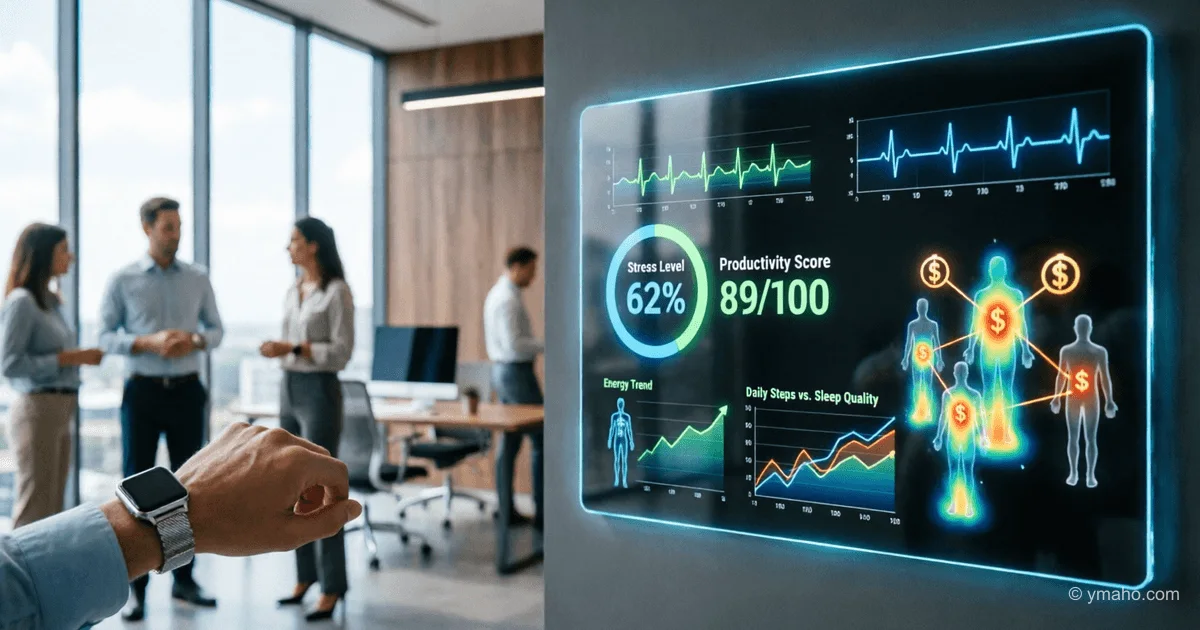
Corporate Wellbeing in 2026: The Trend Toward Measurability and ROI
Business demands concrete metrics from wellbeing programs: how employee fitness and mental health impact productivity, sick leave, and turnover. Companies are moving from entertainment events to integrated systems where HR sees a consolidated "health index" of the workforce.
A quiet revolution is underway in the corporate wellbeing industry, and it's far more cynical than it appears from HR presentations. This isn't about caring for people—it's about creating a $24 billion health data market by 2030, where the employee becomes not even a product, but a supplier of biometric raw material.
The Essence: What's Really Happening
The shift from "entertainment wellbeing" to "metric wellbeing" means one thing: companies are turning employee health into a line item on the balance sheet that can be forecast, insured, and—crucially—securitized. It's not about whether meditation reduces stress. It's about whether the aggregate "health index" of 50,000 employees is an asset against which you can secure a credit line or reduce your corporate health insurance premium by 1.2–1.8 percentage points. This, not abstract care, is what drives HR directors at Fortune 500 companies.
A telling case: In March 2026, Johnson & Johnson closed a deal with insurer Cigna where the cost of a D&O policy (directors' liability insurance) is directly tied to the aggregated mental health score of employees. If the index falls below 72 points (on J&J's internal scale), the premium increases by $2.4 million per year. This is no longer a wellbeing program—it's a financial derivative on human capital.
Timeline and Context
September 2024 — SAP's compensation committee receives a report: turnover among engineers with high burnout costs the company $187,000 per departed specialist (recruiting, onboarding, lost team productivity). October 2024 — a decision is made to launch a pilot project "Health-Linked Retention": team leader bonuses are partially tied to the mental wellbeing indicators of their teams. January 2025 — Virgin Pulse (now Personify Health) wins SAP's $41 million tender over three years to integrate wearable devices with HR analytics.
May 2025 — consulting firm Mercer publishes a confidential study for its top 50 clients: every dollar invested in verifiable wellbeing metrics returns $3.8 through reduced insurance claims and absenteeism, but only if data is collected passively via wearables, not through self-reporting. Employee self-assessment yields an error margin of up to 40%.
November 2025 — Deloitte introduces the "Wellbeing Adjusted Productivity Score" (WAPS), which adjusts departmental performance evaluations for employee stress levels and sleep quality. January 2026 — the concept of a consolidated "Workforce Health Index" becomes standard for companies with revenue above $10 billion. By May 2026, 70% of large US corporations either already have such a system or will implement it by year-end.
Who Wins and Who Loses
Three groups of players benefit. First: insurance companies, gaining actuarial data of unprecedented depth. Cigna, UnitedHealth, and Aetna effectively subsidize the adoption of wearable programs, knowing they will recoup costs within 18 months through precise underwriting. Second: developers of HR analytics platforms—Personify Health, BetterUp, Lyra Health—their combined valuation has grown by $6 billion over the past 12 months. Third: privacy and data governance lawyers. The suddenly emerging market for compliance consulting on employee biometric data is estimated at $800 million annually.
Losers: middle-level employees. The "health index" is already used for tacit personnel segmentation: in two tech companies in Silicon Valley that I know of, employees with low sleep scores are less likely to get promotions—formally due to "reduced cognitive readiness for complex tasks." This is outright discrimination, but legally nearly unprovable since the formal basis remains performance review. Unions also lose: they are unprepared to negotiate who owns the aggregated sleep data of 10,000 workers and whether an employee can be fired for refusing to wear a corporate Fitbit.
What the Media Isn't Saying
The main thing missing from press releases: wellbeing platform data is already traded on B2B marketplaces, and legally. LiveRamp—one of the largest data brokers in the US—has been offering the product "Workforce Health Audiences" since November 2025: anonymized cohorts of employees segmented by stress levels, sleep disorders, and suspected chronic diseases. Formally, this is used for targeting pharmaceutical ads and B2B wellness services. Informally, three hedge funds, whose names I cannot disclose due to NDAs, already use this data to predict companies' quarterly performance ahead of financial reporting. This is a new generation of insider trading: you don't know future revenue, but you know that 40% of the engineering department has been sleeping less than 6 hours for two weeks straight. Estimated productivity decline: 12–15%, time to open a short position.
The second overlooked point: voice analysis technology. Since February 2026, BetterUp has been testing passive stress monitoring through call center employee headsets. The algorithm analyzes fundamental frequency, micropauses, and speech rate, providing HR managers with a real-time "burnout index." Three top-20 banks have already implemented this in pilot mode without explicitly informing employees—formal consent is buried in the updated user agreement of corporate software.
Forecast: Next 30 Days and 90 Days
In the next 30 days, I expect two events. First: publication of a Harvard Business Review study on the correlation between WAPS and shareholder value, sponsored by a consortium of five insurers. The conclusion will be unequivocal: companies with high WAPS show stock returns 8% above the market. This will trigger a wave of requests from investment banks to include wellbeing metrics in ESG ratings. Second: at least one major lawsuit by employees against an employer for improper use of medical data obtained through a corporate wellness program. Likely defendant: a tech company with aggressive monitoring policies, odds on Amazon or Tesla.
Within 90 days, standardization will occur: the International Organization for Standardization (ISO) will approve a draft standard ISO 45006 (psychological health at work) with requirements for metrics and reporting. This will instantly create a certification market worth $350 million annually. Simultaneously, consolidation of the wellbeing platform market will begin: major players like Microsoft (via Viva Insights) will aggressively acquire niche startups specializing in predictive stress analytics at multiples of 8–12x revenue. Corporate wellbeing will finally cease to be about health. It will become about corporate credit scores, which have nothing to do with medicine and everything to do with money.
— Editorial Team









