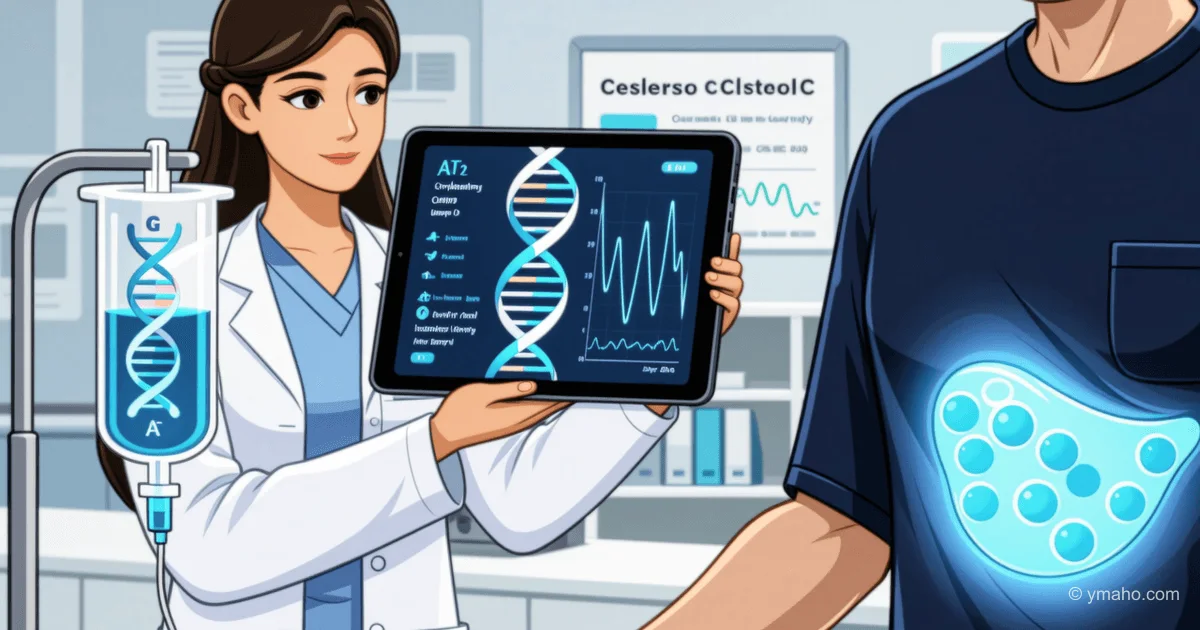
NEJM: In Vivo CRISPR Gene Editing Successfully Lowers Cholesterol in Patients with Hereditary Hypercholesterolemia
In the phase 2b VERVE-102 trial, a single infusion of the base editor VERVE-201 led to a sustained reduction in PCSK9 and LDL cholesterol levels by more than 60% in patients with heterozygous familial hypercholesterolemia.
We are accustomed to thinking of genome editing as something that happens in a Petri dish and then, with colossal risk, returns to the body. VERVE-102 breaks that paradigm. The point is not that scientists have once again "fixed" the PCSK9 protein. The point is that a person has turned into a self-renewing biofactory for a drug, and the tool for this was a single intravenous injection. This is not therapy; it is a biological rewrite of the cell's operating system, and it happened not in a test tube, but in the liver of a living, breathing patient.
Right now, while global media debate the ethics of designer babies, a small group of investors and executives at Verve Therapeutics have already rewritten the rules of cardiology. We are not discussing a 60% cholesterol reduction as a clinical outcome, but the moment when CRISPR ceased to be a tool for orphan diseases and entered a market with an addressable audience of 100 million people—that's exactly how many people on the planet have familial hypercholesterolemia, even without knowing it. And the first stop on this train is the complete destruction of the multi-billion-dollar anti-PCSK9 antibody therapy market, because why inject twice a month when you can fix it once and for all?
Timeline and Context
The roadmap of events leading to May 2026 looks like a fast-forward, though within the industry, this path felt like walking a razor's edge.
July 2022. Verve Therapeutics first demonstrates in non-human primates that single-nucleotide editing of the PCSK9 gene is possible in vivo using lipid nanoparticles. At the time, it seemed like science fiction, but the key word was "lipid nanoparticles"—the same delivery technology that was tested with mRNA vaccines against COVID-19. Verve did not invent delivery from scratch; it shamelessly, brilliantly, and pragmatically borrowed it, cutting the path from concept to clinic by two-thirds.
November 2023. Phase 1b heart-1. The first patient in history receives VERVE-101—the predecessor of the current construct. Results are encouraging, but safety questions arise: transient troponin elevation and, critically for insiders, a hypothetical off-target effect in germline cells. This is the moment that quietly, without loud press releases, prompts the company to switch to the next-generation base editor VERVE-201.
September 2025. Verve, in partnership with Eli Lilly (and that name is not mentioned casually), announces the start of VERVE-102—a trial using not just CRISPR-Cas9, but an adenine base editor that works without double-strand DNA breaks. The risk of major chromosomal rearrangements is radically reduced.
May 10, 2026. Two-year follow-up data from phase 2b draws a standing ovation at the late-breaking clinical trials session of the American Heart Association annual conference. Sustained LDL reduction of more than 60%, no serious adverse events related to the drug over 18 months. What astonishes is not so much the number itself, but the graph curve—it is flat. No peaks, no troughs. The effect neither increases nor wanes; it simply exists, like gravity.
Who Wins and Who Loses
The main beneficiary is hidden in the shadows. It is not Verve Therapeutics with its pre-market capitalization jumping to $5.7 billion. Nor even the patients, though for them it is salvation. The main beneficiary is Eli Lilly. The pharma giant, holding exclusive commercialization rights, is methodically building infrastructure for what I call "genetic franchising." Imagine: instead of three visits to a cardiologist and monthly injections of evolocumab (cost per patient course about $12,000 per year), you receive one infusion of VERVE-201 for an estimated $45,000–$55,000. And you forget about the problem forever. For an insurance company, the payback horizon for such a deal is less than three years. This is unprecedented economics for gene therapy.
Losers are companies that slept too long. Regeneron and Sanofi with their Praluent, Amgen with Repatha. Their business models, built on lifelong prescriptions, will become obsolete not in ten years, but in five. But the most unexpected loser is diagnostic labs that perform lipid profile screening. If the population starts "fixing" itself at age 25–30, the need for total cholesterol monitoring will drop, and that is an $18 billion annual market. We are on the verge of a moment when preventive medicine begins to eat itself.
What the Media Isn't Saying
The mainstream press paints a rosy picture of "healing from hereditary cholesterol." They overlook the fact that VERVE-201 is essentially a Trojan horse for Prime Editing technology inside the body. This is not just replacing a "letter" in a gene. The adenine base editor, delivered to the liver, can in the future be reprogrammed with minimal modification to target another gene. The main asset created by Verve is not a drug, but a platform for intravenous delivery of base editors with tissue-specific tropism, validated on thousands of patient-hours.
And here lies the most explosive insider insight. At the American Heart Association conference, it was discussed in the corridors that, parallel to VERVE-102, an experiment not disclosed in the main abstract was underway—delivery of the same editor to turn off the ANGPTL3 gene. Why is this important? Because ANGPTL3 is the pathway to treating not hereditary, but acquired dyslipidemia resistant to statins. If VERVE-201 treats the familial form, an ANGPTL3 blocker opens the door to gene editing for hundreds of millions of people with metabolic syndrome. This transforms medical technology into a consumer product. And regulators are not ready for it.
Forecast: Next 30 Days and 90 Days
Next 30 days. A domino effect in regulation will begin. The FDA and EMA will be flooded with letters from patient organizations demanding accelerated access. Verve will hold a closed meeting with key payers, where it will announce the price. I expect it in the range of $48,000 per procedure. Simultaneously, Amgen will attempt to challenge base editor patents in court, claiming they are derivatives of CRISPR-Cas9—a tactical move to slow progress and gain a year for its own candidate drug based on siRNA.
Next 90 days. We will hear the first reports of "gene editing tourism." Wealthy individuals from countries with strict regulations (Australia, Japan, Singapore) will start booking the procedure at clinics in the US and Switzerland. Against this backdrop, another epochal event will occur: Verve, together with a broad consortium, will launch a study in children aged 12 and older. The discussion will shift from scientific to purely ethical: is preventive somatic cell editing permissible in a minor without their informed consent, but with parental consent? It is in this question, not in the biology of editing, that the next decade of regulation will be mired. We have just entered an era where medicine has stopped fighting consequences—it has begun to turn off the cause before it can strike.
— Editorial Team









