CRISPR-on-a-Chip Technology Unveiled for Pocket-Sized Molecular Diagnostics
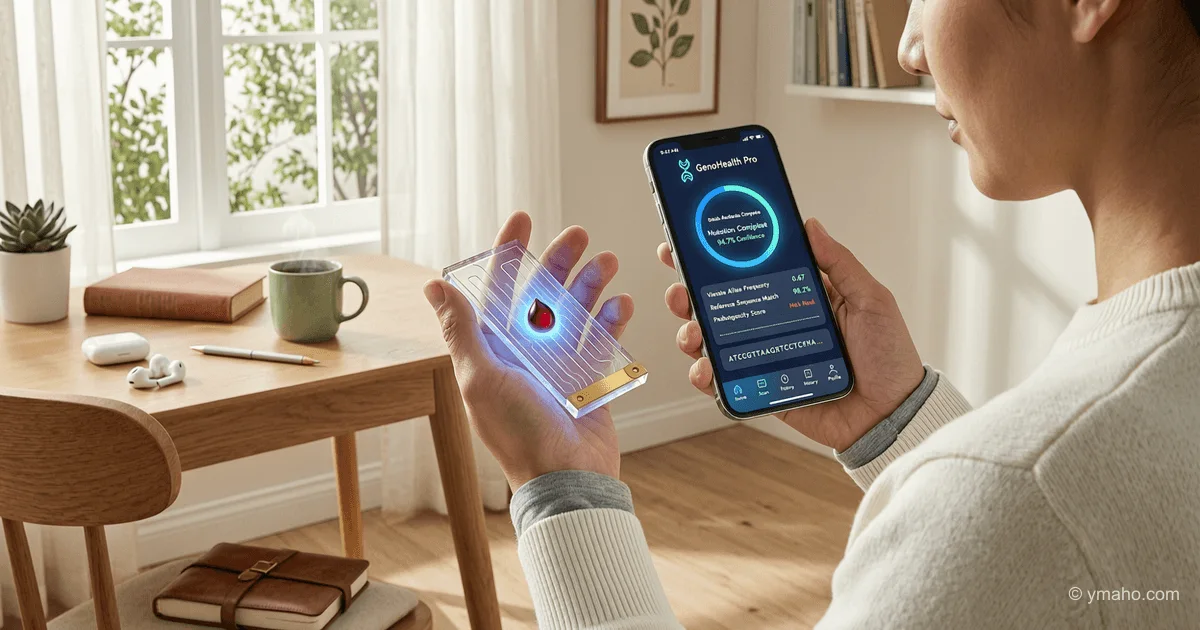
Developers have introduced the concept of portable diagnostics called "CRISPR-on-a-chip," combining gene-editing technology with microfluidics. Such devices can detect single molecules of tumor DNA in blood via a smartphone at home, with accuracy 10–100 times greater than PCR tests.
The Gist: What's Really Happening
JMIR Publications released a review article by Cliff Domini titled "CRISPR Diagnostics, in Your Pocket," painting a picture: CRISPR enzymes integrated with a microfluidic chip connected to a smartphone deliver lab-grade diagnostic accuracy at home. The JMIR article is not original research but a vision piece summarizing the state of development.
But the real story runs deeper. CRISPR-on-a-chip is not futurology. It is an actively developed technology platform, and 2025–2026 have been pivotal years for it. In January 2026, ACS Nano published a comprehensive review titled "CRISPR-on-Chip for Point-of-Care Diagnostics," documenting single-molecule sensitivity and multiplex detection capabilities. That same month, ScienceDirect released a review of microfluidic platforms for CRISPR biosensing, describing a fully automated "sample-to-answer" workflow.
In April 2026, at the Korean Chemical Society meeting in Jeju, a research group from Chung-Ang University presented a poster on a SAW-Enhanced CRISPR-SERS Microdroplet Platform—a system capable of detecting EGFR-mutant ctDNA without amplification. This is no longer a concept but a working prototype.
The key metric cited by JMIR—sensitivity 10–100 times higher than standard PCR—is not an exaggeration. The core mechanism: CRISPR enzymes possess "collateral cleavage"—the ability to nonspecifically cut reporter molecules after activation by the target sequence, creating a signal amplification cascade without thermocycling.
Timeline and Context
- 2020–2024: CRISPR diagnostics (CRISPR-Dx) actively develops for SARS-CoV-2 detection. SHERLOCK (Cas13) and DETECTR (Cas12a) technologies prove the concept.
- December 2025: Journal of Nanobiotechnology publishes an AND logic-gated CRISPR/Cas9-HCR system for ctDNA detection with a limit of detection of 1 fM and the ability to distinguish single nucleotide variants (SNVs) with an allele frequency of 0.1%.
- January 2026: ACS Nano publishes "CRISPR-on-Chip for Point-of-Care Diagnostics"—a review systematizing the integration of CRISPR-Cas with microfluidic systems.
- February 2026: ScienceDirect publishes a 2020–2025 review on microfluidics for CRISPR biosensing.
- April 17, 2026: At the Korean Chemical Congress, a SAW-Enhanced CRISPR-SERS platform for amplification-free ctDNA detection is presented.
- April 28, 2026: JMIR publishes Domini's article, triggering a wave of media coverage.
Two parallel technology tracks have converged just now: CRISPR enzymes have achieved sufficient specificity to distinguish SNVs, and microfluidics has reached enough maturity to integrate the entire "sample-in, answer-out" process on a single chip. ACS Nano puts it precisely: "Microfluidic systems have become a game-changer in diagnostics."
Who Wins and Who Loses
Winners
Patients with early-stage cancer. ctDNA in plasma at stage I is present at concentrations below the detection limit of standard PCR. CRISPR-on-a-chip with 1 fM sensitivity changes the game: recurrence can be detected months before metastases appear.
Diabetics and patients with chronic diseases on remote monitoring. They won't have to travel to a lab every three months. A drop of blood from a finger, a cartridge, a smartphone—results in an hour.
Manufacturers of microfluidic components and graphene. Graphene sensors, mentioned by JMIR, can detect single molecules. The graphene biosensor market was valued at $350 million in 2025—CRISPR-on-a-chip will be a growth driver.
AI developers for diagnostics. ACS Nano explicitly points to "seamless integration of Deep Learning, AI, and IoT" as the next step for CRISPR-on-chip development. Results will be interpreted by algorithms, not humans.
Telemedicine platforms. Domini describes the workflow: results are automatically recorded in the health record, and a notification arrives on the smartphone. Teladoc, Amwell, and similar platforms gain a tool to expand services.
Losers
Clinical laboratory networks (Quest Diagnostics, LabCorp). If cancer marker and infection tests can be done at home with lab-grade accuracy, the centralized lab model with expensive equipment and skilled personnel is threatened. Routine diagnostics will go first, then complex tests.
PCR equipment manufacturers. Standard thermocyclers cost $15,000–$50,000. CRISPR-on-a-chip requires no thermocycling—isothermal reaction or direct detection. This is a fundamentally different economy.
Insurance companies. A dual situation: on one hand, early cancer detection saves the system money. On the other, the availability of home diagnostics explodes utilization. When a patient tests not once a year on a doctor's order but once a month "just in case," costs rise. Insurers will have to develop policies to manage this new behavior.
Developers of traditional liquid biopsies (Guardant Health, Foundation Medicine). Their business model relies on centralized analysis. If doctors and patients can get comparable results in a point-of-care format, the price advantage will destroy this model.
What the Media Isn't Saying
Insight #1: CRISPR-on-a-chip is not a single technology but a battlefield among Cas9, Cas12, Cas13, and Cas14
All headlines write "CRISPR-on-a-chip" as if it were one technology. In reality, four enzymes with fundamentally different properties are competing:
- Cas9 targets dsDNA, has no collateral cleavage, requires pre-amplification. Suitable for SNP genotyping but not for ultrasensitive detection.
- Cas12 targets dsDNA, has collateral cleavage of ssDNA. DETECTR systems are built on it.
- Cas13 targets ssRNA, has collateral cleavage of ssRNA. SHERLOCK platform.
- Cas14 targets ssDNA, has collateral cleavage of ssDNA, is more compact (400–700 amino acids vs. 1200–1500 for Cas12), simplifying engineering.
The commercial winner of this race is not yet determined. ACS Nano honestly admits: "integration with microfluidics for PoC applications is still poorly understood, despite CRISPR-Cas being widely used." Whoever solves the integration problem first will capture the market.
Insight #2: Chinese and Korean labs are outpacing Western groups in publication activity
ACS Nano is an American journal, but the review authors are Turkish researchers (Atceken, Kahya, Yigci, Tasoglu). The breakthrough work on ctDNA detection was published by Chinese groups. The SAW-CRISPR-SERS platform was reported by a Korean group. JMIR covers the technology for a Western audience, but the R&D center of gravity is shifting to Asia. This is a geopolitical fact: the next generation of molecular diagnostics may come not from Silicon Valley.
Insight #3: 10–100x sensitivity over PCR is not always an advantage
PCR has a clinically validated detection limit. Increasing sensitivity 100-fold means the test will detect mutations with an allele frequency of 0.01% and below. The problem: such low levels may be biological noise, not clinically significant signals. Every healthy person has clonal hematopoiesis with somatic mutations. CRISPR-on-a-chip risks creating a wave of false-positive "cancer" findings, leading to unnecessary biopsies and stress. Regulators will have to address not only analytical validity but also clinical utility.
Forecast: Next 30 Days and 90 Days
30 Days (until June 6, 2026)
Domini's article triggers a wave of discussion. Expect at least 5–7 news articles about "pocket CRISPR" in major scientific and tech media. Microfluidics manufacturers (Fluidigm/Standard BioTools, Dolomite, uFluidix) will receive inquiries from investors about platform readiness for CRISPR integration.
At least 2–3 academic groups will announce their own CRISPR-on-a-chip prototypes, citing the ACS Nano review as a conceptual framework. US and EU patent offices will see a surge in provisional applications for CRISPR-microfluidic systems.
The FDA will remain silent—the agency does not yet have a regulatory framework for CRISPR-on-a-chip as a device class. Classification will be needed: medical device, companion diagnostic, or a new hybrid category.
90 Days (until August 5, 2026)
The first pilot clinical study of CRISPR-on-a-chip will be announced. The most likely candidate: monitoring colorectal cancer recurrence via ctDNA detection of KRAS mutations. The AND logic-gated CRISPR/Cas9-HCR technology has already been validated on KRAS G12D, G12C, and EGFR T790M with 97.5% accuracy. Design: 40–50 patients after resection, comparison with Guardant360 as gold standard.
One of the major diagnostic holdings (Roche Diagnostics, Abbott, Danaher/Cepheid) will announce a partnership with a CRISPR biotech or academic group. Roche already has a CRISPR asset portfolio through Spark Therapeutics; Abbott has invested in PoC diagnostics. A pre-competitive collaboration for 12–18 months is logical.
The scientific community will begin a discussion on standardization. PCR took decades to standardize. CRISPR-on-a-chip will require standards for: (1) calibration of graphene sensors, (2) threshold values for collateral cleavage signal, (3) sample collection protocols outside the lab. ACS Nano has already pointed to this problem: standards for "clinical validation, signal amplification needs, and limit of detection" are needed.
The main takeaway: CRISPR-on-a-chip is emerging from the academic phase. Whether it becomes a commercial product depends not on technological readiness (which is sufficient) but on solving three nontrivial problems: (1) regulatory pathway, (2) clinical validation (not just analytical), and (3) an economic model for the mass market. Until a solution exists, CRISPR-on-a-chip is the most promising prototype. When it arrives, it will be not an evolution but a revolution in how we understand diagnostics.
— Editorial Team









