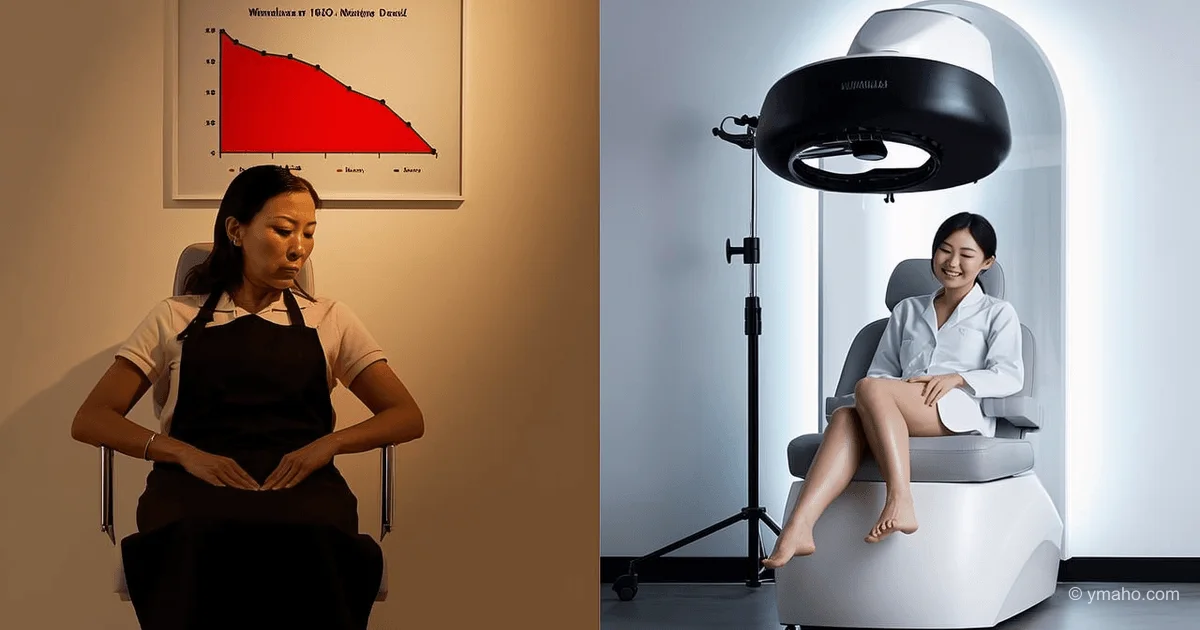
Surge in Laser Hair Removal Popularity Crushes Waxing Professionals' Incomes
In Russia, the income of sugaring and waxing specialists has dropped by 17.7% due to a client shift toward laser methods that offer long-term results.
How laser hair removal became a commodity rather than a service—and why waxing masters are losing the battle for good
The Core: What's Really Happening
The 17.7% decline in income for sugaring and waxing masters is not a temporary correction. It's a point of no return. Consumers have voted with their wallets for long-term results, and traditional hair removal has lost not because it got worse—it's exactly the same as it was ten years ago. The competition has changed.
The laser hair removal market in Russia has recovered from the 2022 downturn and is growing steadily. In 2023, the number of procedures reached 36.2 million. By 2026, according to BusinesStat, this figure will continue to rise—the geography of services is expanding, and repeat clients are increasing. The global hair removal services market, where the laser segment is already valued at $2.5 billion, will grow by 5.9% annually until 2035. Russia is no exception; it's part of a global trend.
But the essence goes deeper than numbers. Laser is no longer a "pricey alternative"—it has become the standard. The cost of a six-session course for underarms today is comparable to 18 months of monthly sugaring. And the result of laser is years without hair versus three weeks of smoothness from waxing. The math is ruthless.
Timeline and Context
The turning point didn't happen yesterday but in 2019–2021, when affordable diode lasers flooded the market. Before that, laser hair removal was a premium service: Alexandrite and Nd:YAG units cost $80,000–$120,000, making procedures expensive and salons rare. Diode devices lowered the entry threshold to $8,000–$15,000 for a professional machine. Laser hair removal studios began opening in residential areas, not just in central Moscow.
Market result: In 2024, the hair removal devices segment in Russia was valued at $242 million, with a forecast growth to $596 million by 2033. The Russian market for laser hair removal devices grew at a CAGR of 17.69% and is projected to reach $89 million by 2033. The clinic/medical lasers segment is the largest and fastest-growing.
Simultaneously, the market for hair removal products—creams, wax, sugar paste—is nearly stagnant. The forecast growth for the Russian hair removal products market from 2026 to 2031 is only $3.2 million at a CAGR of 0.64%. The gap between 17.69% growth for laser equipment and 0.64% growth for hair removal consumables is not market dynamics—it's a change of eras.
Who Wins and Who Loses
Losers—right now:
- Sugaring and waxing masters working in salons. Their income has dropped by 17.7%—and this is just the beginning. Clients who switch to laser never come back. Each lost client is gone forever.
- Manufacturers of hair removal consumables. With 0.64% annual growth, a business model built on sugar paste and wax is doomed to stagnation. Margins will shrink, competition will increase.
- Beauty salons that haven't invested in laser equipment. They are losing clients to specialized laser studios. Narrow specialization beats versatility—clients go where they do "only laser" and do it every day.
Who wins:
- Owners of laser studios. The business model is transparent: with a machine costing $8,000–$12,000 and full capacity, the payback period is 12–13 months. After that, it's pure margin, limited only by the number of hours per shift.
- Manufacturers of diode lasers. The device market is growing at 17.69% per year. 2026 models—with automatic parameter adjustment for skin type and hair thickness—make the procedure more accessible and safer.
- The consumer. Laser is no longer a "rich" service. With a course of 6–8 sessions at 4–6 week intervals, the cost is comparable to regular hair removal, and the result lasts for years. For the client, it's not an expense but an investment.
What the Media Aren't Saying
An insight that explains the irreversibility of this trend: laser hair removal has transformed from a service into a commodity. Let me explain.
When a sugaring master applies paste, they are selling their hands and time. The quality of the procedure depends on experience, mood, fatigue. The client is tied to a specific master. This is a craft model—like having a dress tailored by a seamstress.
A laser machine with auto-tuning minimizes the human factor. The diode laser automatically analyzes skin type and hair thickness, adjusts pulse intensity and flash duration. The master becomes an operator, not a craftsman. Procedure quality is standardized. The client is tied not to the master but to the machine—and can be served by any studio employee.
This shift kills the main competitive advantage of a private hair removal master: personal relationships with the client. When you weigh "a familiar master" against "years without hair," the latter wins.
A second non-obvious point: laser hair removal wins not only over hair removal but also over other beauty services for the client's budget. The average woman spends a fixed amount on beauty services each month. Laser takes $60–100 monthly for six months—and that money comes out of the budget for manicures, coloring, or facial care. A laser studio competes not with wax but with a nail bar. And it wins—because it promises results for years, not weeks.
Forecast: Next 30 Days and 90 Days
30 days (until June 15, 2026):
- Summer is traditionally peak season for hair removal. This year, sugaring masters will see not growth but only a slowdown in decline—clients who haven't switched to laser yet will come out of habit. But there will be no new ones.
- Two or three large beauty salon chains will announce the installation of diode lasers in all locations. For them, it's a way to retain clients who would otherwise go to a specialized studio.
- The first public story of a hair removal master who fully retrained as a laser specialist and shares it on social media will emerge. This will trigger a wave of similar transitions.
90 days (until August 15, 2026):
- By the end of summer, the income decline for hair removal masters will accelerate. Clients who completed a laser course in spring will see results in summer and won't return to wax. The autumn drop could reach 25% year-over-year.
- The second-hand laser machine market will heat up. Small studios that couldn't withstand competition will start selling off equipment. Prices for used diode lasers will drop by 15–20%.
- One of the federal chains (likely Persona or Podruzhka) will launch laser hair removal services at some locations. Retailers moving into services is a sign that the market has fully matured.
The main takeaway: we are witnessing not a shift in preferences but an industrial revolution. The craft model of hair removal is dying, giving way to a technological one. Resisting it is as futile as taxi drivers fighting ride-hailing apps. Hair removal masters who understand this today and retrain for laser will own profitable studios in a year. Those who continue to boil sugar paste will remain in a shrinking market with falling incomes and growing competition for an ever-decreasing number of clients.
— Editorial Team









