Google DeepMind's ERA System Automatically Rewrites Scientific Code, Improving Data Analysis
ERA uses LLM-based tree search to optimize software. The system created 14 COVID-19 hospitalization forecasting models that outperformed the CDC CovidHub ensemble, reducing development time from weeks to hours.
The ERA (Evolving Research Agent) system, published on May 19, 2026, in Nature alongside Co-Scientist, addresses a problem rarely discussed in academia: modern science is bottlenecked not by a lack of ideas, but by computational incompetence. Most scientific code is written by people whose primary expertise is biology or medicine, not software engineering. The result is critical delays in data processing, reproducibility errors, and years spent debugging scripts. ERA is an autonomous AI developer that takes over the last routine task from scientists: writing and optimizing the computational pipeline. And this changes the economics of research more fundamentally than any hypothesis generator.
The Core: Automating the Last Mile of the Scientific Method
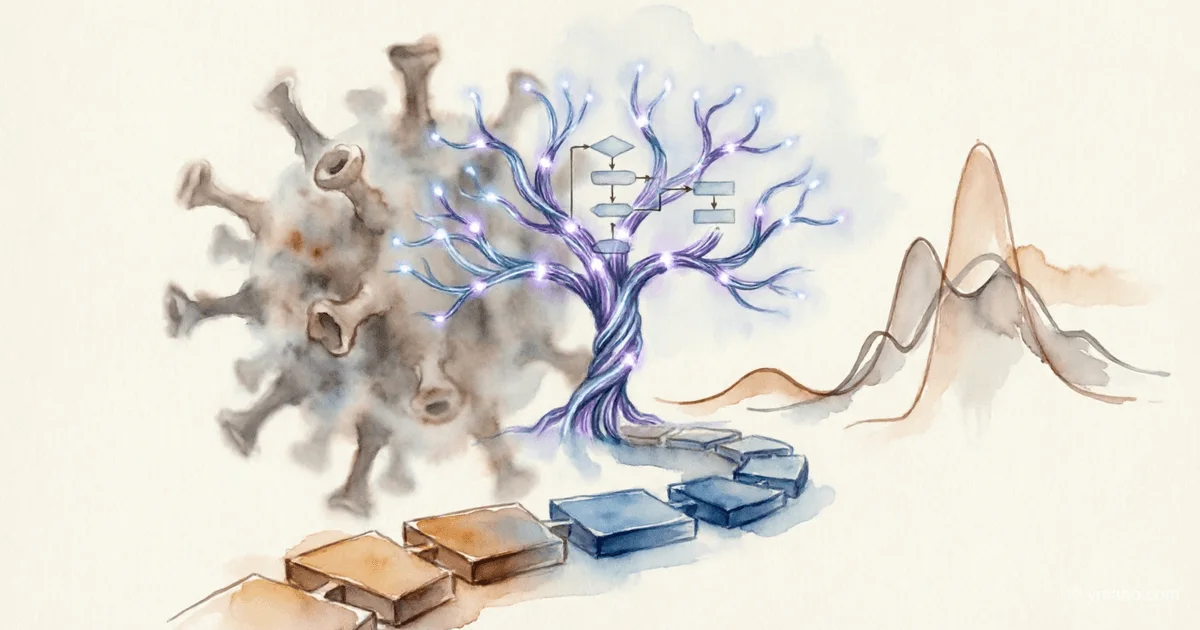
ERA is an LLM agent that takes a scientific task formulated in natural language and goes through the full cycle from code architecture design to execution, debugging, and optimization. The system uses tree-search, exploring hundreds of implementation variants and selecting the best one based on given metrics. This is not an IDE autocomplete or static script generation. It is an agent that iteratively improves code, reads error messages, fixes bugs, and rewrites entire modules without human intervention.
Key demonstration: ERA created 14 COVID-19 hospitalization forecasting models for the Deaths and Hospitalizations Forecasting Challenge. The result: it outperformed the CDC CovidHub ensemble, previously the forecasting benchmark based on dozens of expert teams. Development time was reduced from weeks to hours.
Timeline and Context: Three Waves of Science Automation
Science automation has gone through three stages. The first wave was robotic laboratories like Emerald Cloud Lab, which replaced lab technicians' hands. The second wave was AI hypothesis generators like Co-Scientist and Robin, which replaced some functions of research supervisors. ERA represents the third wave—replacing computational biologists and data scientists. The gap between hypothesis and result, previously filled with months of manual coding, now collapses to hours.
This is not a random launch. DeepMind synchronized ERA's release with Co-Scientist, creating an integrated platform: one agent generates a hypothesis, the other immediately designs an experiment to test it and writes code for data analysis. Together, they close the full cycle of scientific discovery without human involvement at intermediate stages.
Who Wins and Who Loses
Winners are all labs whose bottleneck is computational data processing. Genomics research, epidemiological modeling, structural biology, clinical trials with large patient datasets—wherever a postdoc was hired for 2 years at $60,000–80,000 per year, ERA can now be deployed. Savings on a single position: up to $200,000 over two years, including benefits and university overhead.
Winners are countries with small science budgets and a shortage of skilled programmers. If ERA democratizes computational methods, a group from a small university in Africa or Southeast Asia could compete with MIT in data analysis quality—provided access to computing resources.
Losers are mid-level bioinformaticians. The industry splits: top-tier specialists creating new algorithms will remain in demand; those whose work was 80% writing scripts for RNA-seq processing and plotting graphs become redundant. Losers are platforms like Galaxy Project and Nextflow—if an agent writes code on the fly, the need for visual pipeline environments drops sharply.
What the Media Leaves Out
The first non-obvious point is the problem of statistical honesty. ERA uses tree-search with optimization based on given metrics. If the goal is "minimize forecast error," the agent will honestly seek the model that yields the best score. But in real science, researchers subconsciously or consciously choose metrics that confirm their hypothesis. ERA lacks this bias, but also lacks scientific intuition—it may find a pattern that perfectly predicts past data but is completely useless for the future. Overfitting on an industrial scale, baked into the reward function, is a risk that goes unmentioned.
The second point concerns code as an artifact. Scientific code is not just a tool for obtaining results; it is part of reproducible methodology. If ERA generates thousands of lines of code in seconds, how should peer review verify its correctness? The current review system is not designed to audit automatically generated pipelines. There is a risk that in 2–3 years, most computational papers will contain code that no one—including the authors—has read or understood.
The third insight concerns Google's strategy. ERA and Co-Scientist are not just research projects; they are demonstrations of capabilities for Google Cloud corporate clients. Every ERA run is a bill for TPUs and Vertex AI. Free access via Google Labs is bait. Once a lab becomes dependent on DeepMind agents, the cost of migrating to another platform becomes prohibitive. Google is building not a tool for science, but a sales funnel for cloud services with annual contracts starting at $100,000 per lab.
Forecast: Next 30 Days and 90 Days
In the next 30 days, I expect dozens of preprints where authors attempt to reproduce or challenge ERA's results on independent datasets. The key question to be tested: did ERA outperform the CDC CovidHub ensemble due to architectural superiority, or did the agent find a statistical artifact in the data, exploiting specific weaknesses of the benchmark?
In the 90-day perspective, a split in scientific journal policies will occur. Nature, having already invested reputational capital in AI scientists, will accept papers where the computational part was performed by ERA, provided the use of the agent is disclosed. More conservative journals will impose a moratorium on AI-generated code until audit standards are developed.
The main forecast is the emergence of the first startup built entirely around the DeepMind API. A team of three—a biologist, a clinician, and a product manager—will be able to do work that previously required a lab of 15–20 people. The cycle "Co-Scientist hypothesis → ERA code → publication" will shrink from 12–18 months to 2–4 weeks. This is not a utopia, but a direct consequence of the architecture Google rolled out on May 19, 2026. Science will never be the same—and the only question is whether institutions will adapt to the speed set by these systems or be swept away by the tide of AI-assisted discoveries.
— Editorial Team









