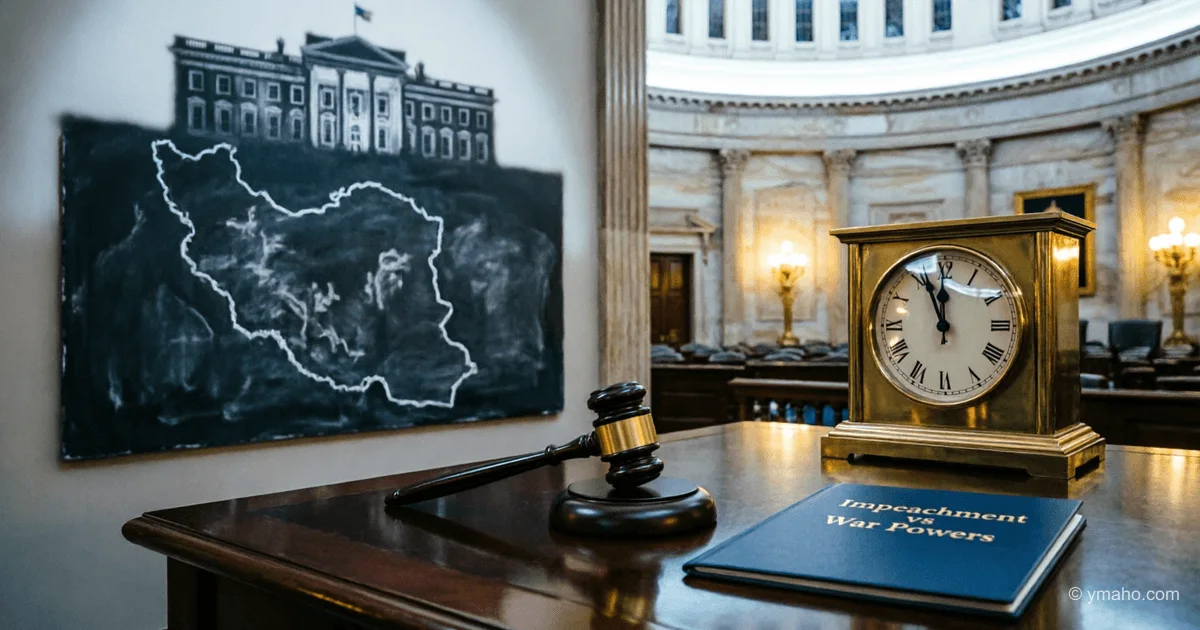
Democrats Prepare Lawsuit Against Trump for Continuing War with Iran Without Congressional Approval
Time magazine reports that Democrats are planning to sue President Trump if he continues military actions against Iran after May 1 without congressional approval. Trump previously criticized German Chancellor Merz for claiming the US underestimates Iran's military capabilities.
Democrats vs. Trump: A Legal Battle Over the Power to Declare War
Introduction
On April 28, 2026, Time magazine published an exclusive report that could alter the course of the Middle East conflict: Democrats in the US Congress are exploring the possibility of filing a lawsuit against President Donald Trump if he continues the military operation against Iran after May 1 without legislative approval.
At the heart of the dispute is the War Powers Resolution of 1973, enacted after the Vietnam War to limit the president's ability to involve the country in prolonged conflicts without congressional consent. The law clearly states: the president may use armed forces abroad without legislative authorization for no more than 60 days, with a one-time extension of 30 days solely for the safe withdrawal of troops.
Trump officially notified Congress of the strikes against Iran on March 2, 2026. The clock is ticking: the 60-day deadline expires on May 1. Now, US politics faces a constitutional crisis that may be resolved not on battlefields but in federal courtrooms.
Event Details and Timeline
The US military campaign against Iran began on February 28, 2026. However, formal notification to Congress, which starts the clock under the War Powers Resolution, was sent on March 2. This three-day gap technically gives Trump until May 1—the key deadline.
Under the law, after 60 days (which falls on April 29, but the count starts from the notification date), the president must cease military actions. The only exception is if Congress has declared war or passed a specific resolution authorizing the use of force. Neither has occurred in the case of Iran.
Democrats, who have unsuccessfully tried for weeks to pass ceasefire resolutions through Congress, see the legal avenue as a last resort. According to Senator Richard Blumenthal (a member of the Judiciary and Armed Services committees), "We need to consider a lawsuit. We should confront him with the illegality, and the courts are one way to do that."
House Democratic Caucus Vice Chair Ted Lieu was even more explicit: "I am absolutely for a lawsuit. I think we will have very strong arguments that we have standing. If we don't have standing, it would mean this law is essentially unenforceable."
However, Democrats are not united. Senator Adam Schiff, also a lawyer, urges caution in relying on the judicial system. He notes that the Supreme Court is very selective in granting Congress standing in such disputes, often treating them as "political questions" not subject to judicial review.
Schiff plans to bring a new War Powers Resolution to a vote at the end of this week, timed to coincide with the 60-day mark. "Republicans who said this date matters to them will have a chance to show it in the vote," he stated.
Impact and Significance (for the World/Industry/Society)
The significance of this legal maneuver extends far beyond domestic US political squabbles. At stake is a fundamental question about the separation of powers and who in the United States has the authority to send the nation to war.
Legal Precedent. If the courts (and the dispute will likely reach the Supreme Court) accept the case and side with Congress, it would fundamentally alter the balance of power between the executive and legislative branches. A long history of judicial refusals—from the war in El Salvador (1982) to the invasion of Iraq (2002) and the operation in Libya (2011)—could be broken. Erwin Chemerinsky, dean of the UC Berkeley School of Law, recently wrote in the New York Times that after May 1, the war would become "clearly illegal" and "federal courts must say so."
However, skeptics recall that in 1982, a district court dismissed a lawsuit by congressmen regarding aid to El Salvador, and in 2002, a similar attempt to block the invasion of Iraq was also dismissed on the grounds of the "political question" doctrine.
Political Pressure. Even if the lawsuit is dismissed, the mere act of filing it creates powerful political pressure. Senator Tim Kaine, who has led Democratic efforts on war powers resolutions for years, says that besides a lawsuit, there are other levers: blocking requests for supplemental funding, defense appropriations, and next fiscal year's budget.
Senator Tammy Duckworth notes that some of her Republican colleagues "have expressed concern and said they will not fund the war after the 60-day mark."
Reactions of Key Players
Democrats. The party is split into two camps. The so-called "hawks," led by Blumenthal and Lieu, insist on immediately preparing a lawsuit. They believe the violation of the law is clear and that the courts must finally intervene. More cautious lawmakers, led by caucus leader Pete Aguilar, are currently focused on legislative options. "Right now, that's the only strategy we're considering," Aguilar says of new votes on the War Powers Resolution.
Republicans. There has been no official response from party leaders. However, according to Time, some Republicans believe May 1 is a turning point that the administration and party leadership should take seriously.
Trump Administration. The White House appears ready to ignore the deadline. Trump has not publicly directed efforts to seek congressional approval. Moreover, his rhetoric on social media indicates an intention to continue pressure. On April 28, he criticized German Chancellor Friedrich Merz for claiming that Iran is "belittling" the US in negotiations.
Trump misrepresented Merz's words, claiming he "thinks it's okay for Iran to have nuclear weapons." In reality, Merz has consistently stated that Tehran must end its military nuclear program. The chancellor also said he does not see a "truly convincing exit strategy" from the conflict on the US side, and that the Iranians are "clearly stronger than expected."
Forecast and Conclusions
The coming days will be decisive. Here are several scenarios:
1. President requests authorization (unlikely). Trump could ask Congress for formal authorization to continue military actions before May 1. However, given the current situation—Democrats opposed and Republicans not showing unity—such authorization would not pass.
2. Continued war without authorization + lawsuit (baseline scenario). Trump continues the operation, Democrats file a lawsuit. Courts may refuse to hear it (as in the past), but the mere filing creates a political crisis. The constitutionality of the president's actions becomes a central issue in the 2026 election campaign.
3. Tactical pause. Trump could formally cease active combat operations, declaring "mission accomplished," but leave the door open for future strikes. This would allow him to technically comply with the law while maintaining military pressure.
4. Schiff's Senate: resolution vote. Schiff intends to bring the resolution to a vote this week. If a few Republicans support Democrats, it could be a political defeat for Trump.
Main Conclusion. Democrats are preparing not just another political maneuver against Trump, but a constitutional battle that could redefine the limits of presidential power in military affairs. Even if courts refuse to hear the lawsuit, the mere filing, combined with the expiration of the 60-day deadline, creates unprecedented pressure on the administration.
As Senator Andy Kim put it, the war "has been illegal from day one." May 1 is not just a date on the calendar; it is a moment of truth for the American constitutional system. The question is no longer whether Trump can win the war with Iran, but whether he has the right to continue it. And the answer may come not from generals, but from judges.
— Editorial Team









