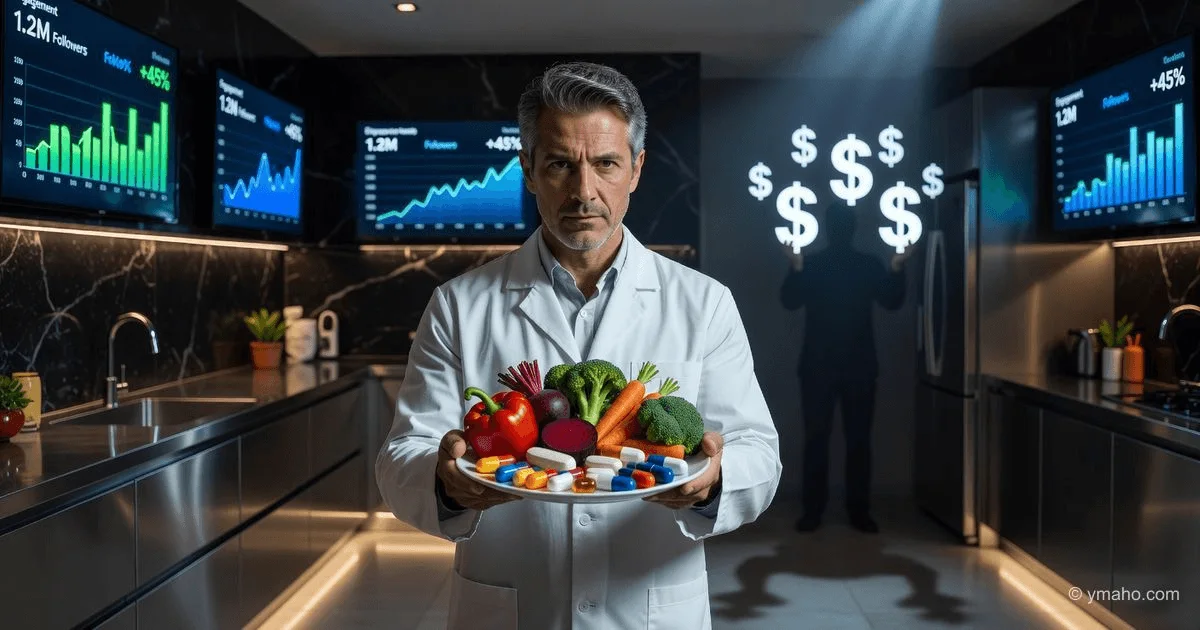
Doctor Eats as if He Has Cancer to Avoid Getting It: The New Viral Trend
Dr. Josh Axe has sparked a trend for an "anti-cancer diet" for prevention: focusing on blood sugar stabilization, fiber, cruciferous vegetables, and eliminating ultra-processed foods to reduce inflammation.
While news aggregators are recapping Dr. Josh Axe's viral post about an "anti-cancer diet," the wellness and nutraceutical industry has gained a perfectly crafted marketing tool. The real story here isn't about health—it's about selling fear packaged in the rhetoric of "proactivity."
[The Gist]: What's Actually Happening
Behind the viral headline "I eat as if I have cancer" lies not a medical innovation but a calculated business maneuver. Josh Axe is not an oncologist or a research dietitian. He is a chiropractor and naturopath. His platform DrAxe.com generates, according to the brand's own data, over 100 million visits per year, comparable to or exceeding the traffic of Dr. Oz and Mercola.
What exactly is being sold? On Axe's website, links to "anti-cancer supplements" and "gut-healing kits" are already posted, with price tags ranging from $45 to $150 for a monthly course. The Instagram post is the top of the funnel. Users intrigued by the "anti-cancer diet" enter an ecosystem: free content → email subscription → diagnostic quiz → personalized supplement recommendation. This is a classic direct-to-consumer health marketing model with conversion rates in the wellness fear niche reaching 3-7%—several times higher than traditional retail.
Timeline and Context
December 2024 – January 2025: Three major studies publish data on the rise of early-onset colorectal cancer in adults under 50. The EPIC cohort (416,081 participants) finds an association between ultra-processed foods and colorectal cancer with an HR of 1.04. A systematic review and meta-analysis by Akapelli et al. (January 2026) shows a pooled RR of 1.13 for high UPF consumption. An information vacuum emerges in the media landscape: people are scared but lack specific guidance.
March 2026: Publication of an Italian study in Cancer Epidemiology Biomarkers & Prevention: among cancer survivors, high UPF consumption yields an HR of 1.48 for overall mortality and 1.57 for cancer-related mortality. Now the issue concerns not only prevention but also survivors—expanding the audience by tens of millions.
Late April – Early May 2026: Josh Axe publishes a post that garners over a million views within hours. Media outlets instantly pick it up: The Economic Times, Moneycontrol, and dozens of aggregators publish nearly identical recaps—listing the "rules of the anti-cancer diet" without a single critical remark. Notably, no major outlet mentioned Axe's reputational baggage.
And that baggage is substantial: Axe has promoted Gerson therapy, proven deadly and banned in most countries, as well as the "Budwig protocol" based on cottage cheese and flaxseed oil, which lacks a single peer-reviewed study on efficacy. His book "Eat Dirt" literally recommends eating soil for "microbiome health"—an approach critics call a dangerous interpretation of scientific data. None of this surfaced in any headline in May 2026.
Who Wins and Who Loses
Winners: Josh Axe Inc. and affiliates. The direct revenue from the post is hard to estimate, but conservatively: 5-8 million additional visits over two weeks with a 2% conversion rate on an average order of $65 yields roughly $6-10 million in additional revenue. This is an ROI that makes marketers at big pharma corporations grind their teeth: they are prohibited from using such rhetoric directly.
Hidden beneficiaries: functional mushroom producers. Axe recommends reishi and turkey tail, and this is no coincidence. The medicinal mushrooms market is growing at 8.3% annually and reached $36 billion in 2025. A first-person mention in a viral post is the advertising equivalent of a budget of about $200,000-$500,000, obtained for free.
Also winning: manufacturers of "clean" snacks and ready-to-eat meals positioned as anti-inflammatory. Brands like Daily Harvest and Splendid Spoon are already using the "anti-cancer nutrition" infrastructure in their creatives.
Losers: Oncology nonprofits and academic institutions. The EPIC study with 416,081 participants and 5,845 cases of colorectal cancer represents years of work and millions of euros in funding. Its findings are cautious: UPF are associated with CRC with a CAF of 5.58% for colon cancer, but mediation mechanisms through inflammation are still being studied. Axe's post erases all nuances and replaces them with the categorical "I do this to avoid getting sick." The audience remembers the formula, not the science.
People with real cancer risk lose out. Axe's anti-cancer diet is a set of general recommendations (fiber, avoiding processed foods, cruciferous vegetables) that are not harmful but are not "anti-cancer" in a clinical sense. The problem arises when someone with a family history of CRC or Lynch syndrome substitutes screening and gastroenterologist follow-up with "proper nutrition." The time lag between such substitution and late diagnosis can be fatal.
What the Media Isn't Saying
First non-obvious insight: Axe's anti-cancer diet is methodologically based on studies he himself does not cite—and which do not support his central thesis. A 2026 meta-analysis covering 16 cohort studies with over 2 million participants showed a modest effect of UPF on CRC: RR 1.13. This means a 13% increase in relative risk, which, given a baseline absolute risk of CRC of about 4%, translates to an absolute risk change of roughly 0.5 percentage points. In other words, even complete avoidance of UPF, according to the best current data, prevents less than 1 case per 200 people over decades of follow-up. This is not an "anti-cancer shield" but a statistically significant yet modest association.
Second insight: Axe has built his career on promoting "leaky gut syndrome" as the cause of all diseases—a diagnosis not recognized by mainstream gastroenterology. The NHS explicitly states: "there is little evidence that increased intestinal permeability is the cause of any serious diseases." The shift from leaky gut to "anti-cancer diet" is not a paradigm change but a rebranding of the same concept under a new, more acute audience fear.
Third omission: the complete absence of discussion about nutritional reductionism. Axe lists nutrients: vitamin D, zinc, selenium, vitamins C and E. This is a standard list of antioxidants, clinical trials of which in supplement form have repeatedly failed: the SELECT study (selenium + vitamin E) was stopped early due to a trend toward increased prostate cancer risk in the vitamin E group. Not a single headline mentioned this.
Forecast: Next 30 Days and 90 Days
30 days (until June 7, 2026):
The viral effect of Axe's post will spawn a wave of user-generated content: mid-tier influencers will start posting their own versions of "anti-cancer menus." Search queries for "anti-cancer meal plan" and "cancer-fighting foods list" will peak. Simultaneously, the first counter-attacking publications will appear: oncologists from Memorial Sloan Kettering and MD Anderson will release statements urging not to replace evidence-based prevention with dietary protocols. In response, Axe will publish a post in the "doctors don't want you to know this" genre, only strengthening his position in the anti-establishment audience segment.
90 days (until August 8, 2026):
I expect three specific events. First: one of the major supplement retailers (iHerb, Vitacost, or Amazon Health) will launch a "Cancer Prevention Support" category with a curated product selection implicitly referencing Axe's theses. The volume of this new category by year-end could reach $120-180 million.
Second: the U.S. Federal Trade Commission (FTC) will issue a warning to several wellness influencers about the inadmissibility of cancer prevention claims without FDA approval. However, by then, the bulk of sales will already be made, and reputational damage will be minimal: supplement consumers rarely track regulatory warnings.
Third: a series of journalistic investigations into Axe's business model will emerge—specifically regarding his traffic structure and affiliate partnerships. The main question that will finally be asked: how many people following the "anti-cancer diet" delay screening, believing that diet protects them? There is no answer to this question from Axe or the admiring media that reprinted his post. But therein lies the silent cost of viral hype.
— Editorial Team









