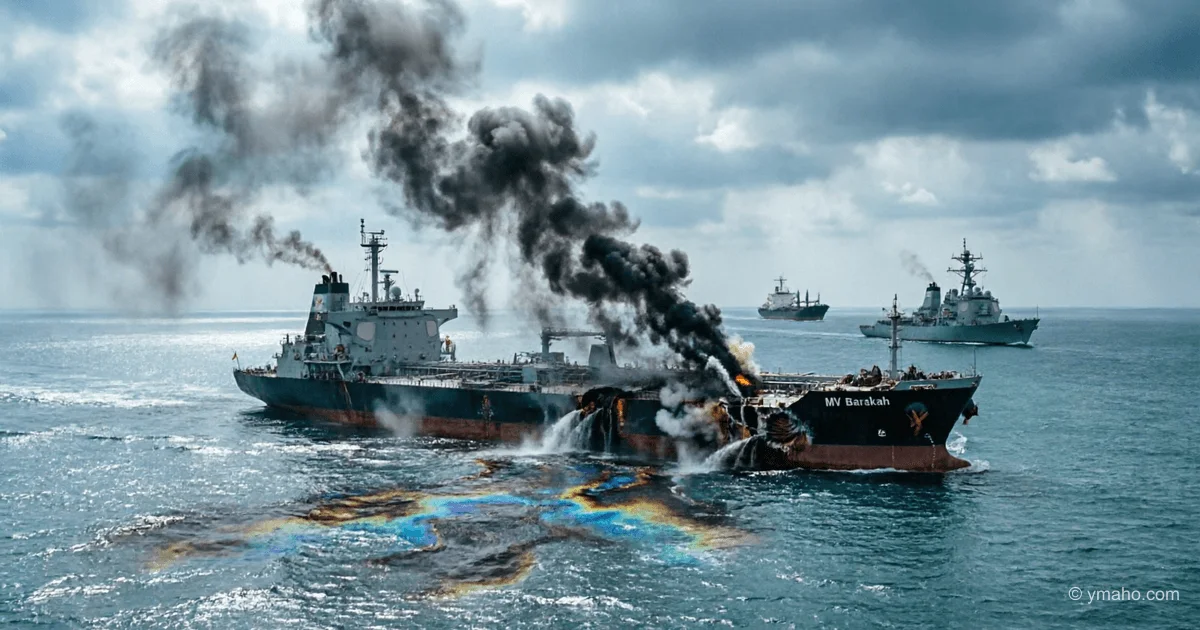
ADNOC Tanker Damaged by Iranian Drones off UAE Coast
The UAE oil company ADNOC confirmed that one of its empty oil tankers was struck by Iranian drones off the coast of the emirate. The incident resulted in civilian casualties and injuries.
Attack on ADNOC Tanker: Civilian Casualties and the New Reality of Naval Warfare
Introduction
On May 4, 2026, the oil tanker MV Barakah, owned by the Abu Dhabi National Oil Company (ADNOC), was struck by two Iranian drones in the Strait of Hormuz. This incident was not just another episode in a protracted conflict but a convergence of two dangerous trends: the spread of hostilities to civilian shipping and the emergence of information warfare where civilian casualties instantly become tools of political pressure. The uniqueness of the situation lies in the fact that the attack occurred against the backdrop of the first US attempt to implement Operation "Project Freedom" to provide military escort for merchant vessels through the blocked strait, and data on casualties vary dramatically—from claims of no casualties to reports of five civilians killed.
Event Details and Timeline
The events of May 4 unfolded rapidly and on multiple levels. In the morning, US President Donald Trump announced the start of Operation "Project Freedom"—a large-scale mission to provide military escort for merchant vessels stranded in the Persian Gulf since February. The operation involved guided-missile destroyers, over 100 air and naval assets, and approximately 15,000 military personnel. Iran's response was immediate and multi-pronged.
The first recorded incident was the attack on the ADNOC tanker. According to the UAE Ministry of Foreign Affairs, the MV Barakah was struck by two Iranian drones while transiting the Strait of Hormuz. The Emirates' official position, as stated by the ministry, characterized the attack as a "terrorist Iranian attack." Crucially, according to UAE authorities, the tanker was empty at the time of the strike and was not carrying oil.
Concurrently with the tanker attack, Iran launched a massive strike on UAE territory. The UAE Ministry of Defense reported intercepting 19 aerial targets: 12 ballistic missiles, three cruise missiles, and four drones. One drone struck an oil industrial zone in the port of Fujairah, causing a large fire. As a result of this strike, three Indian nationals sustained moderate injuries and were hospitalized. Additionally, there were reports of an attack on a residential building in the Tibat area of Oman's Al Buraimi Governorate, where two people were injured, four vehicles were damaged, and windows were blown out in homes.
Data on civilian casualties from the ADNOC tanker attack became a focal point of intense information warfare. Official UAE authorities stated there were no casualties. However, Iranian sources offered a different version: Tehran claims that during the US attack, not military boats but two civilian cargo vessels traveling from the Omani port of Khasab toward the Iranian coast were struck, resulting in the deaths of five civilians. Independent verification of these claims is lacking, creating a highly toxic information environment.
Impact and Significance
The attack on the ADNOC tanker has far-reaching consequences beyond a single military incident. The strategic significance of the target stems from its ownership: the tanker is part of the fleet of the Abu Dhabi state oil company, and ADNOC itself is a co-owner of the VTTI oil terminal in Fujairah alongside the world's largest independent oil trader, Vitol Group, and IFM Global Infrastructure Fund.
The economic consequences of the attack are multifaceted. First, the damage to a tanker in the Strait of Hormuz sets a precedent for direct military action against civilian shipping, inevitably leading to further increases in insurance premiums. Second, the VTTI terminal in Fujairah, co-owned by ADNOC, is critical infrastructure for global oil supplies. This port is located on the UAE's east coast in the Gulf of Oman, geographically outside the Strait of Hormuz, and has long been considered a "backup exit" for hydrocarbons in the event of an Iranian blockade.
Notably, almost simultaneously with the attacks, Iran published a map of a "controlled zone" in the Strait of Hormuz, whose southern border runs along a line to an area south of Fujairah. This indicates that Tehran is deliberately expanding its area of operations to the UAE's east coast, previously considered relatively safe. The shipping lane through the Strait of Hormuz—which handles about a fifth of global oil consumption—is now under direct threat.
The issue of civilian casualties deserves special attention. In a situation where each side offers its own version of events and independent on-site verification is impossible for security reasons, the international community finds itself in an information vacuum. Tehran's claims of civilian deaths are unconfirmed but also unrefuted by independent sources.
Reactions of Key Players
The reactions of the involved parties demonstrate a deep divide in perceptions of the incident. The UAE Ministry of Foreign Affairs issued a strong statement, characterizing the attack as "dangerous escalation" and stating that the country "reserves its full and legitimate right to respond to these attacks." The Emirates emphasized that attacks on civilian objects and infrastructure are "completely unacceptable" and called on Iran to cease military operations and guarantee the "full and unconditional opening of the Strait of Hormuz."
Iran holds a fundamentally different version. Senior Iranian military official Ali Abdollahi stated that Tehran "had no premeditated intention to attack oil facilities in Fujairah," and that the incident was a consequence of "adventurous behavior by the US military." He accused the US of attempting to "create an illegal channel for the passage of ships through the Strait of Hormuz" and emphasized that responsibility for the attack on UAE oil infrastructure lies with Washington.
Iranian Foreign Minister Abbas Araghchi went further, calling the US operation "Project Freedom" a "project of deadlock" and warning the US and UAE not to "let the ill-wishers drag them into the swamp again." At the same time, Araghchi stressed that negotiations mediated by Pakistan are ongoing, creating a contradictory backdrop: diplomatic assurances accompany military escalation.
The US, for its part, declared the successful start of Operation "Project Freedom." According to CENTCOM, two merchant vessels under the US flag successfully transited the Strait of Hormuz escorted by destroyers. President Trump, in a televised address, threatened that Iranian forces would be "wiped off the face of the earth" if they attempted to attack US ships.
Forecast and Conclusions
The attack on the ADNOC tanker marks a qualitatively new stage of the conflict, characterized by three fundamental shifts. First, the war has definitively spilled over into civilian shipping. Even though the tanker was empty, the very fact of a deliberate strike on a commercial vessel sets a dangerous precedent.
Second, a trend toward expanding the conflict's geography to the UAE's east coast has emerged. The port of Fujairah, once considered a "safe haven" for oil exports bypassing the blocked Strait of Hormuz, has now itself become a target. Iran's "control zone" map extending south of Fujairah shows that Tehran intends to extend its military activity to areas previously considered rear areas.
Third, the incident has revealed a critical vulnerability in the global system of information verification during military conflict. Contradictory reports of civilian casualties—from official statements of none to claims of five deaths—create an environment where any further action can be portrayed as disproportionate use of force.
The main conclusion is that the military solution to the shipping problem in the Strait of Hormuz proposed by the US under "Project Freedom" inevitably leads to escalation, not de-escalation. Iran demonstrates a willingness to strike both US allies' military infrastructure and civilian vessels, making the escort operation for merchant ships extremely risky. Until the diplomatic process through Pakistani mediators yields tangible results—and Iran's foreign minister has already characterized US demands as "excessive appetites" and "unreasonable demands"—the region will remain on the brink of full-scale naval war, and the price of a barrel of oil will reflect not supply-demand balance but market fears of another round of violence.
— Editorial Team









