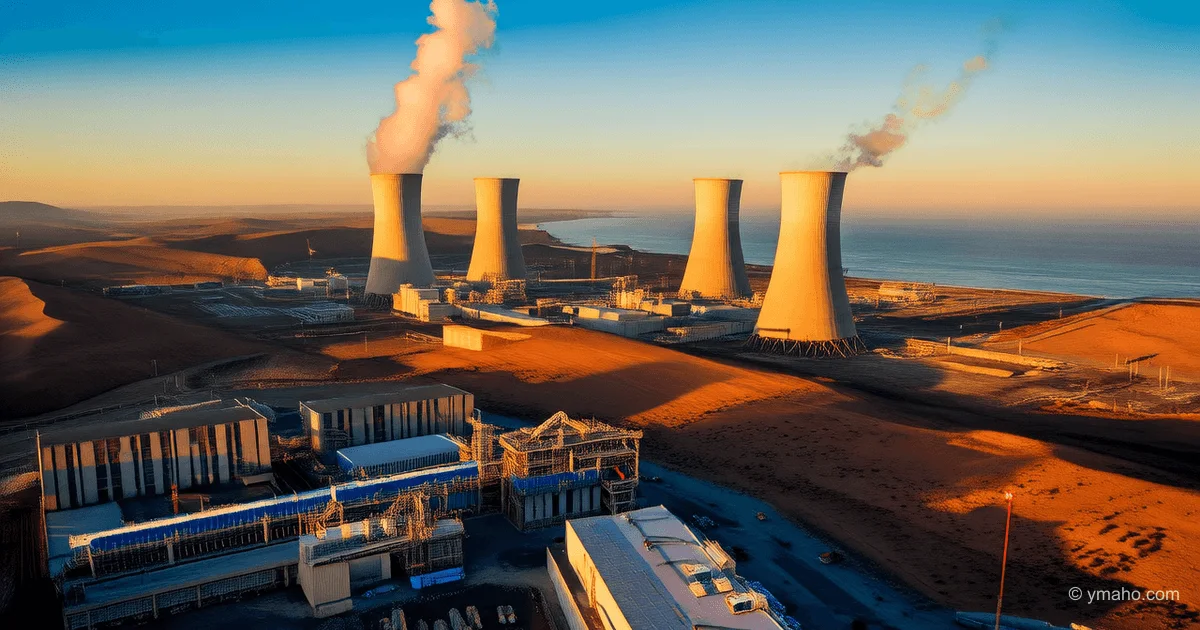
Drone Strikes Barakah Nuclear Plant in UAE, War Reaches the Persian Gulf
A drone breached a nuclear facility in Abu Dhabi and sparked a fire, further evidence of the fragility of the ceasefire. The incident triggered a new wave of panic in oil markets.
At 4:37 a.m. local time, a drone breached the perimeter of the Barakah Nuclear Power Plant in Abu Dhabi and crashed into an administrative and warehouse complex 180 meters from the first reactor unit. Fire crews extinguished the blaze in forty minutes. The reactor was not damaged. But panic in oil markets was immediate—Brent jumped $4.80 before Asian exchanges even opened.
This is the first ever drone strike on a civilian nuclear facility in the Arabian Peninsula. The fragile ceasefire, which had barely held for three weeks, is now unraveling. The war that diplomats tried to confine within the borders of Israel and southern Lebanon has reached the Persian Gulf—a region through which a fifth of the world's oil passes.
What Exactly Happened in Al Dhafra
The Barakah Nuclear Power Plant is located in the Al Dhafra region, 53 kilometers from central Abu Dhabi. Four APR-1400 reactors built by South Korea. The first unit was launched in 2020, the fourth only in September 2025. The plant supplies 25% of the UAE's electricity needs.
The drone approached from the sea at ultra-low altitude—air defense radars detected it just 18 seconds before impact. Electronic warfare systems failed to intercept control. The drone—presumably Iranian-made, a modified Shahed-136 with an extended range of 1,200 kilometers—carried 40 kilograms of explosives.
The strike hit the administrative wing adjacent to a warehouse of chemical reagents for water treatment. The fire covered 400 square meters. The reactor's sealed containment shell—a steel-reinforced concrete dome 1.2 meters thick—was not damaged. But the very fact of penetration into the restricted zone of a nuclear facility represents a catastrophic failure of the entire security system.
Who Is Behind the Attack
No one has claimed responsibility yet. But the flight trajectory points to southern Iran—the coast of Bushehr province, where IRGC units specializing in kamikaze drones are based. The distance from Bushehr to Al Dhafra is 380 kilometers; the upgraded Shahed-136 can easily cover 1,200.
A representative of the Islamic Revolutionary Guard Corps, speaking on condition of anonymity, told Iranian news agency Tasnim that "the Zionist regime and its allies will not sleep soundly." Official Tehran denies involvement. Foreign Minister Abbas Araghchi called the incident "a provocation aimed at derailing peace talks."
The Emirates remain conspicuously silent. President Mohammed bin Zayed Al Nahyan held an emergency Security Council meeting, but no public statements have been made. The diplomatic channel between Abu Dhabi and Tehran—the very one the Emirates built over the past five years as an alternative to Saudi-Iranian confrontation—is now operating at its limit.
Why Barakah Is a Red Line
The plant took ten years to build and cost $24.4 billion. It is the UAE's flagship project, a symbol of technological capability and energy independence from oil. Striking it sends a clear message: "We can reach you anywhere, even where you feel completely safe."
A multi-layered air defense system is deployed around the plant. American THAAD systems at Al Dhafra Air Base, Israeli EL/M-2084 radars, Emirati Patriot PAC-3 batteries—and all of this hardware failed to detect a single drone at ultra-low altitude. Military analysts are already calling the incident "a failure of the Western air defense paradigm" against asymmetric threats.
The nuclear context adds an entirely different dimension. Even if the reactor is structurally protected from a direct hit, the psychological effect destroys years of investment in the Emirates' image as a "safe haven" in a turbulent region. Dubai grew on capital fleeing wars and revolutions of its neighbors. Now war has arrived on its doorstep.
Oil on a Roller Coaster
Market reaction was immediate. Brent surged from $109.40 to $114.20 in the first hours of trading. WTI broke $110. Insurance premiums for transiting the Strait of Hormuz jumped another 18%. Tanker companies began urgently rerouting.
Emirati state oil company ADNOC suspended shipments from the Ruwais terminal for 24 hours—formally for security system checks. In reality, to assess risks. Traders took this as a signal: infrastructure vulnerability extends far beyond the Strait of Hormuz.
Saudi Aramco, having learned from the attacks on Abqaiq and Khurais in 2019, put its security forces on high alert. Back then, six years ago, a single drone strike on oil facilities knocked out 5% of global production. Now the potential damage is greater—Iran's drone fleet is three times larger than the Houthis' in 2019.
Who Loses and Who Wins
The Emirates lose the most—their status as a safe jurisdiction. Foreign investment in Dubai real estate, which reached $44 billion in 2025, could collapse. The Dubai Financial Market index plunged 3.7% at the open, and Emaar Properties shares fell 5.2%.
Insurers are also taking a hit. Lloyd's of London is reassessing rates for infrastructure assets in the Gulf region. Reinsurance contracts expiring in July will be renewed with premium increases of at least 40%.
Oil companies in the US and the North Sea are back in profit. ExxonMobil gained 2.8% in market cap in a single day. Norway's Equinor rose 3.1%. The more dangerous the Middle East, the more expensive alternative oil becomes.
Air defense system manufacturers—Raytheon, Rafael, IAI—have received not just a sales argument but a screaming advertisement. Analysts predict a new wave of defense contracts from Gulf states worth tens of billions of dollars. The Emirates have already announced an emergency tender for low-altitude drone defense systems.
What Happens Next
The Emirates face a painful choice. Responding with military force means engaging in direct confrontation with Iran, which is a 40-minute drone flight away. Not responding would show weakness and invite further attacks.
Abu Dhabi will almost certainly choose an asymmetric response: a cyberattack, diplomatic isolation through Arab allies, and increased sanctions pressure via ties with the US Treasury. But that may not be enough. If the strike on Barakah goes unpunished, why not hit the desalination plants in Jebel Ali? Or the oil terminal in Fujairah, through which 70% of Emirati exports pass?
Iran, for its part, is showing that the Geneva talks are nothing but theater. Tehran dictates the rules of the game on the ground, not at the diplomatic table. While Washington debates the terms of the nuclear deal, a drone flies into a protected nuclear facility of a US ally.
The main risk in the coming days is a chain reaction. Saudi Arabia, Kuwait, Bahrain, Qatar—each is now assessing how vulnerable its critical infrastructure is. One successful strike destroys an entire security paradigm that held the Persian Gulf together. And it cannot be quickly restored—whether negotiations resume or not.
— Editorial Team









