UAE Hit by Drone Attacks for Second Consecutive Day Despite Ceasefire
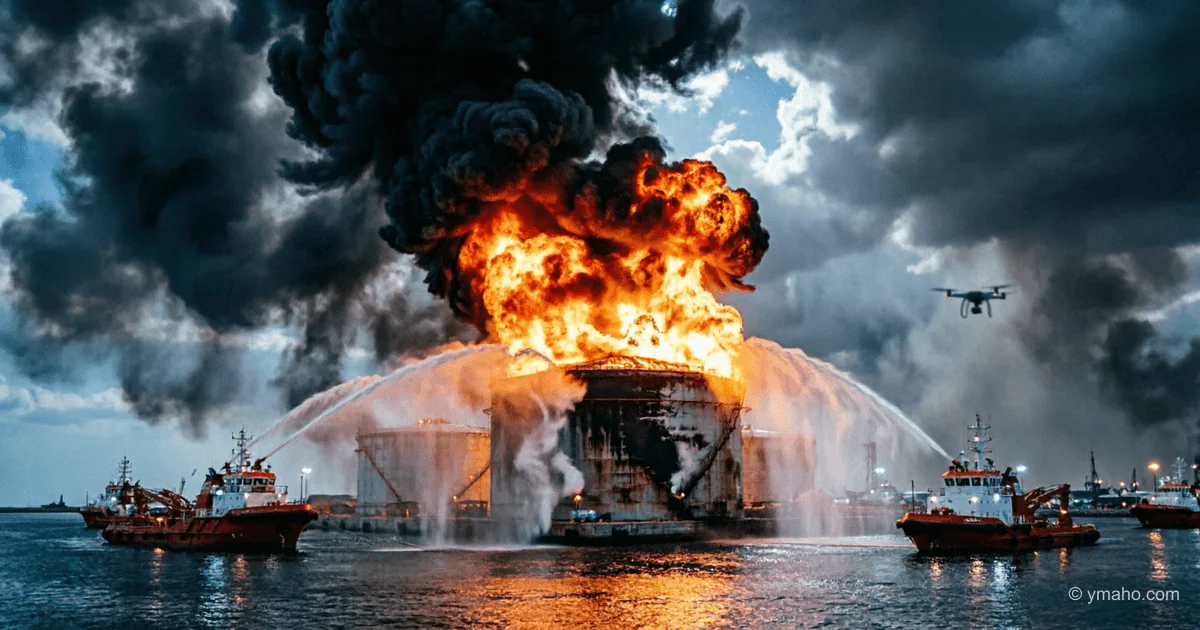
The United Arab Emirates reported attacks by Iranian missiles and drones for the second straight day: at least three people were injured, and a drone sparked a fire at a key oil facility in the emirate of Fujairah.
The attack on the oil facility in Fujairah on May 5-6, 2026, is not escalation for escalation's sake. It is a surgical strike by the Iranian General Staff on the sole artery that allowed the UAE and Saudi Arabia to maintain relative economic stability amid the paralysis of the Strait of Hormuz. Looking at a map rather than press releases, it becomes clear: Iran is methodically cutting off bypass routes, turning the enemy's logistical advantage into a fiery trap on land.
The Gist: What Is Really Happening
Fujairah is not just a port. It is a key element of the UAE's strategy to de-risk the Strait of Hormuz. Up to 70% of bunkering and hydrocarbon transshipment that the emirates and their allies exported bypassing Iran's zone of control passed through the oil terminal and storage facilities in Fujairah. The drone strike that caused a major fire at the oil facility is a clear signal: "You no longer have a safe rear."
The essence is that Iran is implementing the "ring of fire" doctrine not somewhere in Lebanon or the Gaza Strip, but directly on the territory of the Gulf Cooperation Council (GCC). Attacking the UAE on the second day after failed negotiations and amid the hypocritical "active ceasefire" touted by the Pentagon means deliberately blackmailing the entire insurance and financial market of the region. Iran is showing that for it, the concept of "ceasefire" is an operational pause, not an obligation.
Timeline and Context
Events unfolded rapidly. On May 4, 2026, as it became known, Tehran conveyed its 14-point conditions through Oman, including a call to end the war in Lebanon and create a new mechanism for monitoring navigation in the Strait of Hormuz with the participation of the IRGC. Donald Trump publicly rejected the proposal, stating that "all military options" remain on the table.
On May 5, early in the morning, the first wave of Shahed-136/131 kamikaze drones struck the outskirts of Fujairah. Logistics buildings were damaged, but the main blow was not aimed at populated areas—the three civilian casualties were tragic but collateral damage. The primary target was chosen with reconnaissance precision. On May 6, a drone penetrated the THAAD and Patriot air defense systems (deployed by the US specifically to protect the emirate) and hit the oil facility, causing a fire. Systems costing hundreds of millions of USD failed to intercept a cheap device worth less than $50,000. This is classic asymmetric war economics, draining allied budgets.
Who Wins and Who Loses
The loser is obvious—the UAE, but the scale of losses runs deeper than just burned infrastructure. Lloyd's of London insurance syndicates began emergency policy reviews for all facilities in Fujairah as early as the evening of May 5. Reinsurance rates for war risk on commercial property and terminals in the emirate jumped 25-30 percentage points within a day. For an economy dependent on foreign investment, this is a gut punch. Abu Dhabi will now have to either subsidize these risks from the Mubadala sovereign fund (estimated at an additional $400-500 million annually) or watch capital flee.
The second victim is Saudi Arabia. The HABSHAN-FUJAIRAH pipeline, which yesterday seemed like a lifeline for oil exports from Abu Dhabi bypassing Hormuz, now leads to a port under direct threat. Oil delivered via pipeline simply cannot be safely loaded onto tankers. Storage under constant attack risk means creating a giant incendiary bomb.
The winner, paradoxically, is Qatar. Qatar's gas sector does not depend on Fujairah; its main logistics are tied to Ras Laffan and go through the Gulf of Oman without needing to enter the heavily targeted zone. The attacks on the UAE make Qatar the only predictable "haven" for energy exports from the region, sharply increasing its geopolitical weight in negotiations with Europe and Asia. Qatari LNG becomes a premium product with minimal location discount.
What the Media Is Not Saying
Major media outlets report a "fire" and a "drone attack." They do not report that the target of the strike, according to AIS marine vessel tracking and Planet Labs satellite imagery, was a specific tank farm owned by the Vopak Horizon Fujairah Limited consortium. This facility was filled not just with crude oil, but with premium refined products—Jet A1 aviation fuel and very low sulfur fuel oil (VLSFO). Iran destroyed fuel stocks critical for refueling coalition military transport aircraft and naval vessels in the region.
Prior to the operation, the US Air Force and Royal Air Force refueled their fighters and transports using logistics chains through Fujairah. Now the Pentagon must urgently relocate fuel storage to Al Udeid Air Base in Qatar or Diego Garcia, lengthening the refueling leg. This is not just a "fire"—it is a strike on NATO's logistics system in the Gulf, delivered by a cheap drone that penetrated the vaunted air defense due to limitations in minimum effective radar cross-section at ultra-low altitudes. Officially, US systems did not detect the drone because it flew "outside radar coverage"—insiders in the insurance business call this the most expensive excuse of 2026.
Forecast: Next 30 Days and 90 Days
30-Day Horizon (by June 5, 2026)
The UAE will be forced to begin mass evacuation of non-military personnel and expat families from the emirate of Fujairah. International oil traders (Vitol, Glencore, Trafigura) have already privately suspended physical delivery operations through this port. We will see a sharp drop in the stock prices of DP World (operator of UAE ports) and the Dubai Financial Market. The UAE and Saudi Arabia's attempt to convene an emergency summit of the Arab League or the GCC will fail due to lack of unity. The US will find itself in an extremely difficult position: direct military intervention to protect Fujairah would mean opening a new front in addition to Yemen and the Eastern Mediterranean, while inaction would further erode the already undermined credibility of American "security umbrellas."
90-Day Horizon (by August 2026)
If the diplomatic track is not urgently restored, Trump will be forced to order a "retaliation" operation directly against IRGC military bases launching drones in the Bandar Abbas area. This would turn the conflict from a proxy war into a limited direct one, to which Iran would respond with ballistic missile strikes on targets in Qatar or Kuwait. Economically, this means that the base war risk insurance rate for the entire Persian Gulf will be unified to the level of an "active combat zone," making any export except US government shipments commercially unviable. Brent oil, fueled by fear of disruptions, will establish a new corridor of $125-$135 per barrel. And against this backdrop, ultra-hawks at the Fed, upon receiving May PCE inflation data, will demand an emergency rate hike outside the schedule, shocking markets more than the most powerful kamikaze drone.
— Editorial Team









