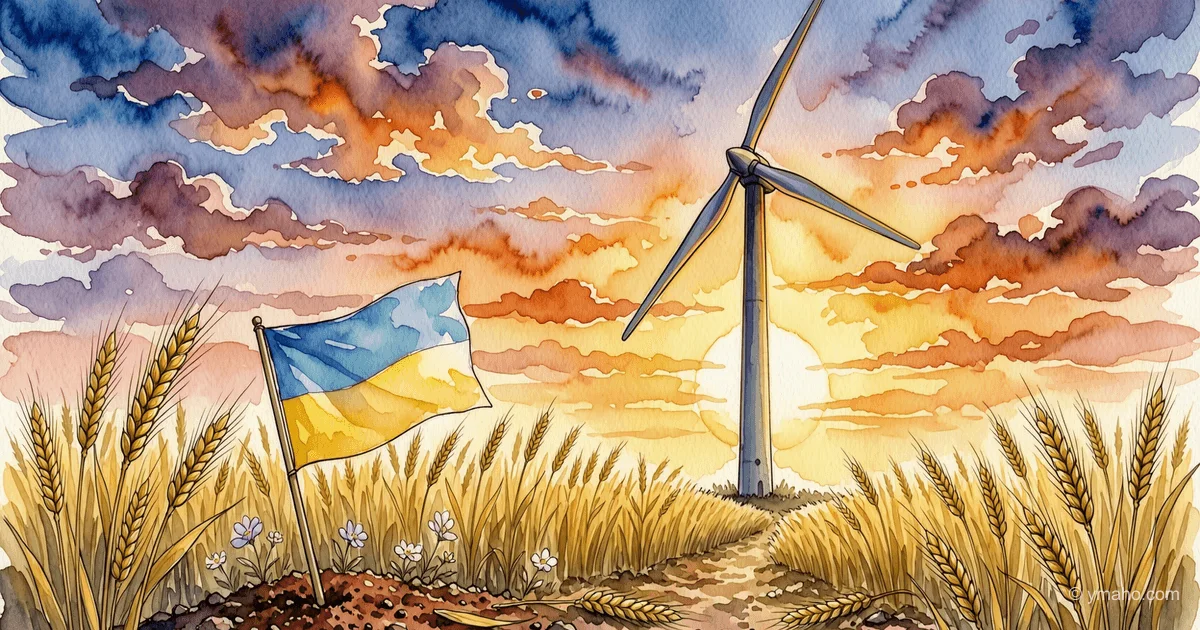
DTEK to Build One of Europe's Largest Wind Farms for €1.2 Billion: What It Means for the Energy Market
Ukrainian energy holding DTEK has announced the construction of a 650 MW wind farm worth €1.2 billion in the Poltava region. The project will become one of the largest onshore wind farms in Europe. For comparison, this is roughly half the capacity of the Zaporizhzhia Nuclear Power Plant (currently offline) and more than the capacity of many coal-fired units. Why is this needed, and why is it important not only for Ukraine?
Project Details: Scale and Timeline
The wind farm will consist of approximately 100 wind turbines. Each turbine is a modern unit with a capacity of about 6.5 MW, capable of supplying electricity to several thousand households. Construction is planned to be completed within a few years, though exact timelines have not been announced. The €1.2 billion investment is the largest in Ukrainian renewable energy since the start of the full-scale war.
The project is being implemented in the Poltava region, located in central Ukraine, relatively far from the front line. This reduces the risks of direct shelling, though it cannot be completely ruled out. DTEK already has experience building wind farms: the company operates the Botievo and Prymorsk wind farms in southern Ukraine, which were partially damaged by hostilities.
Context: Why This Matters for Ukraine's Energy System
Ukraine's energy system has lost a significant portion of its generating capacity due to Russian attacks. Thermal and hydroelectric power plants have been damaged, and the Zaporizhzhia Nuclear Power Plant—the largest in Europe—is occupied and non-operational. As a result, rolling blackouts occurred during the winter of 2022–2023.
The new wind farm will help address two challenges:
- Compensation for lost capacity. 650 MW is a significant contribution to total generation. For comparison, before the war, Ukraine consumed about 13–14 GW in winter. Thus, the new plant will cover about 5% of demand.
- Enhanced energy resilience. Wind farms are less vulnerable to missile attacks than large thermal or nuclear units. If one turbine is damaged, the others continue operating. Additionally, geographic dispersion reduces risks.
Global Context: Renewable Energy in Europe
DTEK's project is part of a Europe-wide trend to ramp up renewable energy capacity. The EU has set a target of 45% renewable energy by 2030. Ukraine, although not an EU member, synchronized its energy grid with Europe in 2022 and can now export electricity to Europe.
Large wind farms are expensive and lengthy projects. For example, building an offshore wind farm in the North Sea can cost €2–3 billion and take 5–7 years. Onshore farms are cheaper and faster. DTEK's project is one of the largest onshore wind farms in Europe. For comparison, the largest onshore wind farm in Europe is Romania's Fantanele-Cogealac (600 MW), so the Ukrainian plant could become a record-holder.
Key Takeaways
- DTEK is investing €1.2 billion to build a 650 MW wind farm in the Poltava region.
- The plant will become one of the largest onshore wind farms in Europe.
- The project aims to compensate for capacity lost due to Russian attacks and enhance the resilience of Ukraine's energy system.
- Construction will take several years; exact timelines have not been announced.
- The project supports the Europe-wide trend toward renewable energy and strengthens Ukraine's energy independence.
What This Means for Ordinary People
For Ukrainians, it offers hope for more stable electricity supply in the future, especially during winter. For Europeans, it signals that Ukraine remains part of the European energy space and contributes to the common green transition. In the long term, such projects reduce dependence on fossil fuels and make energy cleaner and more affordable.
— Editorial Team









