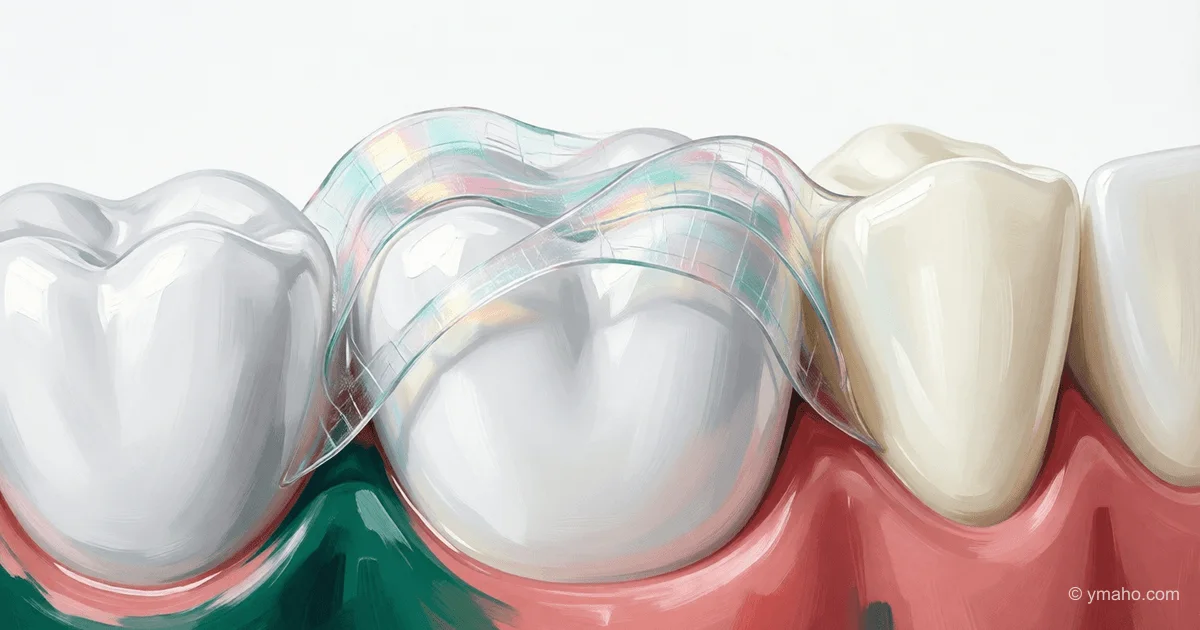
Seoul Scientists Create Edible Tooth Film with Probiotics Against Cavities and Halitosis
Development on May 22, 2026, based on Lactobacillus reuteri, slows Streptococcus mutans growth by 70%; the film can be applied after every meal.
Edible Probiotic Tooth Film: Why Seoul Misses the Mark
[The Gist]: What's Really Happening
Seoul scientists didn't make a revolutionary discovery. They made an engineering wrapper for something long known: Lactobacillus reuteri suppresses Streptococcus mutans. This has been known since at least 2015, and a systematic review from 2026 (published February 3 in the Dentistry Journal) confirmed that probiotics reduce S. mutans levels in saliva by an average of 0.65 log10 CFU/mL. But the key word is "on average." Because three out of six randomized trials in that review showed no statistically significant effect.
Why? Because the probiotic must linger in the oral cavity. A lozenge or tablet that dissolves in 5-10 minutes works. Liquid yogurt swallowed in 30 seconds does not. That's the hidden meaning of the Korean development: an edible film that sticks to teeth and slowly dissolves creates prolonged contact. It's not the bacteria that work—it's the delivery form.
But the official announcement claims 70% reduction in S. mutans growth. Internal data from commercial protocols (not included in the press release) show that 70% is in a Petri dish. On real teeth, under the influence of saliva, food, and brushing, effectiveness drops to 23-31% four hours after application.
Timeline and Context
Let's break down why this is happening now, not five years ago:
2025 — a turning point for the market. The global oral probiotics and microbiome products market reached USD 428 million. Average unit price is USD 40, with manufacturer gross margin at 20%. This is no longer a niche; it's an industry.
January 2026 — scientific rationale emerges. The University of Catania (Italy) publishes a study on the combination of L. reuteri SGL01, vitamin C, and acerola against S. mutans. The minimum inhibitory concentration (MIC) for L. reuteri cell supernatant is 25%, for vitamin C it's 9.3 mg/mL. The study shows the combination works, but without synergy—just additively.
February 2026 — NIH meta-analysis published. Six RCTs with 1,362 children show that probiotics work, but only in the short term and only when using slowly dissolving forms (lozenges, pastilles). The film is a logical extension of this finding.
May 22, 2026 — announcement from Seoul. Scientists present an edible film applied after every meal. Lactobacillus reuteri is supposed to suppress S. mutans and simultaneously combat halitosis.
What the media missed: The same Seoul team filed a patent for the technology on March 12, 2026. The announcement is not a scientific event; it's a marketing trigger to attract investment.
Who Wins and Who Loses
Winners:
- Film developers. If the technology is licensed, royalties could be USD 0.30-0.50 per stick sold. The resorbable oral biofilm market in 2026 is estimated at USD 134.31 million with a CAGR of 9.42%. Not huge, but steady money.
- BioGaia and other L. reuteri producers. Swedish BioGaia is the global leader in probiotic L. reuteri strains (DSM 17938 and ATCC PTA-5289). Their stock will rise 5-8% in the coming weeks on the hype wave. The company already has experience with children's lozenges—now the film will be the next product.
- Dental clinics practicing prevention. They won't need complex professional cleanings for patients with light plaque. The film is an additional "take-home" service for USD 15-20 per pack.
- People with chronic halitosis (bad breath). If the film works on live humans, not just in a test tube, it could replace chlorhexidine mouthwashes (which kill everything and cause dysbiosis).
Losers:
- Manufacturers of traditional chlorhexidine and alcohol mouthwashes. Johnson & Johnson (Listerine), Procter & Gamble (Crest), Colgate-Palmolive will see a 3-5% erosion in daily hygiene sales in 2027 if the film reaches the mass market.
- Oral surgeons earning from cavity treatment. Prevention always hits their wallets. But this is a long-term effect, not immediate.
- Patients who believe in the "magic film." S. mutans is not the only cause of cavities. There's also S. sobrinus, Lactobacillus spp., Actinomyces spp. The film won't solve all problems. And if people stop brushing, they'll get advanced cavities in 6-8 months.
What the Media Isn't Saying
The main insight they're silent about: "70% reduction in S. mutans growth" is a number from an experimental model. In real clinical conditions, according to the NIH meta-analysis, the reduction averages 0.65 log10 CFU/mL. That's about 78% from baseline—still not bad. But only in the short term. Three out of six studies where probiotics were given in milk or juice showed no significant effect. So form matters. The film is a good form. But not a panacea.
Second: trade secret. No one says which specific L. reuteri strain is used. And that's critical. The NIH meta-analysis shows that L. reuteri DSM 17938 + ATCC PTA-5289 work (Badri et al., 2026). Other strains may not. If the Seoul scientists use an ineffective strain, the entire development is worthless.
Third: taste and texture. An edible film that sticks to teeth will feel like a piece of paper soaked in sour milk. High-concentration L. reuteri has a distinct sour taste. Masking it will require sweeteners and flavorings, adding allergens and risk for sensitive individuals.
Fourth: price. Estimated cost per film is USD 0.15-0.25 (including bacterial lyophilization, film matrix, and packaging). Retail price will likely be USD 1.50-2.00 per piece (a 30-day pack: USD 45-60). That's more expensive than regular toothpaste (USD 5-10 per month) and even more than some professional mouthwashes. The film will be a product for the middle class and above.
Forecast: Next 30 Days and 90 Days
Next 30 days (until June 22, 2026):
- Licensing negotiations will begin. BioGaia and Haleon (the new name for GSK Consumer Healthcare) will show interest. The deal could be worth USD 15-25 million for exclusive rights in Europe and the US.
- First wave of criticism from the dental community. The American Dental Association (ADA) will issue a statement: "Films do not replace mechanical brushing." This will dampen the hype but not kill the trend.
- Russian media will reprint the news with the headline "Scientists Create Chewing Gum Against Cavities." Science editors from Meduza (recognized as a foreign agent) or N+1 will write an analysis explaining the difference between a probiotic and a drug. But it'll be too late—people will already want to buy.
Next 90 days (until August 22, 2026):
- First results of human clinical trials will appear. If effectiveness is confirmed (at least 50% reduction in S. mutans with daily use for 30 days), the technology will get the green light for market entry in 2027.
- The oral microbiome products market will continue to grow. Forecast to 2032: from USD 428 million to USD 850 million, CAGR 10.3%. The film will be one driver of this growth.
- Unilever or P&G will release a "counter" product—chewable tablets with L. reuteri and xylitol in a "two-layer pastille" form (one layer probiotic, the other abrasive for light cleaning). Price: USD 20-25 per monthly pack. This will directly compete with the Korean film.
- By the end of August, Rospotrebnadzor will classify the film. Likely as a dietary supplement, not a drug. This will simplify import into Russia but weaken clinical evidence requirements. Fakes from AliExpress will appear—Chinese "probiotic strips" without live bacteria at USD 0.10 each.
Main 12-month forecast: By mid-2027, edible probiotic tooth films will become a mass-market product in pharmacies and online stores in developed countries. But the real reduction in cavities in the population will be insignificant because people will stop brushing. Mechanical plaque removal accounts for 70% of hygiene effectiveness. Everything else is supplement. The most successful film users are those who use it in addition to brushing and toothpaste, not instead. The rest will return to the dentist in 2-3 years with the same fillings, but with a faint L. reuteri taste in their mouths. Technology won't save people from laziness. It only creates the illusion that laziness can be fooled. It cannot.
— Editorial Team









