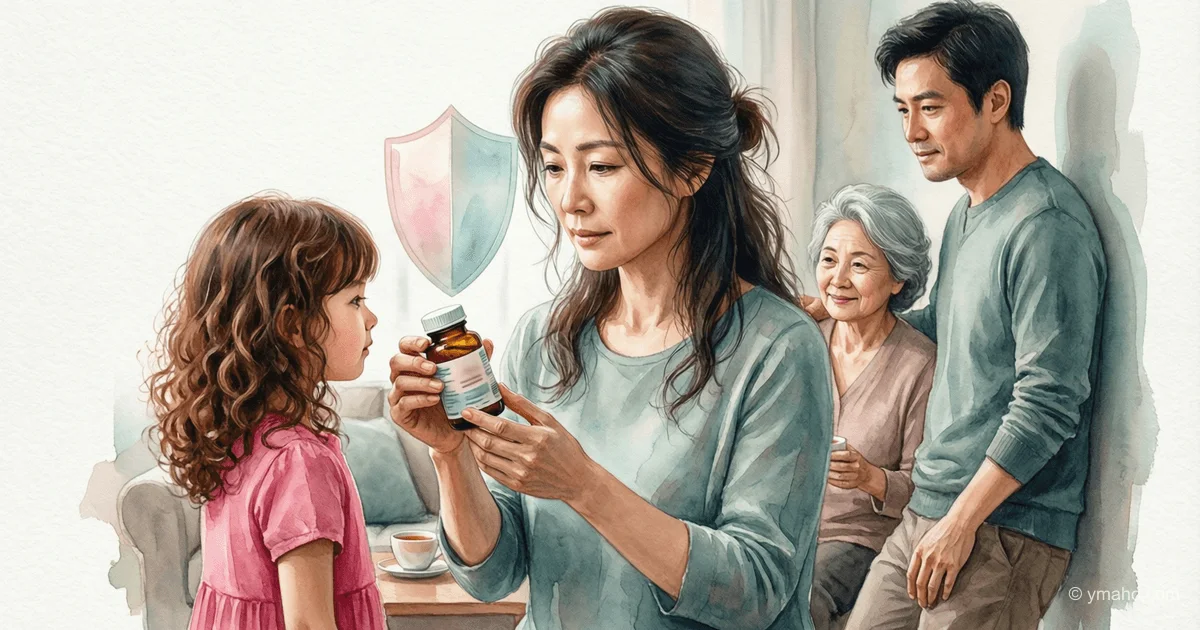
Breakthrough in COVID-19 Prevention: Ensitrelvir Prevents Infection After Virus Exposure
According to Phase III clinical trial results published in NEJM, the Japanese drug ensitrelvir reduced the risk of developing COVID-19 after exposure to an infected household member by 66% compared to placebo. The FDA is expected to approve the drug in June 2026.
Ensitrelvir: The Quiet Revolution No One Noticed
[The Gist]: What's Really Happening
We've gotten used to COVID-19 becoming routine. Came from the office with a runny nose? Test, a couple of days at home, a pack of Paxlovid if you're lucky. But on May 14, 2026, a publication in the New England Journal of Medicine quietly, without fanfare, changes the game.
It's about ensitrelvir—a drug from the Japanese company Shionogi. And no, this isn't just another antiviral. It's the world's first oral medication for post-exposure prophylaxis of COVID-19 proven effective in Phase III.
What does this mean in practice? If someone in your household gets sick, you take ensitrelvir within 72 hours of their symptom onset—and your risk of getting sick drops by 67%. And if you have at least one risk factor for severe disease (age, diabetes, obesity, hypertension), the risk drops by 76%.
Numbers from the SCORPIO-PEP study (n=2,041 in the primary population): in the ensitrelvir group, symptomatic COVID developed in 2.9% of participants. In the placebo group—9.0%.
Why is this important not just "a little more," but fundamentally? Because existing strategies work after the fact: you get sick—you get treated. Preventive measures were limited to vaccination (which doesn't provide 100% sterile immunity) and social distancing. Ensitrelvir fills the gap: it blocks viral replication in the "window of vulnerability"—between exposure and symptom onset.
Shionogi already received approval for this indication in Japan in March 2026. Now all eyes are on the FDA: the PDUFA date is June 16, 2026.
Timeline and Context
To understand why this event is far from routine, let's unfold the timeline.
November 2022: Japan grants emergency approval for ensitrelvir (brand XOCOVA) for treatment of COVID-19.
March 2024: Japan upgrades it to full approval for treatment.
June 2023 – September 2024: The global SCORPIO-PEP study is conducted. It involves 2,387 participants from the US and other countries. A key detail most overlook: over 98% of participants had antibodies to SARS-CoV-2 (from prior infection or vaccination, or both).
This is a critical nuance. Ensitrelvir was tested not on "naive" populations, but on people with pre-existing immunity. And it still showed a 67% reduction in disease incidence.
March 2025: Results first presented at the CROI conference in San Francisco.
March 2026: Japan approves post-exposure prophylaxis—ensitrelvir becomes the world's first oral drug with this indication.
May 14, 2026: Publication in NEJM. The date is no coincidence—one month before the FDA decision.
Why is this important now, in May 2026? Because in the US and other countries, a heavily mutated Omicron subvariant BA.3.2, dubbed "Cicada," is circulating. It has been detected in at least 25 states. The effectiveness of monoclonal antibodies against new variants is always questionable. Vaccines take time to build immunity. But ensitrelvir is a small molecule whose target (3CL protease) is conserved. It should work against any variant.
Who Wins and Who Loses
Winners:
- Shionogi & Co., Ltd. The 148-year-old Japanese company, long associated globally with antibiotics and antivirals for influenza, has just created a new blockbuster. Analysts are already sizing up the post-exposure prophylaxis market. At a price comparable to Paxlovid (about $1,660 per course in the US) and considering seasonal COVID-19 waves, potential sales could reach billions of dollars annually. But there's a catch: in Japan, the price is set at about 7,090 yen per 125 mg tablet—around $45. A 7-tablet course costs about $315. The global price will differ.
- High-risk patients (cancer patients, transplant recipients, elderly with comorbidities). For them, a 76% reduction in the risk of symptomatic COVID-19 is not just convenience—it's prevention of hospitalization, death, and long COVID.
- Healthcare systems (in the long term). A prevented COVID-19 case means saved beds, ventilators, outpatient visits, and sick leave payments.
Losers:
- Pfizer (Paxlovid). Yes, Paxlovid is treatment, and ensitrelvir is prophylaxis. But the narrative is shifting. Doctors and patients start thinking, "Could I have avoided getting sick altogether?" Moreover, ensitrelvir has a fundamentally better tolerability profile: in the SCORPIO-PEP study, no cases of dysgeusia (taste distortion)—that "metallic bitterness in the mouth" that makes many abandon Paxlovid—were reported.
- Companies developing monoclonal antibodies for prophylaxis. An oral pill will always beat an intravenous or subcutaneous injection in terms of convenience and scalability.
- Rapid test manufacturers. Paradoxically. Ensitrelvir is effective if started within 72 hours. This creates demand for ultra-rapid diagnostics. But if you prevent the disease, the need for tests to confirm COVID-19 in contacts decreases.
What the Media Isn't Saying
Now let's get to the most interesting part—what's on the surface but missing from headlines.
Non-obvious Insight #1: "Failure" in Treatment and "Triumph" in Prophylaxis
Ensitrelvir has a dark side that Shionogi doesn't shout about in press releases, but it's clearly described in the literature. The SCORPIO-HR study, which investigated ensitrelvir for treatment of already ill patients (regardless of risk factors), did not meet its primary endpoint—a statistically significant reduction in time to sustained resolution of 15 symptoms.
Treatment doesn't work. Prophylaxis works brilliantly.
This is counterintuitive. Usually, if a drug suppresses viral replication, it should help even in early disease. Why is it different here? Probably because the SCORPIO-HR treatment study included a broader, less "selected" population (including people with low viral load or late treatment initiation). But there's a deeper reason.
Non-obvious Insight #2: The "Prophylaxis Window" Paradox
Ensitrelvir works as prophylaxis because its job is simply to prevent the virus from multiplying to a detectable level. The recipient's immune system (98% already familiar with the virus or vaccine) does the rest. In treatment, when symptoms are already present, the inflammatory cascade is triggered, and suppressing viral replication may no longer halt clinical manifestations. This means that ensitrelvir's effectiveness critically depends on timing and background immunity. The higher the population immunity (and in 2026, it's high for most), the better this drug works for prophylaxis.
Non-obvious Insight #3: The CYP3A4 Problem No One Talks About
Ensitrelvir is a moderate inhibitor of CYP3A4. This enzyme metabolizes a huge number of drugs: statins, some immunosuppressants (tacrolimus, cyclosporine), benzodiazepines, many antiarrhythmics, etc. In the high-risk group for COVID-19, where ensitrelvir use is most justified, these drugs are routine. An elderly person with hypertension taking atorvastatin and amlodipine? Dose adjustment needed. A transplant patient on tacrolimus? Potentially dangerous interaction, up to nephrotoxicity.
In the SCORPIO-PEP study, this wasn't a problem because such patients were either excluded or carefully monitored. In real-world practice, this will become a headache for primary care physicians and pharmacists. Shionogi will have to invest huge resources in educational programs and possibly in creating digital drug interaction checkers.
Forecast: Next 30 Days and 90 Days
30 days (by June 23, 2026):
The main event is the FDA decision on June 16. Approval is highly likely. Why? The drug already has approval in Japan for the same indication. The NEJM results are the gold standard of evidence. And most importantly, there are no alternatives. There is no approved oral drug for post-exposure prophylaxis of COVID-19 in the US market. The FDA won't create a vacuum, especially amid the wave caused by the "Cicada" variant.
Once the FDA approves (which is almost certain), a wave of contract negotiations with pharmacy chains and insurance companies will follow. CVS, Walgreens, Walmart will start working on logistics. The main question: will a prescription be required? Most likely yes, given the drug interaction profile. This will limit the "viral" (in terms of spread) potential of the drug.
Expect guidelines from IDSA (Infectious Diseases Society of America) on the use of ensitrelvir for PEP. This will set standards for physicians for the next 2-3 years.
90 days (by August 2026):
If FDA approval happens in June, the drug will appear in pharmacies by August. The first three months will be a stress test for three groups:
- Insurance companies: How will they cover prophylaxis? Fully, with copay, or only for high-risk groups? The PEP market is huge because household exposure is common. The cost per course (likely in the range of $300–$1,500) will be the subject of intense negotiations. Medicare and Medicaid will likely get special terms.
- Primary care physicians: They will have to learn a new routine—prescribing prophylaxis to a healthy person who isn't sick yet. This is a psychological barrier. Many will continue to say, "Come back when you get sick—I'll prescribe Paxlovid." Only advanced clinics will implement "telephone prophylaxis" protocols: the patient calls, says "my husband got COVID," the doctor checks interactions in 10 minutes and prescribes ensitrelvir.
- Diagnostic companies: The 72-hour window means that classic PCR with its 12-24 hour turnaround is too slow. Highly sensitive rapid tests with results in 15-30 minutes, preferably with digital verification, are needed. Expect a wave of investment in such platforms.
And the most important forecast: by the end of 2026, the concept of "COVID-19 is a disease that can be prevented in the household" will become the new normal in developed countries. Ensitrelvir may achieve what vaccines couldn't in 2021-2022—give people a sense of control over the situation. When you have a pill in your medicine cabinet that you need to take within three days after your spouse sneezes, the psychological burden of the pandemic drops significantly.
That's why the publication in NEJM is not just a scientific article. It marks the post-vaccination, post-infection phase of COVID-19, where humanity finally has a personal, convenient, predictable "shield."
— Editorial Team









