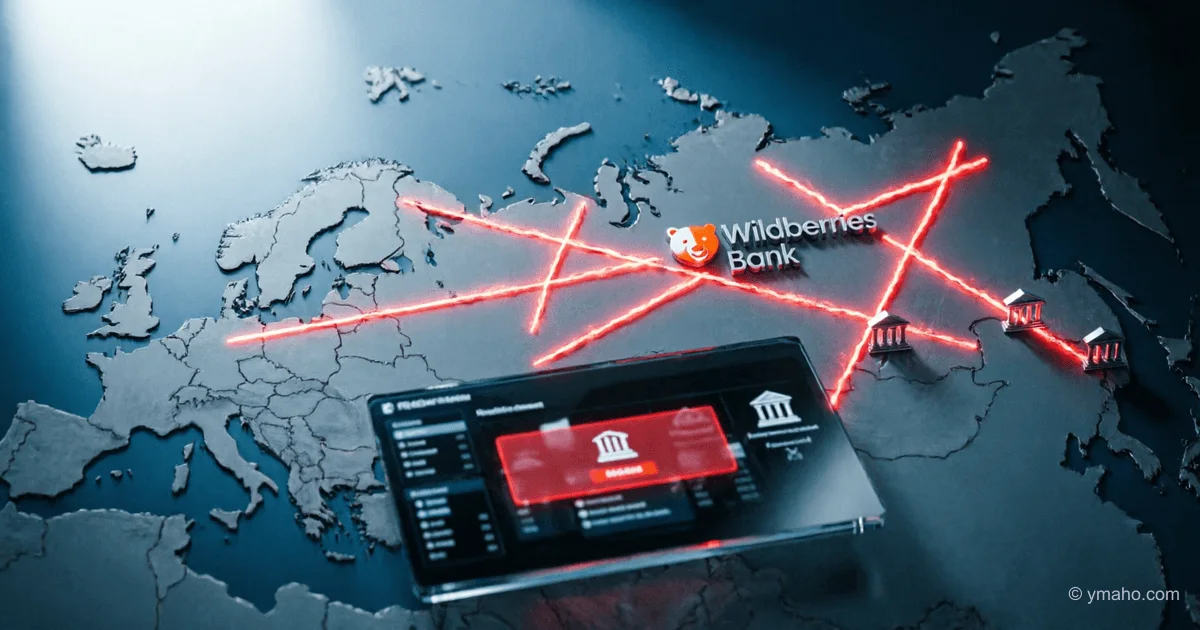
EU Imposes Sanctions Against Wildberries Bank and 19 Other Russian Banks
The European Union has included 20 Russian banks in its 20th sanctions package, among them Pochta Bank, Russian Standard, and WB Bank. The restrictions will take effect on May 14, 2026, but Wildberries Bank stated it will continue operations as usual.
20th EU Package: Regional-Scale Banking Blockade
Introduction
On April 24, 2026, the European Union published its 20th package of anti-Russian sanctions, the key blow of which was the inclusion of 20 Russian banks in the list of organizations with which any transactions are prohibited. Contrary to expectations, the targets were not federal-level giants, but mainly regional and niche credit institutions — Pochta Bank, Russian Standard, BKS Bank, and even Wildberries Bank (WB Bank), owned by the largest marketplace.
This step marks a significant shift in Brussels' strategy: from attempts to "collapse systemic banks" to methodically "cutting off the capillaries" of the Russian financial system. While previously Sber, VTB, Alfa-Bank, and Gazprombank were sanctioned, the EU is now finishing off the regional network and alternative settlement channels, including crypto exchanges and banks in Central Asian countries.
The restrictions will come into force on May 14, 2026. However, as Wildberries Bank itself stated, their operations will continue as usual — the bank is focused exclusively on the domestic Russian market.
Event Details and Timeline
Although rumors about the preparation of the 20th package had been circulating since February 2026, when the European Commission first announced its intention to expand the banking list, final approval came only at the end of April. The day before publication, on April 22, EU ambassadors lifted the vetoes of Hungary and Slovakia, which had long bargained for exemptions for their companies.
On April 23, 2026, the EU Council officially published the list in the Official Journal of the European Union. The full list of 20 organizations includes:
- Wildberries Bank (WB Bank)
- Pochta Bank
- Russian Standard Bank
- BKS Bank
- Ural Bank for Reconstruction and Development (UBRD)
- Metallinvestbank
- Fora-Bank
- Avangard Bank
- Chelyabinvestbank
- Derzhava Bank
- Levoberezhny Bank
- Solidarnost Bank
- Khlynov Bank
- Iturup Bank
- Avers Bank
- Petersburg Social Commercial Bank (PSCB)
- SDM-Bank
- Evrofinans Mosnarbank
- Blank Bank
- Yenisei United Bank
It is important to note that even the status of a "subsidiary" of state structures did not provide protection. For example, Pochta Bank is ceasing its operations in May 2026 precisely through merger with VTB, but the EU still included it in the list. Also, three foreign banks were hit with blocking sanctions: Keremet Bank (Kyrgyzstan), Capital Bank of Central Asia (Kyrgyzstan), and Joint Development Bank (Laos) for aiding in circumventing previous restrictions.
Additionally, for the first time, a sectoral ban on cryptocurrency operations was introduced. The EU prohibited EU providers and platforms from interacting with Russian crypto exchanges and wallets, as well as with the "ruble stablecoin" A7A5 operating through Kyrgyz infrastructure.
The package was not limited to finance: it also complicated Russia's maintenance of a "shadow fleet" of tankers and banned the supply of certain CNC machines to third countries that could redirect them to the Russian Federation.
Impact and Significance (for the World / Industry / Society)
For the World: A Blow to "Gray" Schemes
The EU has moved to implement the concept of "secondary sanctions" against the financial system. Although only transactions of European legal entities with these banks are formally prohibited, in practice European banks will now fear conducting any payments even indirectly linked to sanctioned organizations. This sharply increases the cost of the financial bridge between Russia and the rest of the world. Banks in the UAE, Turkey, and China are tightening compliance, fearing loss of access to the euro and dollar.
For the Industry (Banking and Retail)
The most notable effect is expected for Wildberries Bank. This is the bank of the largest marketplace, through which billions in payments to sellers and warehouse employee salaries flow. Although the bank itself did not conduct international settlements, its correspondent banks and processing centers, possibly using European software, have been sanctioned. This threatens disruptions in cross-border payments for imported goods (Turkish, electronics) that pass through WB-controlled structures.
Pochta Bank is geographically the most widespread, with branches in every post office. Its reputational risks due to sanctions could reduce trust among pensioners and civil servants receiving payments through this channel.
Russian Standard and BKS are major non-state players. Russian Standard holds a significant portfolio of credit cards and POS lending. BKS has a complex structure of assets and clients trading on the Moscow Exchange. Although the Moscow Exchange operates domestically, access to Western liquidity for these structures is now cut off.
For Society
For ordinary Russians inside the country, there will be no visible changes. Cards, SBP transfers, ruble cash withdrawals — everything will remain available. Problems will arise for those trying to pay for foreign services (Netflix, Steam, AWS), send money to relatives abroad, or use cards from these banks while traveling (in friendly countries, but through European processing centers — e.g., Visa/Mastercard). Such transactions will now be declined.
A serious blow has been dealt to crypto enthusiasts. The EU ban on operations with Russian crypto exchanges means that P2P platforms, often hosted on servers in the EU or using European domains, will start blocking users from Russia. This pushes the market even deeper into the "gray" zone — toward decentralized exchanges and direct exchangers, but with the risk of fraud.
Reactions of Key Players
Wildberries Bank issued an official statement via TASS: it emphasized that it is focused exclusively on the domestic market and assured clients and marketplace partners that "there will be no changes in service." Legal entities and individuals can "freely carry out all operations." This is a standard scenario of "sanctions resilience," where the bank continues operations but is effectively cut off from European currency.
The Russian Ministry of Finance on the same day (April 24) announced the resumption of budget rule operations starting in May. Market participants interpreted this as preparation for a ruble weakening in response to the sanctions.
The EU Council explained the measures as necessary to "cut off circumvention channels." Special emphasis was placed on the fact that from now on, not only Russian banks but also any crypto platforms allowing conversion of rubles into digital currency are targeted.
Major brokers in Russia began sending warnings to clients about the impossibility of withdrawing currency to accounts of sanctioned banks and recommended switching to "friendly" Gazprombank or Sber (although they are also under US blocking sanctions, their mechanisms for working with the yuan are more established).
Forecast and Conclusions
The 20th package is not an attempt to strangle the economy "here and now," but a "burning floor" strategy. With major systemic banks already under sanctions, a layer of medium and small banks remained through which Western currency was leaking (including through cryptocurrency purchases). Now this layer has been cut off.
What Will Happen to the Ruble?
After the package announcement, the yuan exchange rate (CNYRUB) on the Moscow Exchange rose above 11 rubles. Analysts at Bank Saint Petersburg predict that with an active reduction of the key rate by the Central Bank of Russia (expected on Friday, April 24), the yuan could move toward 11.20. This implies a soft but steady devaluation of the ruble, as exporters find it harder to repatriate currency and importers struggle to pay for goods.
Bottom Line for Investors
Savings in rubles in accounts at the listed banks are preserved, but there is a currency risk of being unable to withdraw dollars/euros. It is recommended to transfer large sums to banks already under sanctions (Sber, VTB) that have established alternative channels, or to reliable brokerage accounts for conversion into yuan or gold.
Russia will continue to shift toward Asian jurisdictions and develop parallel payment systems. However, the price of this "sovereignty" is rising fees for cross-border payments (up to 5-7%) and accelerating technological fragmentation of the world. Europe, in turn, pays for this with higher energy prices and loss of market.
— Editorial Team









