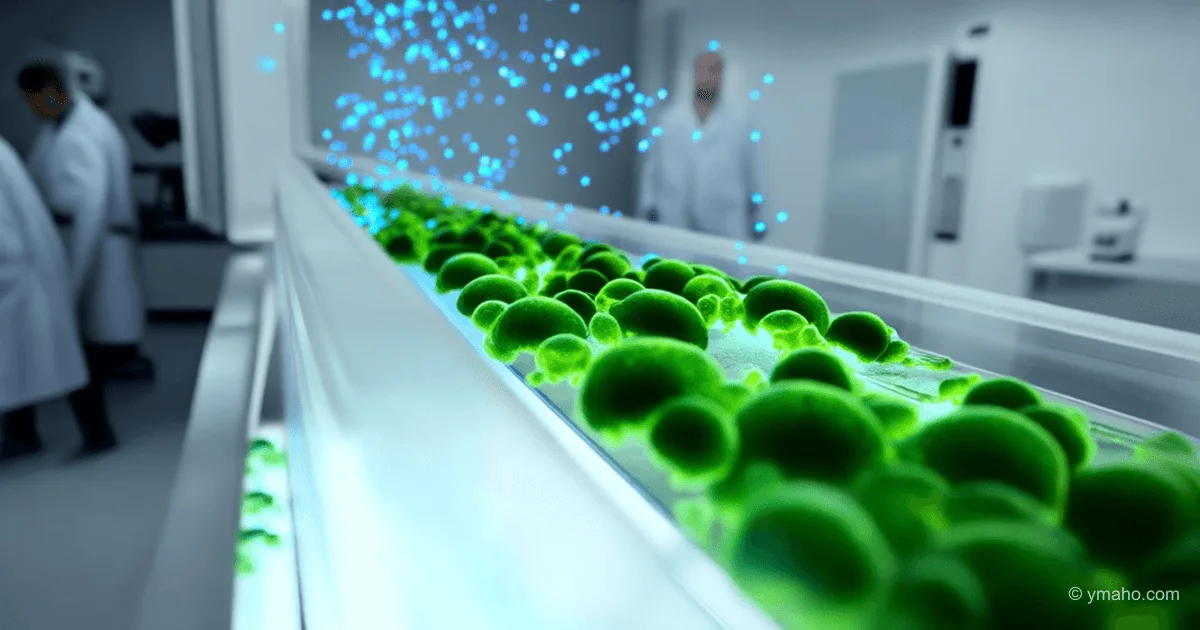
Extremophiles in Cosmetics: Extremophilic Microalgae as a Source of Eternal Youth
Lucas Meyer by Clariant has launched AlgaSurge, a skin longevity active obtained through blue biotechnology from extremophilic algae. The ingredient aligns with the trend of caring for skin cell 'survival' and firmness.
We are used to 'revolutions' in skincare coming from Silicon Valley labs or L'Oréal's closed R&D centers. But AlgaSurge from Lucas Meyer by Clariant breaks this paradigm — the innovation is literally 'fished out' of nature's boiling cauldron. However, viewing this merely as the launch of a new ingredient means missing the tectonic shift occurring in the raw materials market.
[The Core]: What's Really Happening
The launch of AlgaSurge is not about algae. It's about a radical change in the strategy for protecting intellectual property and the supply chain economy in cosmetic chemistry.
Let's face it: the classic anti-aging market rests on two pillars — hyaluronic acid (HA) and polynucleotides (PDRN). Both components have become hostages of their own popularity. The HA market is oversaturated, margins are squeezed to a minimum, and consumers can no longer distinguish 'low-molecular-weight' innovation from the ordinary. PDRN (derived from salmon milk) faces limited raw material supply, rising raw material prices, and regulatory risks, as working with animal material requires impeccable cold chain control and documentation.
Clariant is pulling a clever move. They are not offering 'yet another HA.' They are engineering a sulfated polysaccharide (SP) that mimics both benchmark ingredients simultaneously but lacks their systemic vulnerabilities. It cannot be broken down by hyaluronidase (the enzyme that degrades HA in the skin). It does not need to be extracted from an endangered fish species. It is vegan, stable, and, critically, produced in photobioreactors — meaning the raw material base is unaffected by climate, season, or geopolitics.
This is a tectonic shift from harvesting (or fishing) to programmable fermentation. From a business model perspective, Lucas Meyer is not selling an HA analog but a 'derisking' tool for formulators, allowing them to replace two complex ingredients with one, with guaranteed supply stability.
Timeline and Context
- Early 2020s. HA reaches peak commoditization. Everyone, from luxury to mass market, sells multimolecular complexes. Differentiation disappears.
- April 2026. AlgaSurge presentation at in-cosmetics Global. Clariant first showcases a sulfated polysaccharide from extremophilic microalgae. Key message: resistance to skin enzymes (unlike HA), dual action (film + deep delivery), and restimulation of autophagy in aged fibroblasts.
- May 2026. The industry registers a 'post-show' effect. Specialized press confirms: 'the active ingredient aims to redefine skin longevity.'
Who Wins and Who Loses
Winners:
- Clariant / Lucas Meyer. They are the first to create a 'chameleon' that can be sold in a two-for-one deal. Formulators, weary of complex combinations, will buy simplicity.
- Biotech startups focused on extremophiles. For example, Uruguay's Antarka, which raised $3.5 million for Antarctic bacteria. AlgaSurge has paved the way: major brands are now more actively looking at extremophiles as a source of unique metabolites.
- Pharma and food giants entering blue biotechnology. The market, according to various estimates, is growing at a CAGR of 7.15% to 12.4%, heading toward tens of billions of dollars. AlgaSurge is an ideal case for 'petrochemical' companies shifting their portfolios.
Losers:
- Traditional HA manufacturers. Especially those betting on conventional linear forms. Their product gets labeled as 'unstable.'
- Suppliers of animal-derived PDRN. Salmon DNA now has a plant-based competitor that does not depend on fish farms.
- Small independent formulators who missed the procurement window. While AlgaSurge is a proprietary Clariant ingredient, only their strategic partners will have access to the best results on the 'longevity shelf.'
What the Media Isn't Saying
Insight: Control over extremophiles is control over the future 'oil' of biotechnology.
Everyone discusses the vegan alternative itself but misses the geopolitics. Extremophiles inhabit unique niches: geysers, permafrost, the Mariana Trench, and, of course, Antarctica. AlgaSurge is just the tip of the iceberg. Clariant does not disclose the specific algal species or its origin, and this is not just a trade secret.
This is an intellectual land grab. Look broader: at a time when melting permafrost is opening access to new bacterial colonies and disputes over Antarctic resources are intensifying, building a pool of 'blue assets' is turning into a goldmine. Clariant is creating a market where they own not only the molecule but also the IP on the genes responsible for synthesizing these unique sulfated polysaccharides. Acquiring startups like Antarka for $3.5 million today is just a reconnaissance mission. Tomorrow, these figures will rise to hundreds of millions of dollars for control over unique strains.
Forecast: Next 30 Days and 90 Days
- 30 days (by June 11, 2026). Major brands (luxury segment) will start closed tenders for developing 'extremophilic lines' with AlgaSurge or its competitors. Expect leaks about contracts with top-10 beauty conglomerates. The contract price for an exclusive formula with AlgaSurge could reach $2-5 million at the development stage.
- 90 days (by August 10, 2026). We will see a wave of startups mimicking 'Extreme Biotech.' Clariant will likely announce a multichannel campaign: B2B training for formulators on 'How to Replace HA and PDRN Without Losing Efficacy.' I also expect a 'Pandora's box' to open in regulation: once extremophiles become a mass cosmetic ingredient, the question of verifying their absolute safety for 'use on the face, not in a reactor' will become front-page news in dermatology journals. And that is when the real battle for consumer trust will begin.
— Editorial Team









