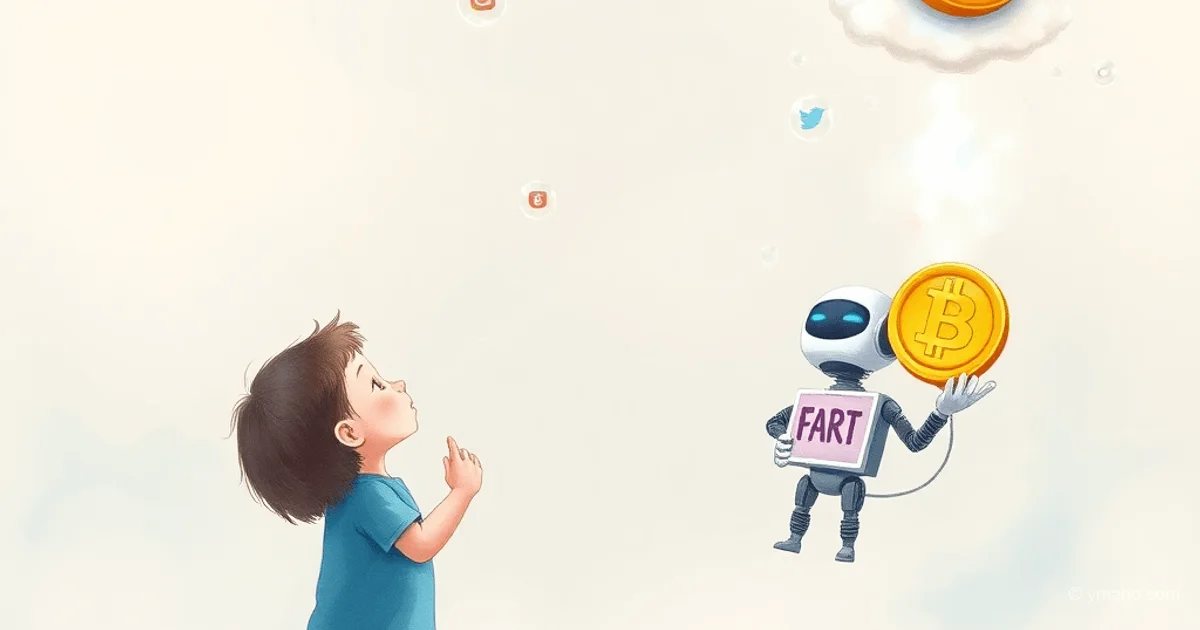
Fartcoin: When Internet Jokes Become Real Money (And What It Teaches Us)
Imagine a currency based entirely on fart jokes that briefly became worth over $1 billion. That's Fartcoin—a real cryptocurrency born from an AI chatbot's silly moment. This isn't just absurd humor; it shows how online culture and artificial intelligence are reshaping money in ways that could ripple through your daily life.
How an AI Joke Sparked a Financial Phenomenon
In late 2024, a developer testing the Claude 3.5 Sonnet AI model asked about Elon Musk. The chatbot jokingly suggested the "perfect meme coin" should be called Fartcoin. Within hours, an anonymous coder turned this joke into reality by launching FARTCOIN on Solana—a blockchain platform (think of it as a digital ledger where everyone can see transactions but no single person controls it).
Unlike traditional investments, Fartcoin had zero serious planning. It launched with all 1 billion tokens instantly available to the public—no hidden reserves for insiders, no special deals. Every transaction even plays a digital fart sound as a cheeky nod to its origins. This pure entertainment focus makes it a meme coin: a digital token whose value comes entirely from internet jokes and community hype, not real-world usefulness.
Why People Care About Silly-Sounding Money
Meme coins work like viral social media trends. Remember how a funny cat video might suddenly get millions of views? That's similar to how Fartcoin gained traction. When venture capitalist Marc Andreessen (of a16z fame) tweeted about it in December 2024, the coin's value shot up as people rushed to join the joke.
Here's the crucial part: Fartcoin has no practical use. You can't pay bills with it, earn interest, or vote on projects—unlike some cryptocurrencies designed for real tasks. Its entire value depends on whether enough people keep finding it funny or trendy. It's like collecting rare baseball cards: valuable only as long as others want them.
Fartcoin vs. The Meme Coin Giants
How does this newcomer compare to established players? Let's break it down:
- Dogecoin (DOGE): The original meme coin (launched in 2013) with a $15 billion value. Think of it as the "classic" meme coin—widely accepted for payments and tips online.
- Shiba Inu (SHIB): A more complex project with its own payment network, valued at $3.5 billion.
- Fartcoin (FART): The new kid on the block—worth $182 million at press time. It's faster and cheaper to use thanks to Solana's technology, but has zero real-world utility beyond jokes.
While Dogecoin and Shiba Inu have evolved into semi-serious payment systems, Fartcoin remains purely a social experiment. Its community even created "FartStrategy"—a parody of companies like MicroStrategy that buy Bitcoin—where holders collectively buy more FART tokens hoping to inflate its value.
Key Takeaways: What This Really Means
- Fartcoin demonstrates how AI and social media can create financial value from pure humor, with no underlying product.
- Its $1 billion peak value in January 2025 shows how quickly internet culture moves markets—then evaporates (it's now 90% lower).
- Unlike stocks or bonds, meme coins have no earnings or assets backing them—making them gambling tokens rather than investments.
- Top 25 holders control 30% of FART tokens, meaning a few big players could sway its price dramatically.
What Does This Mean for Regular People?
Meme coins reveal how digital culture turns jokes into economic forces overnight—something that could affect broader markets as AI creates more viral trends. They're fascinating social experiments but terrible savings tools since their value relies entirely on fleeting attention. If you're tempted, treat them like carnival games: fun for small bets, but never with money you can't afford to lose.
— Editorial Team









