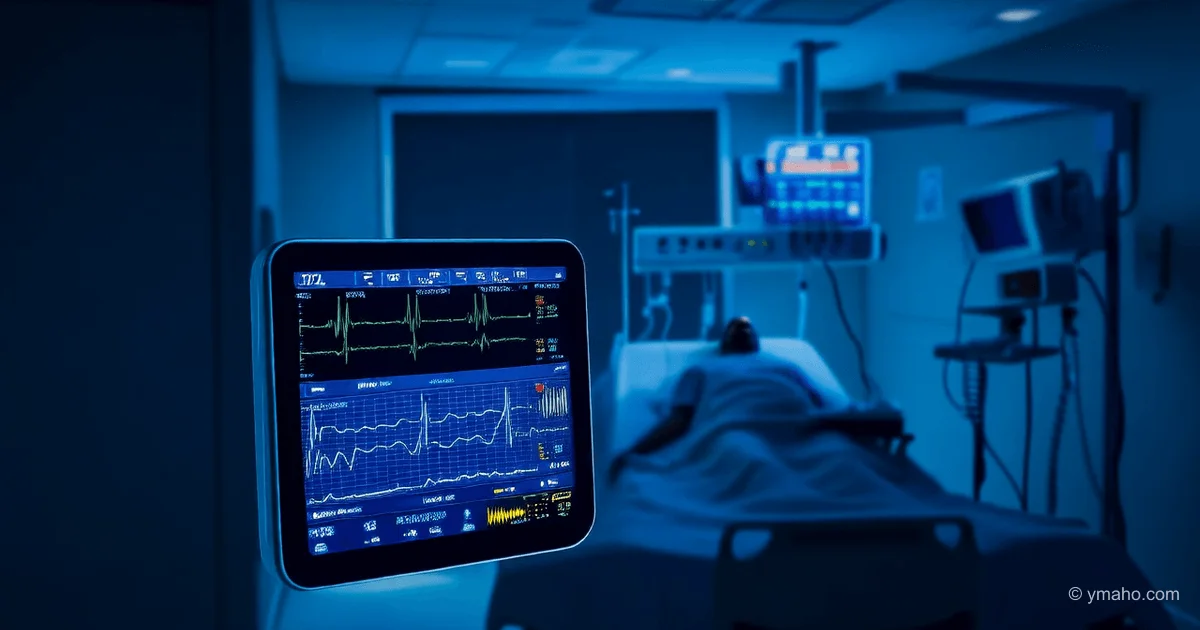
FDA Approves First AI-Powered Continuous Sepsis Monitoring System
Bayesian Health's platform from Johns Hopkins University becomes the first AI tool for early sepsis detection to receive FDA clearance. The system detects sepsis hours before clinicians and has already reduced mortality by nearly 20% in dozens of US hospitals.
An algorithm that sees death before the doctor: why Bayesian Health's approval is a turning point for all of medicine
The Core: What's Really Happening
On April 30, 2026, the FDA granted 510(k) clearance to Bayesian Health's Sepsis Flagging Device—the first AI/ML tool in history for preclinical sepsis detection. On the surface, a routine regulatory announcement. But those who understand the FDA know: a precedent has been set not for one startup, but for an entire product class. The regulator has acknowledged for the first time that an algorithm has the right to precede a clinician's suspicion, not just confirm it.
Behind this lies a decade of work by Suchi Saria—a Johns Hopkins professor who lost her nephew to sepsis in 2017 and turned personal tragedy into an engineering challenge. She didn't just build a model; she achieved what almost no one in clinical AI has: real data on mortality reduction in a multicenter study. 764,000 patients, five hospitals, an 18% reduction in mortality when clinicians respond to the flag.
But the most important number is buried deeper in the FDA documents. Episode-level sensitivity is 79.4%, but flag-level Positive Predictive Value is only 11.7% at a sepsis prevalence of about 3%. This means the system generates roughly 9 false alarms for every true case. And the FDA approved it anyway. Why—I'll explain below.
Timeline and Context
2015–2017 — Saria's lab at Johns Hopkins begins developing TREWS (Targeted Real-Time Early Warning System). Unlike competitors, they bet on reinforcement learning on streaming EHR data rather than static SIRS/qSOFA thresholds.
2017 — Saria's nephew dies of sepsis. By her own account, this is when the academic project becomes a mission.
2022 — Publication of results on 764,000 patients: relative mortality reduction of 18.7%, average diagnosis lead time of 5.7 hours.
2023 — FDA grants Breakthrough Device Designation. Pilots at Cleveland Clinic, MemorialCare, University of Rochester School of Medicine confirm reductions in mortality, morbidity, and length of stay.
April 30, 2026 — Formal FDA decision: K250680, Class II, device type SAK. The regulator accepts 11.7% PPV as sufficient for clinical use.
May 2026 — Public press releases. Medicare opens the path to NTAP reimbursement.
Who Wins and Who Loses
Winners.
Suchi Saria and Bayesian Health. The company gains a monopoly on an entire device category—"pre-suspicion sepsis screening"—for at least 18–24 months. Market estimate: about 6,100 hospitals in the US, annual sepsis losses exceed $62 billion. Even 10% penetration at a subscription price of $200–500k per year per hospital means a market of $120–300 million per year.
Patients with atypical sepsis—young, without comorbidities, whom clinicians objectively do not suspect. The system catches exactly them.
Hospital CFOs: NTAP reimbursement from CMS turns AI purchase from a cost center into a revenue generator. For a 500-bed hospital, savings from reduced ICU bed-days can exceed $2 million per year.
Epic and Cerner: Each such AI tool requires deep EHR integration, strengthening their platform positions.
Losers.
Daseena, Sentient, EarlySense, and dozens of startups working on AI sepsis without FDA clearance. They will either pivot to other conditions or be acquired.
Epic Sepsis Model (ESM)—Epic's built-in algorithm that many hospitals use for free. New data creates legal risk: if a hospital continues using an unapproved FDA tool when an approved alternative exists, that's potential malpractice.
Old-school clinicians who distrust AI. A system with 11.7% PPV requires clinical judgment: 9 out of 10 flags are false. This will inevitably create tension between administrative mandates to respond to flags and clinical experience.
What the Media Isn't Saying
Insight #1: This isn't about sepsis. It's about shifting the diagnostic window.
All headlines scream sepsis, but Saria's fundamental achievement is proving that AI can reliably work in a zone where the clinician has no hypothesis yet. This removes the regulator's main objection: "the algorithm should assist the doctor, not replace them." Bayesian Health showed: you can replace not the doctor, but the absence of suspicion in the doctor.
This precedent opens the door for pre-suspicion screening of myocardial infarction, thromboembolism, delirium, acute kidney injury. Each of these conditions has the same problem: the clinician must suspect to order a test, but suspicion often comes too late.
Insight #2: Lousy PPV is a feature, not a bug.
A casual reader sees 11.7% PPV and says: "Garbage, 9 false alarms." An intensivist sees the same number and says: "Only 9 false alarms for each saved sepsis case? I'll take it."
Context: each hour of antibiotic delay reduces survival by 8%. Nursing screening yields PPV around 3-5% with much higher labor costs. Procalcitonin has specificity around 70%. Against this backdrop, 11.7% PPV from an automatic, zero-labor screening is clinically valuable. The FDA understood this.
Insight #3: Saria used personal story as a regulatory strategy tool.
Mention of her nephew appears in every press release. This is no accident. The FDA is a bureaucratic machine, but first-in-class device decisions always go through advisory committees where real people sit. The story of "a professor who lost a relative" resonates in the hearing room more than any p-value.
Forecast: Next 30 Days and 90 Days
Days 1–30 (mid-May to mid-June 2026):
Hospitals that participated in pilots (Cleveland Clinic, MemorialCare, University of Rochester) will announce full-scale deployment. Contracts are ready—they were waiting for FDA clearance.
Competitors will start filing 510(k) submissions based on "substantial equivalence" to Bayesian Health. First filings will come from those who already have clinical trial data.
CMS will publish refined NTAP reimbursement criteria specifically for AI devices—current wording is vague. The reimbursement amount will likely be 50–65% of technology cost per episode.
Days 31–90 (June to August 2026):
The first hospital will be sued for NOT using AI sepsis screening. Legal logic: if an FDA-approved tool is available and a clinician didn't use it, that's a deviation from the standard of care. The plaintiff will be the family of a patient who died of sepsis in a hospital where the system was not installed.
Major insurers (UnitedHealth, Anthem) will start including AI screening use in quality criteria for hospital contracts.
Suchi Saria will receive an offer to take a position at the FDA or become an AI advisor at the White House—her experience navigating an AI device through regulatory process is unique.
The first data on AI fatigue among clinicians will emerge: fatigue from false alarms. Bayesian Health will likely announce an improved PPV version based on supervised learning from data collected in the first 90 days of commercial operation. They knew PPV would increase once the system received feedback from thousands of clinicians—and built that into the product roadmap.
Fundamentally, this story is not about yet another AI tool. It's about medical AI moving from the "can work in a lab" phase to the "must work in a hospital, and the regulator certifies it" phase. The boundary between assistive tool and standard of care has just shifted. Irreversibly.
— Editorial Team









