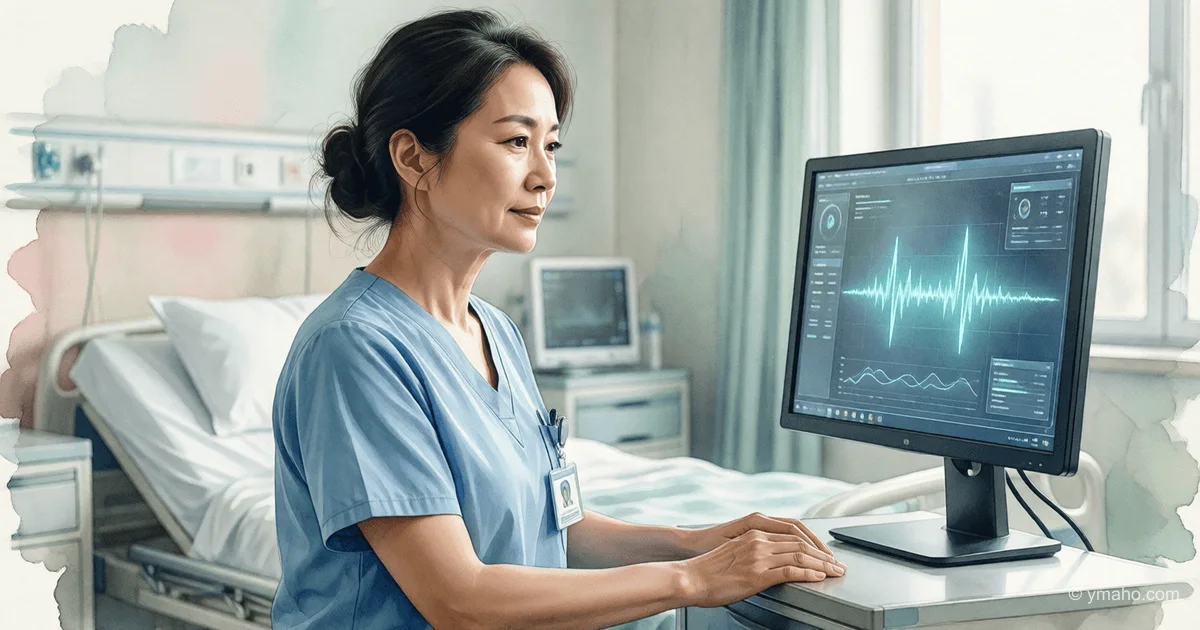
FDA Approves First Artificial Intelligence System for Early Sepsis Warning
The TargetReal-time Early Warning system, an AI-based tool developed at Johns Hopkins University, has received FDA clearance. The instrument detects sepsis hours before physicians, reducing mortality by nearly 20% in participating hospitals.
Green Light for Life: What the FDA's Approval of the First AI for Sepsis Warning Really Means
The Gist: What's Actually Happening
On May 12, 2026, the FDA cleared the TargetReal-time Early Warning (TREWS) system—the first AI-based tool in history capable of detecting sepsis before a clinician suspects an infection. Developed at Johns Hopkins University and commercialized by Bayesian Health, the system reduced sepsis mortality by nearly 20% in hospitals where it was tested.
But if you view this event not as news but as a precedent—and I do—you'll see a completely different story. This isn't about saving lives. It's about opening a multi-billion-dollar market for predictive hospital analytics.
Before May 12, 2026, no AI tool in FDA history had received clearance under the "pre-suspicion screening" category. All existing systems—whether checklists or rule-based alerts in electronic medical records—activate only after a clinician has already begun to suspect sepsis. TREWS works differently: it continuously analyzes the stream of hospital data and raises a flag 2 to 48 hours before a human suspects something is wrong. This is a paradigm shift, and pharmaceutical giants are already recalculating the addressable market.
The key figure behind all this is Suchi Saria, director of the AI & Healthcare Lab at Johns Hopkins University. She turned a personal tragedy into a technological product: Saria's nephew died of sepsis in 2017, after which she refocused the lab on creating an early warning system.
Timeline and Context
The story of TREWS is a classic journey from academic development through regulatory barriers to a commercial product. Let's reconstruct the timeline:
2017 — The death of Suchi Saria's nephew from sepsis. Saria decides to turn academic research into a clinical tool.
2022 — Publication in Nature Medicine of a prospective study on 764,000 patients across five U.S. hospitals. Result: when physicians responded to system alerts, patients were 18% less likely to die.
2023 — FDA grants TREWS Breakthrough Device Designation. The system is deployed at Cleveland Clinic, MemorialCare (California), and the University of Rochester School of Medicine. All three sites report significant reductions in mortality, morbidity, and length of stay.
2024-2025 — Bayesian Health, the commercial partner, refines the system for a 510(k) submission to the FDA. Meanwhile, Epic Systems—the dominant player in the electronic medical record market—tries to salvage the reputation of its own sepsis algorithm, which hospitals widely disabled from 2019 to 2021 due to a flood of false alarms.
May 2026 — FDA issues clearance. This is the first-ever approval of an AI tool for pre-suspicion sepsis screening.
Context is critical here: five years ago, the sepsis prediction market collapsed. Hundreds of hospitals deployed Epic's algorithm and then turned it off—the model looked good on paper but failed in the real world, generating so many false alerts that physicians simply stopped responding. TREWS directly addresses this wound.
Who Wins and Who Loses
Winners:
- Bayesian Health. The startup that commercialized TREWS now holds a unique asset—the first and only FDA-cleared AI for pre-suspicion sepsis screening. But the real jackpot is access to Medicare and Medicaid reimbursements through the New Technology Add-on Payment (NTAP) program. The NTAP decision is expected in early August 2026. If positive, hospitals will have a direct financial incentive to adopt TREWS, turning regulatory approval into cash flow.
- Hospital networks that adopted TREWS early. Cleveland Clinic, MemorialCare, and the University of Rochester now have a competitive advantage—they've already integrated the technology and can demonstrate outcome metrics to insurers and rating agencies.
- Insurers. Sepsis costs U.S. hospitals over $50 billion annually. Each prevented case of advanced sepsis saves tens of thousands of dollars in intensive care costs. Medicare and Medicaid have a strong interest in scaling TREWS, which is why NTAP is almost certain to be approved.
Losers:
- Epic Systems. The company controls 42% of the U.S. acute hospital EHR market. Its own sepsis algorithm, according to a 2026 meta-analysis, achieved an AUROC of only 0.65—far below claimed performance. While Epic tries to relaunch its model, Bayesian Health has received regulatory blessing. The fact that Epic "updated" its algorithm and now claims built-in calibration for specific populations only confirms that in-house development is losing to a specialized solution.
- Developers of rule-based screening systems. All checklists, SIRS criteria, and qSOFA protocols activate reactively. TREWS is proactive. Once Medicare starts reimbursing for approved AI systems, hospitals will begin mass-discontinuing old tools.
- Seed-stage medical startups working on similar products. Obtaining FDA clearance for pre-suspicion screening signals to the market: the regulator has opened the door, but the bar is high. Prospective studies on the scale of Nature Medicine (764,000 patients, 5 hospitals) will be required. This means the barrier to entry for the hospital predictive AI market just jumped an order of magnitude.
What the Media Isn't Saying
Non-obvious insight: TREWS is a Trojan horse for data collection to support a new category of insurance products.
Here's what all the "saving lives" headlines miss: TREWS is approved not as a drug or a lab test, but as a monitoring device. This means Bayesian Health gains legal, FDA-approved access to a continuous stream of clinical data from dozens, then hundreds of hospitals. The system "continuously monitors the full patient record to determine their baseline and track significant changes."
This is an ideal position for accumulating the world's largest dataset on early-stage sepsis—and not just sepsis. The next step: correlating predictive signals with outcomes for other acute conditions. Then, creating actuarial models for an entirely new type of health insurance: predictive. Imagine a policy that doesn't wait for an insured event but predicts and prevents it. TREWS is the foundation for exactly this kind of business.
A second point that goes unnoticed: Suchi Saria herself has emphasized in several talks that the system can "reason across the full breadth of messy, real-world hospital data"—meaning it processes the entire array of dirty, unstructured data. This implies that TREWS's architecture is not tied to sepsis. Change the input parameters, and the same platform could predict acute kidney injury, delirium, or thromboembolism. Bayesian Health deliberately calls TREWS "part of a real-time clinical intelligence platform." Sepsis is use case #1 that opened the door. Behind the door lies the entire hospital nosology.
Forecast: Next 30 Days and 90 Days
30 days (by June 22, 2026):
- Bayesian Health announces pilot agreements with 5-8 additional major hospital systems. The logic is simple: everyone was waiting for the FDA signal, and now that clearance is obtained, legal due diligence in large networks will accelerate.
- Epic Systems issues a press release about "significant improvements" to its own sepsis algorithm, hinting that their solution is "integrated and requires no additional cost." This will be a defensive reaction—they'll try to retain customers by promising that the built-in functionality is "almost as good."
- Investment newsletters will report that Bayesian Health has hired a bank to prepare for a Series C round or a direct IPO. The company's valuation will at least double from its last closed round.
90 days (by August 20, 2026):
- CMS (Centers for Medicare & Medicaid Services) announces its NTAP decision for TREWS. My forecast: approval. The reason is simple: the federal government funded TREWS's development, and denying reimbursement would be politically illogical. Once NTAP is confirmed, every U.S. hospital will have a financial incentive to adopt—this triggers exponential growth for Bayesian Health.
- Mednition, a competitor with the KATE AI system (95% sensitivity, 96% specificity in retrospect), will accelerate its FDA submission. But their weak point is the lack of prospective data on the scale of TREWS. Without that, clearance is unlikely, so I expect Mednition to announce a partnership with a major hospital network for a prospective trial.
- At least one major EHR vendor will announce an acquisition or strategic partnership with a company in the predictive analytics segment. Epic is unlikely to buy Bayesian Health but may absorb one of their less advanced competitors to keep pace.
Bottom line: On May 12, 2026, the FDA didn't just approve a "tool to save people from sepsis." It created a new regulatory category—pre-suspicion AI screening—and opened Medicare funding for it. This is a watershed moment. The AI diagnostics market is now divided into "before" and "after" TREWS. And if you're not watching Bayesian Health and their competitors right now, you're missing the biggest transformation in hospital medicine since the adoption of EHRs.
— Editorial Team









